Su Dong Chen Teaching in Taiwan.
Showing posts with label Kung Fu Bad Ass. Show all posts
Showing posts with label Kung Fu Bad Ass. Show all posts
Thursday, April 12, 2012


Thursday, November 3, 2011
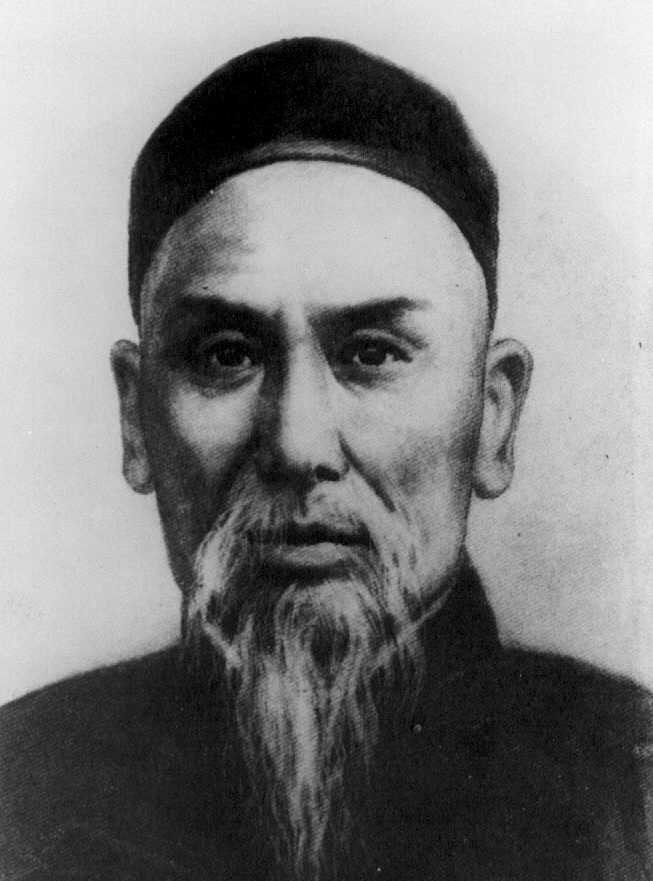
Kung Fu Bad Ass: Xingyi Master Guo Yun Shen (郭云深) (1829 - 1898)
Kuo Yun-Shen
 Kuo Yun-Shen's given name was Yu-Sheng. He was born in China's Hebei Province, in a town called Hsi Luo Ma Chuang. He was short in stature, standing only about shoulder-high to most men, but he was strong and healthy by nature. He is said to have been the best disciple to ever have studied under Master Li Luo-Neng. No matter when he fought, using Peng Chuan ("Crushing Fist"; one of the five elemental forms of Hsing-I) and its half-step he could fell any opponent. No-one could stand against his use of P eng Chuan, and he was known throughout the Empire as Ban Bu Peng Kuo; Kuo of the Half-Stepped Crushing-Fist.
Kuo was a violent man who loved to fight. Because of this, he committed not a few violent acts, as we will see below.
In the beginning, he wanted to study Hsing-I, and so went to pay his respects to the famous master Li Luo-Neng in hopes of becoming a student. However, Master Li despised his rough and violent nature, and refused to teach him. But with all his heart he wanted to study Hsing-I. So he disguised himself as a workman to be able to come and go in Master Li's house, and in his spare time practiced what he had seen Master Li teach.
At the time it so happened that Peng Chuan was very popular. So it was that Kuo studied this particular form with the utmost dedication. After diligently studying for three years, he had perfected Peng Chuan.
One day, Kuo again went to pay his respects to LiLuo-Neng, and showed him Peng Chuan as he had been practicing it. His style was in almost all aspects in accord with the principles of Hsing-I. When Master Li saw that his determination and dedication we re so great, he agreed to teach Kuo all of the secrets of Hsing-I.
Among the great masters of Hsing-I, there are more stories about Kuo Yun-Shen than any other. Kuo's strength was without equal. It didn't matter how his opponent attacked; at his first move with Peng Chuan, they would drop to the ground.
It didn't matter how powerful the enemy he faced - he could easily defeat them all. There was a saying among the people: "Under all of Heaven, nothing may prevail against Peng Chuan" Kuo was the embodiment of this saying. Kuo was righteous in actions a nd truthful in speech. His disciples and succeeding generations in general all thought of him with the utmost veneration. In his later years he wrote a book called An Explanation of Hsing-I Chuan. Thanks to this book we have some taste of what kind of man he was.
The following are just a few of the stories concerning him...
"The Tiger Fist"
According to Master Wang Shu-Jin, one day Kuo Yun-Shen was sparring with a master of another style. In the course of the fight he was too forceful in his use of Peng Chuan; his opponent began to spit blood, and died. Because of this, Kuo was sent to prison.
After three years he was finally released. One of the top students of the Master he had killed came and declared his intention to avenge his teacher's death, inviting Kuo to compete with him. People knew that for the three years he had been in prison, Kuo had been manacled hand and foot, unable to move with much freedom, and so unable to fully practice his art. All thought that his health was probably weakened, and his vehemence doubtless dimi nished from its former state. His opponent was undoubtedly taking advantage of all this to get his revenge.
As soon as they crossed arms, however, Kuo struck violently with both fists, and his opponent was actually thrown back some fifteen to twenty feet and collapsed. It was very obvious that everybody was mistaken in their belief. During the time that he w as in prison, even though Kuo Yun-Shen did not have complete freedom of movement, he thought incessantly about his fighting style; although his hands were chained, borrowing from Hu Hsing Hsing-I's Tiger Form) he was able to come up with a new hand style. Morning and night he developed and practiced his "Tiger Striking Hand".
There exists yet another version of this same story, told in A Biographical Sketch of Master Kuo.
Kuo Yun-Shen was appointed as warden of Shen County. When he went to take over his post, the county magistrate presented him with money and gifts in recognition of his achievements. Because of this he drew the ill-will of the local bandits, who took ev ery opportunity to make trouble for him.
One day, Kuo found himself face-to-face with a sword-brandishing brigand. He easily took the sword from him, and using it to return the attack hacked him to death. The penalty for killing a man was very severe, and Kuo found himself facing this penalty . But the county magistrate was fond of Kuo and so lightened his sentence to only three years imprisonment.
When the day for his release arrived, Magistrate Ch'ien asked, "Have you lost your kung-fu?" Kuo Yun-Shen declared "Absolutely not." His glance happened to fall on the courtyard wall. He struck it with his "Tiger Fist", and with just this one blow, the wall collapsed in a thunderous roar. For the three years that he was in prison, even though manacled, he found a way to practice, and created his "Tiger Fist". For this reason, his fame shines even today.
"Battle with the Shaolin Priest"
In an unnamed temple at the end of Steel Alley in Beijing, there lived a priest whose strength was without equal. It was said that he could lift a stone lion weighing 600 jin. He had wanted very much to study Hsing-I Chuan, but was refused as a student; instead he studied the Shaolin style. His skill was known far and wide. Everyone thought that someone this skillful and powerful would be able to defeat a Hsing-I practitioner with one blow. In order to prove this, the priest went to Beijing.
At that time, Liu Ch'i-Lan's chief student, Li Tsun-I had established a studio in Deck Alley. He accepted the priest's challenge, and was defeated. Thinking of the disgrace this must surely bring to Hsing-I Chuan, he asked Kuo Yun-Shen to face the chal lenge.
Kuo Yun-Shen stepped up and began to demonstrate his Peng Chuan. Advancing with the half-step, he attacked the Shaolin priest. The priest flew back some ten feet and fell at the base of a wall. "Come try again", Kuo said. The priest came forward and Ku o advanced again, adding even more strength and ferocity to his half-step, and again attacked with Peng Chuan. He hit him in the chest so hard that he hurt the ribs in the priest's back, leaving him in such pain that he was unable to stand.
Kuo pulled some medicine from within the folds of his robe, saying "Take this medicine, Priest, and after you apply it rest gently while you heal." He then walked away. The next day, this Shaolin priest prepared lavish gifts and went to pay his respect s to Kuo Yun-Shen, acknowledging him as a teacher.
Later, Kuo Yun-Shen was heard to say, "When I first saw the priest, I could tell that he had potential, was teachable. Because of this, I only used the Chi from my lungs to steal the strength from his; this was curable with medicine. Had I used Chi from my kidneys to sap the strength in his arms, he would have never recovered." The listening crowd all clamored their approval.
"Kuo Yun-Shen and Tung Hai Chuan"
At the time, there was a Pa-Kua practitioner named Tung Hai-Chuan, whose skill was renowned. Kuo went to pay his respects to Tung Hai-Chuan, asking that they compare skill in fighting. They fought for three days and three nights without rest, neither g aining a clear advantage over the other. Later, when. talking together, they discovered that there were many similarities in the underlying Theories behind their two respective styles, and so decided to combine both into one school; those who studied Hsin g-I must study Pa-Kua, and those who studied Pa-Kua must study Hsing-I.
So the disciples of Li Tsun-I and Tung Hai-Chuan worked with Masters Kuo and Tung to combine Hsing-I and Pa-Kua into one school. This feat was something that no ordinary person could have accomplished: only Masters Kuo and Tung could have brought it ab out. And in fact even to this day, the tradition remains unchanged.
About the Author:
Robert Brewer is currently completing his masters degree in Asian Studies. He has studied in both Mainland China and Taiwan. He is an accomplished language teacher and a long time practitioner of the internal arts, with an emphasis on Hsing I Chuan.
From www.hsing-i.com
Monday, October 17, 2011
Hsing I History - Hsing I Tales
Translated by Robert Brewer
Throughout the history of Hsing-I, Pa Kua and Tai Chi Chuan there have been many masters of legendary stature. The stories about them, while not always based in verifiable historical fact, are nonetheless important for what they tell us about the spirit of each master's art, as well as giving us a wonderful glimpse of times and traditions of a bygone age.
Through Hsing-I Tales, I hope to make available as many of these anecdotes as possible. Hope you enjoy them!
Shang Yun Hsiang

When Shang Yun Hsiang was ten years old, he went to the capitol with his father to study the art of lamp making. By nature he was interested in the martial arts, most especially in sparring both empty handed and with the staff. He became the student of Ma Ta I, and for ten years studied Kung Li Chuan.
He once had an occasion to meet with a high-level practitioner of Hsing I, a certain Li Chih He. They began to fight, and he was very easily beaten by Chih-he. It was then that he realized the superiority of Hsing I Chuan, and so became a disciple of Li Ts'un I.
Shang practiced night and day, and his martial ability improved daily. Because of this, he had no spare time to take care of his business, so he abandoned his lamp making. In Five Cities Camp he got work as a scout, searching for the whereabouts of ba ndits in the area. For a time he lived in the ruins of a temple, economizing in what he needed to live. Sometimes he had just barely enough for three meager meals a day.
Disregarding the fact that he was living in rags, shirtless and barefoot he would practice. The soles of his feet became hard as iron. The court yard of the temple originally consisted of small pebbles, yet after he had been practicing there for a whil e, the pebbles became sand. Everyone gave him the nickname The iron-footed Buddha.
Kuo Yun Shen heard that Shang Yun Hsiang's martial ability was very good. From far away, he traveled to Beijing to see him. He decided that if he were indeed worthy of the true knowledge, then he would accept him as a pupil and teach him himself. After the two of them had met, Kuo Yun Shen began to give Shang Yun Hsiang advice about Hsing I. Shang responded so well that he did indeed accept him as his own student.
In those days, there was a famous teacher of martial arts named Feng Lao Cheng, who excelled at wrestling, a style known as Fan Tzu. He had over 1000 disciples; in Hobei province there were none who had not heard of him. People called him the "marvelo us spirit hand," and he indeed lived up to his name.
One day, Feng and Shang were talking together when Feng boasted, "All the fighting styles in the world are low-class and unbearable, none can match my Fan Tzu style. There is no one who is worthy to be my opponent; would you believe it?"
Shang muttered, "I don't believe you," and then quickly changed the subject. Feng took this as a sign of fear, and decided that he must fight with Shang Yun Hsiang.
Initially, Shang would not agree, but because the challenge was thrown down a second --and then a third-- time, he had no choice but to give in. From several steps away, Feng began his attack with the ferocity of a whirlwind, attacking Shang's Pai Hui point with a stone-like fist. Not at all concerned, Shang defended himself using the Phoenix form from Hsing I, then pressed the attack, striking Feng in the groin. That was it: with a great cry, Feng fled the scene.
Another time, Shang went to visit a friend in another county. It just so happened, at the time that a high-level practitioner of Pa Chi Chuan and the staff, named Ma Hsiu, was in the same county. They found themselves seated together, and Ma kept casti ng aspersions upon Hsing I, saying that there was no way that Hsing I could compare with his art of the staff. He made clear his intent to fight with Shang using the staff. How was he to know that Hsing I Chuan had had its origins in the art of the staf f (the author of this story says that one of the founders of Hsing I Chuan was a master of the staff), and this was passed down through Hsing I staff.
The two of them faced off with staffs. Ma thought that even though Shang was famous for his bare-handed fighting ability, he wouldn't be able to win with a staff. He opened with a high-level move, striking at Shang's throat. But Shang didn't even fli nch. Moving from high to low, he struck down Ma's staff using Hsing I's Metal staff form. So powerful was this single blow that when Shang moved forward to present an attack, Ma was already saluting him, admitting defeat.
Chan Yun T'ing, Na Yue Chen, Hsu Hsiao Yu, Ch'en Tzu Ming, and Sun Meng Chih were all extremely skilled practitioners who all came from Shang Yun Hsiang's school. Of these, Chan Yun T'ing wrote the Book of Hsing I Five Elements, and A Collection of the Lore of Hsing I. From these books, it is not hard to divine the character of his master, Shang Yun Hsiang.
About the Author:
Robert Brewer is currently completing his masters degree in Asian Studies. He has studied in both Mainland China and Taiwan. He is an accomplished language teacher and does a lot of translating for us at the Journal. He is a long time practitioner of the internal arts, with an emphasis on Hsing I Chuan.
From Hsing-I.com
Throughout the history of Hsing-I, Pa Kua and Tai Chi Chuan there have been many masters of legendary stature. The stories about them, while not always based in verifiable historical fact, are nonetheless important for what they tell us about the spirit of each master's art, as well as giving us a wonderful glimpse of times and traditions of a bygone age.
Through Hsing-I Tales, I hope to make available as many of these anecdotes as possible. Hope you enjoy them!
Shang Yun Hsiang
When Shang Yun Hsiang was ten years old, he went to the capitol with his father to study the art of lamp making. By nature he was interested in the martial arts, most especially in sparring both empty handed and with the staff. He became the student of Ma Ta I, and for ten years studied Kung Li Chuan.
He once had an occasion to meet with a high-level practitioner of Hsing I, a certain Li Chih He. They began to fight, and he was very easily beaten by Chih-he. It was then that he realized the superiority of Hsing I Chuan, and so became a disciple of Li Ts'un I.
Shang practiced night and day, and his martial ability improved daily. Because of this, he had no spare time to take care of his business, so he abandoned his lamp making. In Five Cities Camp he got work as a scout, searching for the whereabouts of ba ndits in the area. For a time he lived in the ruins of a temple, economizing in what he needed to live. Sometimes he had just barely enough for three meager meals a day.
Disregarding the fact that he was living in rags, shirtless and barefoot he would practice. The soles of his feet became hard as iron. The court yard of the temple originally consisted of small pebbles, yet after he had been practicing there for a whil e, the pebbles became sand. Everyone gave him the nickname The iron-footed Buddha.
Kuo Yun Shen heard that Shang Yun Hsiang's martial ability was very good. From far away, he traveled to Beijing to see him. He decided that if he were indeed worthy of the true knowledge, then he would accept him as a pupil and teach him himself. After the two of them had met, Kuo Yun Shen began to give Shang Yun Hsiang advice about Hsing I. Shang responded so well that he did indeed accept him as his own student.
In those days, there was a famous teacher of martial arts named Feng Lao Cheng, who excelled at wrestling, a style known as Fan Tzu. He had over 1000 disciples; in Hobei province there were none who had not heard of him. People called him the "marvelo us spirit hand," and he indeed lived up to his name.
One day, Feng and Shang were talking together when Feng boasted, "All the fighting styles in the world are low-class and unbearable, none can match my Fan Tzu style. There is no one who is worthy to be my opponent; would you believe it?"
Shang muttered, "I don't believe you," and then quickly changed the subject. Feng took this as a sign of fear, and decided that he must fight with Shang Yun Hsiang.
Initially, Shang would not agree, but because the challenge was thrown down a second --and then a third-- time, he had no choice but to give in. From several steps away, Feng began his attack with the ferocity of a whirlwind, attacking Shang's Pai Hui point with a stone-like fist. Not at all concerned, Shang defended himself using the Phoenix form from Hsing I, then pressed the attack, striking Feng in the groin. That was it: with a great cry, Feng fled the scene.
Another time, Shang went to visit a friend in another county. It just so happened, at the time that a high-level practitioner of Pa Chi Chuan and the staff, named Ma Hsiu, was in the same county. They found themselves seated together, and Ma kept casti ng aspersions upon Hsing I, saying that there was no way that Hsing I could compare with his art of the staff. He made clear his intent to fight with Shang using the staff. How was he to know that Hsing I Chuan had had its origins in the art of the staf f (the author of this story says that one of the founders of Hsing I Chuan was a master of the staff), and this was passed down through Hsing I staff.
The two of them faced off with staffs. Ma thought that even though Shang was famous for his bare-handed fighting ability, he wouldn't be able to win with a staff. He opened with a high-level move, striking at Shang's throat. But Shang didn't even fli nch. Moving from high to low, he struck down Ma's staff using Hsing I's Metal staff form. So powerful was this single blow that when Shang moved forward to present an attack, Ma was already saluting him, admitting defeat.
Chan Yun T'ing, Na Yue Chen, Hsu Hsiao Yu, Ch'en Tzu Ming, and Sun Meng Chih were all extremely skilled practitioners who all came from Shang Yun Hsiang's school. Of these, Chan Yun T'ing wrote the Book of Hsing I Five Elements, and A Collection of the Lore of Hsing I. From these books, it is not hard to divine the character of his master, Shang Yun Hsiang.
About the Author:
Robert Brewer is currently completing his masters degree in Asian Studies. He has studied in both Mainland China and Taiwan. He is an accomplished language teacher and does a lot of translating for us at the Journal. He is a long time practitioner of the internal arts, with an emphasis on Hsing I Chuan.
From Hsing-I.com
Monday, October 10, 2011
Kung Fu Bad Ass - Wang Zi Ping (1881-1973)

Early in his life, Wang was a member of an underground revolutionary group known as "The Righteous and Harmonious Fists" during the Boxer Rebellion. This was believed to be resulting from the fact that Ziping had lived most of his life under colonial rule from major European powers. He later resigned membership after the fall of the Qing government and became a student of Yang Hongxiu,[3] from which he learned the art of Cha Quan.
He developed an exercise regimen for long life. He published works on martial arts exercises.[4]
When Zhou Enlai visited Burma, Wang, then 80 years old, went with them performed martial arts during the visit. He died when he was 93 years old.[5]
Wang developed "Quan Shr Er Shr Fa" (Twenty Fist Method)[6] as well as "Ching Long Jian" (Green Dragon Sword). He was succeeded by his daughter Wang Ju-Rong and his granddaughters Grace Wu, Xiaoping wu and Helen Wu. From Wikipedia
Monday, September 5, 2011
Mind Form Fist Two Man Set
Xingyi Quan An Shen Pao - Mind Form Fist Stable Body Pounding Set
Yi Zong Founder Zhang Jun Feng - An Shen Pao at 14 sec:
Yi Zong Founder Zhang Jun Feng - An Shen Pao at 3:40
Yi Zong Founder Zhang Jun Feng - An Shen Pao at 14 sec:
Yi Zong Founder Zhang Jun Feng - An Shen Pao at 3:40
Thursday, July 21, 2011
Kung Fu Bad Ass: Master Su Dong Chen - Push Hands!
Master Su Dong Chen demonstrating various push hands skills and applications.
Thursday, June 16, 2011
General Guan Movie with Donnie Yen!
I think this movie is going to be good! Donnie Yen is one of the most under-recognized (in the west) Asian action stars. After Ip Man 1 & 2 i think his time is due.
"The Lost Bladesman is an upcoming Chinese biographical martial arts film based on the life story of general Guan Yu. It stars Donnie Yen as Guan, who also served as the film's action director. Written and directed by Alan Mak and Felix Chong. Filming began in March 2010 and wrapped up on 30 June 2010."
"The Lost Bladesman is an upcoming Chinese biographical martial arts film based on the life story of general Guan Yu. It stars Donnie Yen as Guan, who also served as the film's action director. Written and directed by Alan Mak and Felix Chong. Filming began in March 2010 and wrapped up on 30 June 2010."
Friday, May 6, 2011
KUNG FU BAD ASS - LI CUN YI
Li Cunyi (李存义), a.k.a. Li Zhongyuan (李忠元), was one of the most influential Xingyiquan figure at the end of 19th century and early 20th century.
Li Cunyi
 Li Cunyi was born in Shen County of Hebei Province in 1847. Li studied Xingyiquan under Liu Qilan (刘奇兰, 1819 – 1889) at 20 years old , he later became friend with Cheng Tinghua (程庭华, 1848 – 1900) and studied Baguazhang under Cheng’s teacher, Dong Haichuan (董海川, 1797 – 1882). In actual fact, it was Cheng who passed most of the Baguazhang skills to Li.
Li Cunyi joined “Righteous Harmony Society” at the age of 50 in 1900. Li used to held a saber against the army of the Eight-Nation Alliance during Boxer Rebellion, and the nickname of “Single Saber” Li has became famous.
Li Cunyi has been teaching martial arts to the army of Liu Kunyi (刘坤一, 1830 – 1902) in 1890. Li later ran a “Biaoju” business in Baoding, and he also tough Xingyiquan (both staffs and students) during those years. The business later closed down due to poor management.
Li Cunyi has co-founded “Chinese Warrior Association” at Tianjin City in 1911 which spread the skill of Xingyiquan, this caused Tianjin to become one of the headquarter of Hebei Xingyiquan. Li Cunyi later tough his arts at Shanghai Jingwu Tiyuhui (Chin Woo Athletic Association) under the invitation of the association.
Li Cunyi resided to his hometown and tough the skills of Xingyiquan in his later years. Li passed away at the age of 74 in 1921.
Li Cunyi’s students include Shang Yunxiang (尚云祥, 1846 -1937, his Xingyiquan was later known as Shang Style Xingyiquan by his successors), Wang Benian (黄柏年, 1880 – 1954), Fu Jianqiu (傅剑秋, 1885 – 1956), Chen Panling (陈泮岭, 1891 – 1967, Chen later resided to Taiwan during the Civil War of China).
Re-Blogged from Xingyi Max
Li Cunyi
Li Cunyi joined “Righteous Harmony Society” at the age of 50 in 1900. Li used to held a saber against the army of the Eight-Nation Alliance during Boxer Rebellion, and the nickname of “Single Saber” Li has became famous.
Li Cunyi has been teaching martial arts to the army of Liu Kunyi (刘坤一, 1830 – 1902) in 1890. Li later ran a “Biaoju” business in Baoding, and he also tough Xingyiquan (both staffs and students) during those years. The business later closed down due to poor management.
Li Cunyi has co-founded “Chinese Warrior Association” at Tianjin City in 1911 which spread the skill of Xingyiquan, this caused Tianjin to become one of the headquarter of Hebei Xingyiquan. Li Cunyi later tough his arts at Shanghai Jingwu Tiyuhui (Chin Woo Athletic Association) under the invitation of the association.
Li Cunyi resided to his hometown and tough the skills of Xingyiquan in his later years. Li passed away at the age of 74 in 1921.
Li Cunyi’s students include Shang Yunxiang (尚云祥, 1846 -1937, his Xingyiquan was later known as Shang Style Xingyiquan by his successors), Wang Benian (黄柏年, 1880 – 1954), Fu Jianqiu (傅剑秋, 1885 – 1956), Chen Panling (陈泮岭, 1891 – 1967, Chen later resided to Taiwan during the Civil War of China).
Re-Blogged from Xingyi Max
Tuesday, May 3, 2011
KUNG FU BAD ASS - SHANG YUNXIANG
Shang Yunxiang (尚云祥), a.k.a. Shang Jiting (尚霁亭), was a renowned master during Xingyiquan of late Qing Dynasty (1644 – 1911) and early Minguo (Republic of China, 1911 – 1949).

Shang Yunxiang was born in Leling City of Shandong Province in 1864, he passed away at the age of 73 in 1937.
Shang Yunxiang obtained his Xingyiquan skills from Li Cunyi (李存义, 1847 – 1927). In the beginning, Li Cunyi refused to accept Shang as a student due to his “not-ideal-physique for martial arts”, Shang was skinny and short with a height of less than 1.6 meters. It was under the intercede of Zhuo Mingtai (周明泰, a student of Liu Qilan) that Li Cunyi accepted Shang Yunxiang as his student.
Shang Yunxiang had also learned Baguazhang from both Li Cunyi and Cheng Tinghua (程庭华, 1848 – 1900). Shang was well known with his bengquan combat skills that motivated Guo Yunshen (郭云深, 1820 – 1901) visited Shang personally and passed his famous “Half Step Bengquan” techniques to Shang.
Shang Yunxiang, like his shifu Li Cunyi, was famous with his combat ability, he earned nicknames like “Iron Arms”, “Iron Feet Buddha”, “Half Step Bengquan”, etc., through real combats and his ability of generating exceptionally strong power. Shang’s career was all martial arts related, he has worked as a biaotou (headman of a biaoju), bodyguard, detective, martial arts teacher and so on.
Shang Yunxiang’s Xingyiquan was heavy promoted as Shang Style Xingyiquan by his successors in recent years. The leading promoters of Shang Style Xingyiquan were Li Wenbin (李文彬, 1918 – 1997, Shang’s student), Shang Zhirong (尚芝容, 1923 – 2004, Shang’s youngest daughter), Li Hong (李宏, 1954 – ), Zhang Shijie (张世杰, 1946 – ), etc.
Notes:
Biaoju is an establishment which provides services such as escorts, bodyguards, transport of goods (armed) for a fee.
re-blogged from Xingyi Max
Thursday, April 28, 2011
KUNG FU BAD ASS - SHA GUO-ZHEN

Translated by Marcus Brinkman O.M.D.
Born in 1904 in eastern Shantung province, China, Sha became an enthusiastic devotee of Chinese boxing arts. Even at a young age he had studied a variety of Shaolin arts that encompass both empty hand fighting arts and weaponry. His early studies of Liuhe Chiang (Six Harmony Spear) formed Sha's continued love for spear practice throughout his life. In Bagua, Sha’s ability in spear and sword were equaled only to the famed Li Ziming.
In 1920, Sha began learning Baguazhang from Wang Chechen. Wang was a student of Dung Haichuan’s student Wang Lide. From Wang he learned Lion style Bagua which was patterned after a lion roaring, clawing, stalking his prey, and opening its massive mouth to devour its capture. Wang Chechen also taught Sha a sword art that Wang Lide learned from Dung. This sword art was named Baxian Jian (8 immortal Sword) and was supposedly taught to Dung by a Daoist monk who learned a circular boxing style near the Wudang mountainous region. In addition to Sword, Sha taught numerous weapons contained in Bagua and Xingyi arsenals.
From 1933-39, Sha moved to Tianjin where he continued to teach, research and study Bagua. He had made friends with practitioners in the Cheng Tinghua branch in that city and acquired deep knowledge of Bagua in these styles. Sha often took the train to Beijing during those years and learned many of Sun Lutang’s Bagua and Xingyi methods. He learned many Xingyi spear routines taught to him by a senior student of Sun who ran a body guard company service for dignitaries. In later years he only taught the Bagua and Xingyi he learned in Tianjin and Beijing if specifically requested, preferring to teach the Lion style method from Wang.
In 1926 or 27, Sha became a disciple of the renowned master of Bagua, Xingyi and Taiji, Jiang Rongjiao (1890-1971) Sha specialized in these areas and additionally
learned Mitsung (Micung) boxing and weaponry. He continued to deepen his studies with Jiang for decades, often traveling hundreds of miles to meet his teacher every few months. Jiang was also trained by the most famous swordsman of China, during the last century, Li Qing-lin. Jiang helped to widely disseminate Cheng Tinghua style Bagua, as well as Bagua spear and sword arts. Sha often spoke about Jiang as a father figure and master-scholar whom he patterned the majority of his Bagua and Xingyi .
Tuesday, April 26, 2011
Kung Fu Bad Ass - Zhang Rong Jiao

A BRIEF ACCOUNT OF ZHANG RONG-JIAO
Translated by Marcus Brinkman O.M.D.
Zhang Rong-jiao (Jiang Rong-qiao) was born in 1890. He became a top student of two of China’s most famous boxing masters, Zhang Zhao-dong and Li Cun-yi. Though Jiang claimed that Zhang Zhao-dong taught him the majority of movements and training methods of his Bagua and Xingyi practice, it was in fact, Li that influenced him most deeply in regard to the Neijia principles of Xing-yi. Both Zhang and Li’s teachings honed Zhang into one of the nation’s top teachers and experts in sanda (free fighting) and weapons. It should also be noted that Li Cun-yi was a teacher of the famed Sun Lutang.
In 1955, Jiang suffered an accident that injured his optical nerve. This damage became progressively worse and could not be stopped by any medical treatment offered at that time. When Jiang, finally lost his site, his adopted daughter, Zou Shou-xian, helped him conduct classes and write the well known book “ Baguazhang Practice Methods”.
Students of Baguazhang in China continue to admire Jiang for writing this book, because it was the first Bagua text published for the public following the 1949 Nationalist and Communist war. Such a publication took courage from Jiang, in that Maoist at that time denounced such texts and boxing masters. Through the years Jiang lectured and taught at numerous institutions of higher learning so that Bagua and Xingyi would retain notoriety as national treasures. Jiang’s blindness did not detour his personal excellence in performing boxing. In fact, he was known for walking a circle more perfect that those with sight. Sadly in 1974, at the age of 84, Jiang passed away. His following of students is among the most concentrated numbers in China to this day. Perhaps his most famous student was the late Sha Guo-zhen; who promoted Jiang’s teachings to there fullest.
Sunday, April 24, 2011
Kung Fu Bad Ass - Yang Lu Chan founder of Yang Style Tai Ji Quan
THE LONG LANCE ART OF YANG LU-CHAN by Wu Meng-xia
 Translated by Marcus Brinkman O.M.D.
During the 1930’s and 1940’s, numerous booklets and short documentaries sponsored by boxing associations, primarily in Beijing, Nanjing and Shanghai, were privately published. In Beijing, Square Handkerchief Alley housed many eating stalls, printing press operations and boxing associations. One such booklet entitled, “The Long Lance Art of Yang Lu-chan” was authored by Wu Meng-xia. It is a story that was told to Wu about his grand teacher by a student of Yang Ban-hou. A copy of this booklet was held by Master Sha Guo-zhen, who read the story to his students. Sha had met Wu at national gatherings of Taiji and Bagua and regarded him as a person of rare knowledge, passed onto him by the Yang’s in Taiji and his Bagua by Han Mu-xia and Gao Yi-sheng, among others. Below is a translation of what Sha Guo-zhen’s had read to students in his classes in the 1980’s.
The first Yang family member to have learned the unique art of Taiji in the Chen village was Yang Lu-chan. When others spoke of him they commented that he was unwearying in practice, kind to all those who met him, and possessed a stout-heartedness in facing life and its challenges. For many years teacher Yang worked for the Chen family and studied their remarkable art and while living there, led a life of hardship and meagerness. He worked from before sunrise until the sun lowered. In summers his skin was dark from the toil of outside house repairs, farming duties and tending to general livestock.
Indoors he was also a servant who dealt with the cleaning of vegetables, cooking rice in large pots,serving food, and was given certain duties in the Chen clan businesses, in their village and nearby townships. As a servant Yang had a small room to sleep within. Inside he had a small bed, a little table for his rice bowl and drinking cup, and a dirt floor. It was a dirt floor that sunk deep into the earth, as it was worn away from him secretly practicing the Chen family boxing art every night. Though he partook of only servant food, he nevertheless maintained his physical stamina. In winters, teacher Yang had no hearth for fire. His warmth came from within. Though his life as a poor servant was difficult he never detoured from training. As the seasons changed so did his skill in Chen family boxing.
After many years, teacher Yang departed the Chen village to return home to impart his knowledge to others. His art was firstly known as Guangping Chuan because of its locale in Guangping. Though teacher Yang Lu-chan was often penniless, he would always find a way to give money to friends who desperately needed funds for family support. One day his friend asked to borrow one hundred dollars that would be returned to teacher Yang within one year. This was quite a large sum of money but teacher Yang had saved nearly this amount for an emergency. He told his friend that he would lend him the money only after he complete done minor feat. The feat was to hold a long pole with both hands, run and vault atop a nearby roof. Upon landing on the roof he must remain stable and upright. His friend reluctantly agreed. Teacher Yang’s friend ran after much hesitation, vaulted and plummeted onto the wooden planks of the roof. He instantly became pale and was so filled with fear that he became as stiff as a piece of wood, unable to move even slightly.The crowd that had gathered made this man even more nervous. It was at that point that teacher Yang took a long pole in both hands, equal to more than three times his own height, and placed the other end on his friend’s stomach. He then miraculously lifted him from the roof onto the ground. Teacher Yang’s effortlessness and stalwart skill of adhering and yielding astonished onlookers by this feat alone. This no doubt was verification that teacher Yang was adept in qing gong (the ability to make one’s self or another lighter in weight). After several minutes, the man was still partially in shock and teacher Yang could not help but to laugh. Yang explained that he was merely jesting with his friend and gladly gave him the one hundred dollars. His friend thereby came out of his shock and cheerfully accepted the money.
This story was told not to boast of teacher Yang’s skill in long lance (pole), but rather to comment upon his jovial character, which he nurtured and held fast to, even while poverty befell him. Though teacher Yang was a demanding teacher he was a true teacher of an authentic art. Kindness and cheerfulness must never be robbed from one’s breast. Teacher Yang’s example remains as an example for us to follow.
Saturday, April 23, 2011
Kung Fu Bad Ass - Wu Meng Xia

Re-blogged from Gaobagua.net
Thursday, April 21, 2011
Kung Fu Bad Ass - Yang Ban Hou
A BREIF ACCOUNT OF YANG BAN-HOU
Translated by Marcus Brinkman OMD
 Yang Ban-hou, also named Yang Wu-di, was born in 1837, as the second son of the famed founder of the Yang family Taiji, Yang Lu-chan. Ban-hou was an aggressive child who studied martial practices with great enthusiasm. His temper aggravated at an early age, by whippings from his father, interfered with his Taiji practice. He also received strict punishment after having run away from home many times, further exacerbating Ban-hou’s growing temper.
As the years passed he grew into a young man with two distinct skills: 1) His Taiji ability in combat was among the best in the Yang clan, and his temper was so quick that he scared challengers. Ban-hou had a rather colorful life as a bodyguard and teacher to the royal Manchu court. As he was Chinese and not Manchu, he did not want to teach the Manchu any of the Yang family boxing secrets. He therefore simplified movements and made them soft, lacking issuance of jin (fa-jin). This style was later termed as Peiping (Beijing) style Taiji.
Ban-hou’s temper was said to be as great as his Taiji boxing skills. For this reason he had but a few students, though all became famous for outstanding Taiji abilities. He demanded excellence, and his students were said to be highly disciplined in attaining excellence in stretching, fajin, and precision in movement. In 1890 (at the age of 53), Ban-hou passed away, leaving a legacy of the hardships one must overcome to become a Taiji master. He left behind a son, Yang Jou-peng, who taught only small groups of students the methods left behind by his father. Today, we can still find direct lineage students in China of both Yang Ban-hou and Jou-ping.
Translated by Marcus Brinkman OMD

As the years passed he grew into a young man with two distinct skills: 1) His Taiji ability in combat was among the best in the Yang clan, and his temper was so quick that he scared challengers. Ban-hou had a rather colorful life as a bodyguard and teacher to the royal Manchu court. As he was Chinese and not Manchu, he did not want to teach the Manchu any of the Yang family boxing secrets. He therefore simplified movements and made them soft, lacking issuance of jin (fa-jin). This style was later termed as Peiping (Beijing) style Taiji.
Ban-hou’s temper was said to be as great as his Taiji boxing skills. For this reason he had but a few students, though all became famous for outstanding Taiji abilities. He demanded excellence, and his students were said to be highly disciplined in attaining excellence in stretching, fajin, and precision in movement. In 1890 (at the age of 53), Ban-hou passed away, leaving a legacy of the hardships one must overcome to become a Taiji master. He left behind a son, Yang Jou-peng, who taught only small groups of students the methods left behind by his father. Today, we can still find direct lineage students in China of both Yang Ban-hou and Jou-ping.
Subscribe to:
Posts (Atom)
Boulder Internal Arts - Classes Ongoing in 2026
Although I don't post much here anymore. We are still training and teaching in Boulder, Colorado USA after 20 years! Boulder Internal A...

-
 FOUND HERE - Dragons Armory web site Jinyiwei: Ming Elite Guards 錦衣衛 1. Bloodhounds ...
-
 Although I don't post much here anymore. We are still training and teaching in Boulder, Colorado USA after 20 years! Boulder Internal A...
-
In this episode, Owen and Randel talk about the eras of a teacher and how their training changes over time and how you should approach it.