THE SONG OF YIN AND YANG - THE 13 METHODS OF TAIJIQUAN BOTH LATTER AND FORMER VERSIONS
Showing posts with label Wu Meng Xia. Show all posts
Showing posts with label Wu Meng Xia. Show all posts
Wednesday, May 27, 2015


Tuesday, December 16, 2014
Yang Taiji Quan - Yang Ban Hou style - Wu Meng Xia
The 81 Posture Large Frame of Yang Ban Hou.. as passed down through Wu Mengxia and the subject of Wu Mengxia's Annotations on Taji Quans 9 Songs and Eighty-One Postures.
Friday, August 8, 2014
Bagua Zhang - Gao School - Ze Zong Branch
This is the school of Wu Meng Xia (Ze Zong), a top student of Gao Bagua Zhang Founder Gao Yi Sheng.
广华哲宗同易派 GuǎngHuá Zhézōng Tóngyì Pài (Mountain)(108 Moves)

广华哲宗同易派 GuǎngHuá Zhézōng Tóngyì Pài (Mountain)(108 Moves)
4 Big parts:
本 Běn is for Xiāntiān Parts
解 Jiè is for Hòutiān Parts
拆 Chāi is for two people sets
变 Biàn is for free sparring with what is learned.
Xiāntiān Portion: 先天龙形穿化掌 (dragon changing) (14)
1. The Four Types of Postures (4)
站 zhàn standing
靠 kào leaning
行 xíng walking
卧 wò lying down
2. Single Palm Change (1)
单换掌 dān huàn zhǎng Single Palm Change
3. Xiāntiān Eight Big Circle Changes (8)
a. Four "Animal" Changes
蛇形顺势掌 shé xíng shùnshì zhǎng snake form moving with the force palm
龙形穿手掌 lóng xíng chuān shǒu zhǎng dragon form piercing hands palm
虎形回身掌 huíshēn dǎ hǔ zhǎng turning body hitting tiger palm
燕形盖手掌 yàn xíng gài shǒu zhǎng swallow overturning & covering strike
b. Four "Body" Changes
转身反背掌 zhuǎn shēn fǎn bēi zhǎng turning body against back palm
拧身探马掌 níng shēn tàn mǎ zhǎng twisting body probing horse palm
翻身背插掌 fān shēn bèi chā zhǎng overturning body back sticking palm
停身搬扣掌 tíng shēn bān kòu zhǎng stopping body, moving capturing palm
4. 五龙摆尾掌: wǔ lóng bǎi wěi zhǎng: Five Dragons wave tails palm (1)
一龙摆尾 yì lóng bǎi wěi first dragon waves tail
二龙分水 èr lóng fēn shuǐ second dragon splits the water
三龙探爪 sān lóng tàn zhuǎ third dragon stretches claws
四龙显身 sì lóng xiǎn shēn fourth dragon shows the body
五龙搅柱 wǔ lóng jiǎo zhù fifth dragon clings on the pole
燕子穿林 yàn zi chuān lín swallow flies through the forest
拨草寻蛇 bō cǎo xún shé separate the grass to find the snake
Hòutiān Portion: 后天蛇形缠连掌 (snake winding) (94)
5. 。 Tiāngān 天干 10項单操 xiàng dān cāo (Heavenly Stems Power Training) (10)
扳 bān move
砍 kǎn chop
鵰 diāo whipping knock
撞 zhuàng knock
靠 kào lean
崩 bēng ruin, crush
抓 zhuā grab
掖 yē press in
挫 cuò filing
松 sōng loose up
6. 64 Hòutiān Combat Palms (64)
| 开 kāi | 捧 pěng | 扽 dèn | 探 tàn | 立 lì | 挑 tiāo | 盖 gài | 缠 chán |
| 截 jié | 藏 cáng | 砍 kǎn | 削 xiāo | 二 èr | 虎 hǔ | 夺 duó | 环 huán |
| 穿 chuān | 扳 bān | 劫 jié | 拦 lán | 停 tíng | 翻 fān | 走 zǒu | 转 zhuàn |
| 推 tuī | 托 tuō | 带 dài | 领 lǐng | 粘 zhān | 连 lián | 随 suí | 黏 nián |
| 掖 yē | 挤 jǐ | 刁 diāo | 掳 lu | 崩 bēng | 撞 zhuàng | 扣 kòu | 扳 bān |
| 捯 dáo | 狸 lí | 吸 xī | 挎 kuà | 摇 yáo | 闪 shǎn | 横 héng | 躥 cuān |
| 蹲 dūn | 盘 pán | 坠 zhuì | 顶 dǐng | 横 hèng | 剉 cuò | 叠 dié | 攥 zuàn |
| 趋 qū | 踹 chuài | 摆 bǎi | 挂 guà | 踢 tī | 截 jié | 蹚 tāng | 撞 zhuàng |
7. 地支 Dì Zhī (12 Animals) (12)
龙 lóng dragon
虎 hǔ tiger
蛇 shé snake
豹 bào cougar
鹰 yīng eagle
鸡 jī rooster
凤 fèng phoenix
狮 shī lion
猫 māo cat
猴 hóu monkey
熊 xióng bear
马 mǎ horse
8. 八趟缠掌 Bā Chán Tàng Zhǎng (Eight Sticking Palms) (8)
清 qīng
明 míng
齐 qí
全 quán
合 hé
顾 gù
连 lián
备 bèi
Found:HERE
Wednesday, March 26, 2014
Gao Bagua Zhang - Wu Meng Xia School - Zi Zong School
Gao Bagua Zhang - Wu Meng Xia School - Zi Zong School
Thursday, January 19, 2012
Guanghua (Gao) style BaGua Zhang
"Guanghua (Gao) style BaGua. Wu Mengxia lineage. Wu MengXia's first teacher was master Han MuXia after which he learned from master Gao YiSheng. Many of the Wu Mengxia lineages still use the name "Guanghua Shan BaGuaZhang" which is the name Gao Yisheng used for his system of BaGua."
Thanks to TheaSinensisSerpenti for all the awesome uploads in the last couple of days!
Thanks to TheaSinensisSerpenti for all the awesome uploads in the last couple of days!
Saturday, April 30, 2011
ORIGINAL SKILL OF TAIJI BOXING by WU MENG-XIA
Translated by Marcus Brinkman O.M.D.
 Introduction
Wu Meng-xia was an adroit practitioner of original Yang family Taiji boxing. He not only studied with the Yang family for many years but also made several trips to teacher Yang Lu-chan’s home in Guangping to study with other family members and students of the late grand-teacher. Wu furthermore studied in the Chen village on several occasions so that he could further understand the original methods taught to Yang Lu-chan and how these teachings varied among the Yang family teachers. Wu was therefore a researcher and scholar who endeavored to preserve the path of our fore bearers in boxing arts.
Below are the writings of teacher Wu Meng-xia and his understanding of Chen family
Taiji and the "Cloud Hands" posture. This information is based upon part of Chen Pingshan’s book (also known as Chen Xin) published in the early 1920’s, teachings imparted to Wu while in the Chen village and teachings from the Yang family. Certainly this is a treasure to repeatedly reference.
Sha Guo-zhen
Heilongjiang, China, 1988
Notation: Wu Meng-xia’s writings are, at times, somewhat obscure. Throughout his
writings he maintained the original information taught to him but helps the reader by further explanation contained in [brackets]
Original Skill of Taiji Boxing by Wu Meng-xia
Practicing boxing resides in the opening posture. As soon as there is rising [hands or the body], there is the birth of posture.
As in “Upward Single Whip” when an adversary approaches from the right side you must initially use your hand to guide it [the adversary’s striking hand]. This guidance by the right hand means you must quickly and first unload its responsibility {burden} onto the right shoulder. To unload onto the right shoulder means that you must first lead upward using the left hand. The hand commands the jing. As the left hand leads upwards the left shoulder relaxes and drops downwardly.The chest moves forward slightly and gathers together to xi xiong {inhale the breath while drawing the chest inwardly}. Move downwardly to the jing of the crotch. The left foot becomes full while the right foot becomes empty.
The shenfa [body method] and shoufa [hand method] move as one [together]. Following this you must first move the right hand to naturally attain the process of the technique. Upon attaining the posture, [the true pulse shall arrive. Without an adversary present the hands move emptily [the hands move empty, that is, not having grasped an adversary]. You should feel that the successive attainment of the process of the technique [posture] [the mechanism of movement] is ongoing. That is, once your hands move you must sense the successive continuation of achieving the posture. The process of arriving at the technique [posture] and once the posture has been attained the sensation of nimbleness should be sensed. Therefore, I say every posture is complete within itself [is all-together and all within the initial rising action]. With the connecting of the bones one must liken this to the joints of bamboo.
Why is it that other postures drop downwardly while this posture tends to float upwardly? To understand this you must very astutely study this concept and process of arriving at the technique [posture]. And,everything [within the body] is in an instant dropping completely, so you must contemplate this before you can achieve [reach] it [the process of movement] without lacking anything. To drop completely from Upward Cloud Hands is called Lower Cloud Hands. When the spirit and qi are full this posture [Cloud Hands]) seems as if it could stop and yet, the process of movement of the lower posture has already moved. Though it,[the process] wants to halt, yet it does not attain halting. So, its wanting to halt is in itself the process of halting. It is also named the “Arising of the Lower Posture” (Raising the Lower Posture). As for not halting the process of movement, the spirit is as if it has not been. Not halted, and yet halted. As for that which has halted, only a single line in the lower posture is to arise. Those in Taiji will understand this concept.
Furthermore, the right forearm is naturally straight, not bent as most assume [an apparent mistake to be avoided, though most do not]. The posture must not be straightened further. Therefore, as the left hand leads upwards the right shoulder relinquishes its burden. The right hand naturally by means of pulling inwardly [leading inwardly], leads the jing [which leads inwardly] while the arms collect [by means of pulling inwardly (leading inwardly) the jing]. Therefore, that which is not bent cannot be straightened. Alas, that which is not straight cannot be bent. These are natural principles and common knowledge. The difficulty is completely in the practice and application of silk cacoon-ing jing. Leading the jing progressively inward and outward, although the left hand rises [leads] upwardly while the right hand leads progressively and gathers inwardly, is the difficulty. The process of movement is also complete within the chest, which faces forward and gathers [links] all together. The jing of the waist moves downwardly while the jing of the crotch [groin area] maintains roundness and openness. The left-foot can now step fully; the right foot raises insubstantially, and the backside of the upper body feels as if it is nimble [alive]. Those who study these teachings to progress in skill should reflect upon these methods.
Cloud Hands, here, is an example of how to attain skill through the process of movement and cacoon-ing of jing common to all postures and movements. Each posture and movement has its neijing (internal jing). That [the neijing] of the “Cloud Hands” action is as follows:
The qi of the dantian is found at 1.5 fen (inches) below the navel. Fen and parts are interchanged, yet are separate in meaning. As the dantian becomes full the qi can reach everywhere. Upwardly and downwardly must not be inverted. The xinqi (heart qi)guides [leads and raises] the dantian 6 parts to the heart. That is, as soon as the heart’s qi draws upwardly it raises the dantian 6 parts to arrive at the heart. Again, one part and two puffs (2 inhalations and 2 exhalations [the two puffs are exhalations] move the qi into position.
Now, three fen (parts) move upward to the right shoulder. All is from within the shoulder bone and penetrates (transverses) to the left and right fingers. The shoulder bone is that which adheres to the white pillar [spinal column] that which is shenzhu [Body Column] (GV-12] . When it is within the bone it is called the Zhongqi (Central Qi). It forms within the sinew and skin [flesh] and is named Chansijin (Silk Caccoon-ing Jin).
The additional four parts each contain two breaths. Hence, two parts move to the left buttocks, while 2 parts move to the right buttocks.
To explain and clarify the neijin of Cloud Hands is important. So, I offer this further clarification of the section above. Fen related to the dantian is measurement of 1.5 fen below the navel. However fen also refers to the term “parts”. That is, the dantian is divided into ten parts:
6 parts rise upward to the heart, when it divides from the heart-
3 parts to the right shoulder, 3 parts to the left shoulder. And, 2 parts descend to the left buttock and 2 parts to the right buttock.
Parts refer to the qi contained in the dantian. The concept of parts and the separation of parts is a rare treasure seldom discussed and seldom known. In each posture the concept of fen and parts is applied. In Cloud Hands, for example, you are at the very edge of moving, yet have not begun moving this action.
This is still the preparation of Cloud Hands. Chen village speaks of 60% qi upward; 40% qi in the lower region. This 60:40 does not concern weight distribution of which the Yang family speaks. Such difference must be realized.
To continue from 4 parts separated and divided equally to the right and left buttocks.
Everything [qi and process] is within the bones and thereby penetrates to the toes. The heel [the area on the backside of the foot] first drops [touches] upon the ground, while the front of the palm of the foot must feel nimble and alive. When the toes touch the ground they touch downward as if upon a dot [a single point]. You must use gongli (strength),but nimbly. This is not brutish force that most will use. When they, [the toes, heel, palm of the foot] must move, then they shall move. The toes, the shin [bone] and the calf all must use this refined measurement of gongli.
The left and right “cloud hands” all move it [qi] by means of correct direction of flow.
Firstly, move upwards (guide upwardly) the left hand. Second, lower (drop) the right
hand. Then, the right hand from the lower right collects (gathers) to the front of the chest.
The left hand from above moves backward twisting a half turn. As the right hand [coming from the chest] moves upwardly and turns toward the rightward direction, the left hand moves downwardly and collects (gathers) to the chest’s front. The left and right hands do
not halt. As one [hand] goes, the other comes. The left and right continually circle (orbit)and pass from one to the other. Likened to the movement of the sun and the moon. As the sun goes [sets/lowers] the moon comes [rises/ascends]. As the moon goes [sets/ lowers] the sun comes [rises/ascends]. Hence, one hand only manages half of the body. The left hand moves to the left, the left foot in accordance with the left hand (steps) to the left, the left foot in accordance with the left hand [steps] to the left. The left steps slightly larger (than a normal step), purely using a horizontal movement forwardly. That is to say, advance forward by using a purely horizontal movement. Large, whether hand or foot
action, does not attain largeness of the rotating (pivoting) of the right hand by hand movement alone. “Large” means slightly larger than a normal stepping action or hand movement.
Large stepping [elongated] is only different than that of foot walking (stepping). The right hand moves toward the right; the right foot also (from the left) steps to the right. We have now changed directions in cloud hands.
The body moves (advances) to the left along the lateral (horizontally). The right footsteps (though not small in portion) gradually availing itself of moving [advancing] forwards.
[Meaning: move left bit by bit] Therefore, rightward stepping must comply [be
respectful] to leftward stepping. [Meaning: literally one foot must yield to the other; one is lesser, and one is greater] The small [of stepping or of hand gestures] does not attain (reach) smallness. [Meaning: Small is not compressed; large is not expansive].
Cloud hands has no fixed number (repetitions) Because of the land nowadays we must
halt at one point. [Meaning: Land is now sectioned off and we must limit the number of movements in a single direction] Generally one would not surpass a distance of stepping to the left or right beyond 3 or 4 steps.
Sunday, April 24, 2011
Kung Fu Bad Ass - Yang Lu Chan founder of Yang Style Tai Ji Quan
THE LONG LANCE ART OF YANG LU-CHAN by Wu Meng-xia
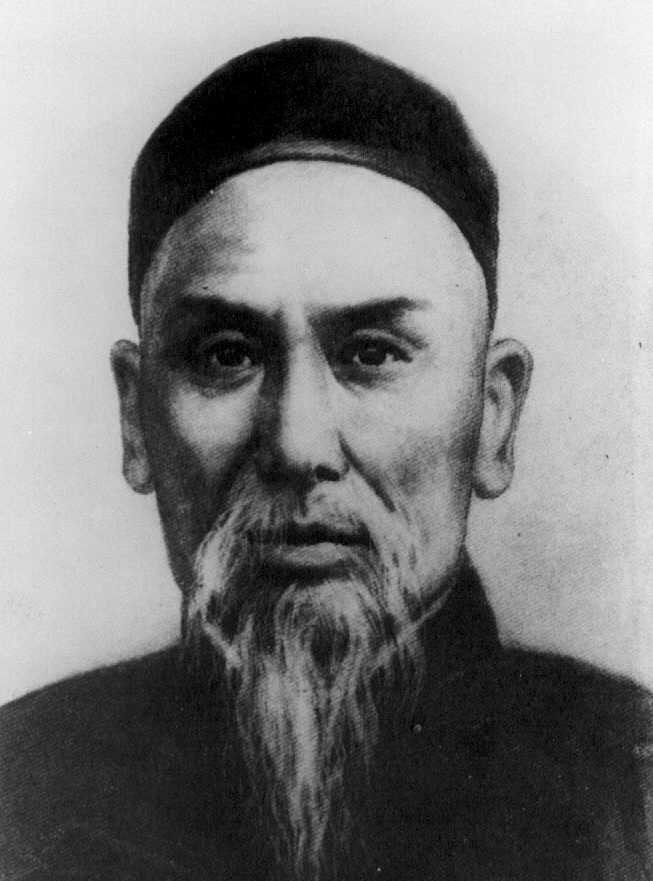 Translated by Marcus Brinkman O.M.D.
During the 1930’s and 1940’s, numerous booklets and short documentaries sponsored by boxing associations, primarily in Beijing, Nanjing and Shanghai, were privately published. In Beijing, Square Handkerchief Alley housed many eating stalls, printing press operations and boxing associations. One such booklet entitled, “The Long Lance Art of Yang Lu-chan” was authored by Wu Meng-xia. It is a story that was told to Wu about his grand teacher by a student of Yang Ban-hou. A copy of this booklet was held by Master Sha Guo-zhen, who read the story to his students. Sha had met Wu at national gatherings of Taiji and Bagua and regarded him as a person of rare knowledge, passed onto him by the Yang’s in Taiji and his Bagua by Han Mu-xia and Gao Yi-sheng, among others. Below is a translation of what Sha Guo-zhen’s had read to students in his classes in the 1980’s.
The first Yang family member to have learned the unique art of Taiji in the Chen village was Yang Lu-chan. When others spoke of him they commented that he was unwearying in practice, kind to all those who met him, and possessed a stout-heartedness in facing life and its challenges. For many years teacher Yang worked for the Chen family and studied their remarkable art and while living there, led a life of hardship and meagerness. He worked from before sunrise until the sun lowered. In summers his skin was dark from the toil of outside house repairs, farming duties and tending to general livestock.
Indoors he was also a servant who dealt with the cleaning of vegetables, cooking rice in large pots,serving food, and was given certain duties in the Chen clan businesses, in their village and nearby townships. As a servant Yang had a small room to sleep within. Inside he had a small bed, a little table for his rice bowl and drinking cup, and a dirt floor. It was a dirt floor that sunk deep into the earth, as it was worn away from him secretly practicing the Chen family boxing art every night. Though he partook of only servant food, he nevertheless maintained his physical stamina. In winters, teacher Yang had no hearth for fire. His warmth came from within. Though his life as a poor servant was difficult he never detoured from training. As the seasons changed so did his skill in Chen family boxing.
After many years, teacher Yang departed the Chen village to return home to impart his knowledge to others. His art was firstly known as Guangping Chuan because of its locale in Guangping. Though teacher Yang Lu-chan was often penniless, he would always find a way to give money to friends who desperately needed funds for family support. One day his friend asked to borrow one hundred dollars that would be returned to teacher Yang within one year. This was quite a large sum of money but teacher Yang had saved nearly this amount for an emergency. He told his friend that he would lend him the money only after he complete done minor feat. The feat was to hold a long pole with both hands, run and vault atop a nearby roof. Upon landing on the roof he must remain stable and upright. His friend reluctantly agreed. Teacher Yang’s friend ran after much hesitation, vaulted and plummeted onto the wooden planks of the roof. He instantly became pale and was so filled with fear that he became as stiff as a piece of wood, unable to move even slightly.The crowd that had gathered made this man even more nervous. It was at that point that teacher Yang took a long pole in both hands, equal to more than three times his own height, and placed the other end on his friend’s stomach. He then miraculously lifted him from the roof onto the ground. Teacher Yang’s effortlessness and stalwart skill of adhering and yielding astonished onlookers by this feat alone. This no doubt was verification that teacher Yang was adept in qing gong (the ability to make one’s self or another lighter in weight). After several minutes, the man was still partially in shock and teacher Yang could not help but to laugh. Yang explained that he was merely jesting with his friend and gladly gave him the one hundred dollars. His friend thereby came out of his shock and cheerfully accepted the money.
This story was told not to boast of teacher Yang’s skill in long lance (pole), but rather to comment upon his jovial character, which he nurtured and held fast to, even while poverty befell him. Though teacher Yang was a demanding teacher he was a true teacher of an authentic art. Kindness and cheerfulness must never be robbed from one’s breast. Teacher Yang’s example remains as an example for us to follow.
Saturday, April 23, 2011
Kung Fu Bad Ass - Wu Meng Xia

Re-blogged from Gaobagua.net
Tuesday, April 19, 2011
Annotations on Taijiquan by Wu Mengxia
Translated by Dr. Marcus Brinkman

Gu Zai San Qian
(Attending to the three fronts)
Pan Zai Qi Xing
(Awareness is on the seven stars)
These are two of the Songs of Eighteen Necessities from Wu Mengxia's taiji book. These eighteen songs are followed by annotations from Wu himself. The order of the songs are as follows:
Peng-Ward Off
Lu- Roll Back
Ji- Press
An- Push
Cai- Pluck
Lie- Split
Zou- Elbow
Kao- Bumping
Jin- Advancing
Tui- Retreating
Gu- Attend
Pan- Observe
Ding- Stability
Zhong- Centrality
Shuang- Double
Dan-Single
Xu- Empty
Shi- Full
The first song is to attend to the three fronts. The three fronts are the forward eye, forward hand and forward foot. These three points are to be taken notice of so that your power is always centralized. If the opponent takes one of these points off the centerline an opening is made. However, looking at the opponent we can use the song in an opposite way. By knowing that keeping these three points is safe for ourselves, also we want to take advantage of any weakness the opponent may show by not keeping his three fronts.
The second song is to be aware or observe of the opponents seven stars. The seven stars are the ankle, knee, hip, wrist, elbow, shoulder, and head. These are all areas that the opponent can use to attack us. On the other hand, these are places on our body that we can use to strike the opponent. Each of the seven stars should be capable of attacking and defending. So we can look at these songs from a yin/yang paradox and extract much more information.
In our school we put these ideas into our martial skill set by including one idea that integrates these two songs in a seamless way. We use another very famous internal martial arts poem, Han Xiong Ba Bei Chen Jian Zui Zou, which means seal the chest, pull up the back, sink the shoulders, and drop the elbows. By conforming our body to this mold we find that defense of the three fronts, and awareness of the seven stars is created naturally by this posture.
Some modern internal arts practitioners have mistaken parts of this song. This song is meant to describe the posture of san ti shi or the starting position for fighting(similar to a boxers starting position). However, during martial arts practice and qigong the chest is not meant to always be sealed. In Internal arts in general there should be an opening of the sternum as well as an opening of the thoracic spine. These two openings oscillate between an open and closed posture much in the same way as the lumbar spine does. If the lumbar and cervicals open and close, then the thoracic spine naturally cannot stay in a static state.
This translation shows many of the ideas that we practice in internal arts but are not often talked about. These are many chapters in this book with many songs in each one. Dr. Brinkman did a great job translating this text which helped understanding it in Chinese. For practitioners of Yi Zong internal arts or Taiji, Xingyi, and Bagua in general, this is an outstanding resource.
re-blogged from Oregon Internal Martial Arts
Subscribe to:
Posts (Atom)
Boulder Internal Arts - Classes Ongoing in 2026
Although I don't post much here anymore. We are still training and teaching in Boulder, Colorado USA after 20 years! Boulder Internal A...

-
 FOUND HERE - Dragons Armory web site Jinyiwei: Ming Elite Guards 錦衣衛 1. Bloodhounds ...
-
 Although I don't post much here anymore. We are still training and teaching in Boulder, Colorado USA after 20 years! Boulder Internal A...
-
In this episode, Owen and Randel talk about the eras of a teacher and how their training changes over time and how you should approach it.