Showing posts with label Shang Yun-xiang. Show all posts

Wednesday, January 7, 2015

Xingyi Quan - Shang Yun-Xiang Style Xingyi Quan - Book Review


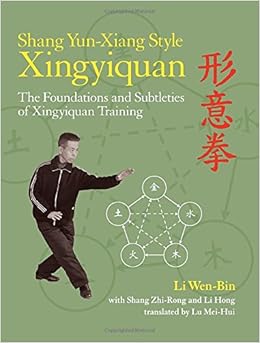
Shang Yun-Xiang Style Xingyiquan: The Foundations and Subtleties of Xingyiquan Training by Li Wen-Bin, translated by Lu Mei-Hui, is one of the few books in English on some of the deeper points of theory, practice and usage of Xingyi Quan (shape and mind boxing) Kung Fu available today. Shang Yun-Xiang was a student of famed master Li Cun Yi and founder of the Shang school of Xingyi Quan. His indoor students, Li Wen-Bin, Shang’s daughter Shang Zhi-Rong and Li’s son, Li Hong, have produced a very interesting book that lives up to its title “The Foundations and Subtleties of Xingyi Quan Training” by touching on, and adding depth too, a number of theoretical and practical areas of Xingyi practice. 

The opening section is about the history of Xingyi Quan and the meaning of the Xingyi Quan “classics” for the modern practitioner. An excellent high level overview of the history of Xingyi is included without the usual silliness about General Yue Fe, caves and lost scrolls. Perpetuating mythology is okay but it needs to be labeled as such, the facts are loose enough surrounding the origins and the players involved in the formation of Xingyi that increasing the confusion by adding mythological or non-related historical figures does not add to the art, or our understanding of it, in any way. By understanding the context and time these “classics” were written in and how and why their meaning has changed as Xingyi has matured and why they are still relevant are all addressed. The discussion of the Xingyi classics, their permutations over the centuries and their roll in modern Xingyi Quan alone is worth the price of the book.
The next section focuses on the stance requirements of the Shang Style. Shang style Xingyi Quan is a type of Hebei Xingyi Quan and, at a high level, uses many of the same training methods and requirements as other Hebei schools. The fascinating thing about this book is its discussion of the details specific to the Shang style discussed by high level, indoor, Shang style practitioners. Discussions of standing, weight distribution, hand position, internal power and their relation to the classics within the context of the Shang style are all touched on.
There are also a number of special topics or sections that may be of use to anyone practicing Hebei Xingyi Quan, a Li Cun Yi or Shang Yun-Xiang style, by discussing a number of variations of the five fists, weapons, Tuo Xing and Tai Xing from the Twelve Animals and San Ti Shi – Three Harmonies Postures to name a few.  The last third of the book covers the Wu Xing Quan (5 Elements Fist) and the Xingyi weapons, these sections provide less depth and detail and focus more on the forms illustrated in the book. This is where, if any where, this book falls short. I am not a fan of reproducing forms via pictures in books. That was useful in the 80’s and 90’s but I logged onto You Tube and in about five minutes I was watching Ms. Shang demonstrate the Wu Xing making the pictures less useful or necessary.
This is not a book for someone looking for a high level or general overview of Chinese Internal Martial Arts or Kung Fu. This book is targeted at an audience who has some connection, be it practical or academic, to Xingyi Quan in particular or Internal Martial Arts in general. That being said, this book is well worth the price, go buy it. 

Owen Schilling is a 20 year practitioner and teacher of Xingyi Quan, Bagua Zhang and Tai Chi Quan, a lineage holder in the Yi Zong School and the lead instructor at Boulder Internal Arts in Boulder, CO.

Sunday, October 19, 2014

Xing Yi Quan - Shang Style


Cui Guogui demonstrating most of the system of Shang style (hebei) Xing Yi Quan.
Master Cui was a student of Xin Jianhou which was one of Shang Yun Xiang's students.
Forms demonstrated include...
WuXingQuan (5 element fists)
Wu Xing Lian Huan Quan(5 elements linking form)
Luohan Ba Shi (arhat 8 postures)
JinGang BaShi ( diamond 8 postures)
Chu Dong Ru Dong
Liu He Quan ( 6 harmonies fist)
ShiEr Hong Chui ( 12 great hammers)
ShiErXing ( 12 animals)
Za Shi Chui ( Mixed postures hammer)
And weapons forms

Monday, October 17, 2011

Hsing I History - Hsing I Tales

Translated by Robert Brewer

Throughout the history of Hsing-I, Pa Kua and Tai Chi Chuan there have been many masters of legendary stature. The stories about them, while not always based in verifiable historical fact, are nonetheless important for what they tell us about the spirit of each master's art, as well as giving us a wonderful glimpse of times and traditions of a bygone age.

Through Hsing-I Tales, I hope to make available as many of these anecdotes as possible. Hope you enjoy them!

Shang Yun Hsiang

When Shang Yun Hsiang was ten years old, he went to the capitol with his father to study the art of lamp making. By nature he was interested in the martial arts, most especially in sparring both empty handed and with the staff. He became the student of Ma Ta I, and for ten years studied Kung Li Chuan.

He once had an occasion to meet with a high-level practitioner of Hsing I, a certain Li Chih He. They began to fight, and he was very easily beaten by Chih-he. It was then that he realized the superiority of Hsing I Chuan, and so became a disciple of Li Ts'un I.

Shang practiced night and day, and his martial ability improved daily. Because of this, he had no spare time to take care of his business, so he abandoned his lamp making. In Five Cities Camp he got work as a scout, searching for the whereabouts of ba ndits in the area. For a time he lived in the ruins of a temple, economizing in what he needed to live. Sometimes he had just barely enough for three meager meals a day.

Disregarding the fact that he was living in rags, shirtless and barefoot he would practice. The soles of his feet became hard as iron. The court yard of the temple originally consisted of small pebbles, yet after he had been practicing there for a whil e, the pebbles became sand. Everyone gave him the nickname The iron-footed Buddha.

Kuo Yun Shen heard that Shang Yun Hsiang's martial ability was very good. From far away, he traveled to Beijing to see him. He decided that if he were indeed worthy of the true knowledge, then he would accept him as a pupil and teach him himself. After the two of them had met, Kuo Yun Shen began to give Shang Yun Hsiang advice about Hsing I. Shang responded so well that he did indeed accept him as his own student.

In those days, there was a famous teacher of martial arts named Feng Lao Cheng, who excelled at wrestling, a style known as Fan Tzu. He had over 1000 disciples; in Hobei province there were none who had not heard of him. People called him the "marvelo us spirit hand," and he indeed lived up to his name.

One day, Feng and Shang were talking together when Feng boasted, "All the fighting styles in the world are low-class and unbearable, none can match my Fan Tzu style. There is no one who is worthy to be my opponent; would you believe it?"

Shang muttered, "I don't believe you," and then quickly changed the subject. Feng took this as a sign of fear, and decided that he must fight with Shang Yun Hsiang.

Initially, Shang would not agree, but because the challenge was thrown down a second --and then a third-- time, he had no choice but to give in. From several steps away, Feng began his attack with the ferocity of a whirlwind, attacking Shang's Pai Hui point with a stone-like fist. Not at all concerned, Shang defended himself using the Phoenix form from Hsing I, then pressed the attack, striking Feng in the groin. That was it: with a great cry, Feng fled the scene.

Another time, Shang went to visit a friend in another county. It just so happened, at the time that a high-level practitioner of Pa Chi Chuan and the staff, named Ma Hsiu, was in the same county. They found themselves seated together, and Ma kept casti ng aspersions upon Hsing I, saying that there was no way that Hsing I could compare with his art of the staff. He made clear his intent to fight with Shang using the staff. How was he to know that Hsing I Chuan had had its origins in the art of the staf f (the author of this story says that one of the founders of Hsing I Chuan was a master of the staff), and this was passed down through Hsing I staff.

The two of them faced off with staffs. Ma thought that even though Shang was famous for his bare-handed fighting ability, he wouldn't be able to win with a staff. He opened with a high-level move, striking at Shang's throat. But Shang didn't even fli nch. Moving from high to low, he struck down Ma's staff using Hsing I's Metal staff form. So powerful was this single blow that when Shang moved forward to present an attack, Ma was already saluting him, admitting defeat.

Chan Yun T'ing, Na Yue Chen, Hsu Hsiao Yu, Ch'en Tzu Ming, and Sun Meng Chih were all extremely skilled practitioners who all came from Shang Yun Hsiang's school. Of these, Chan Yun T'ing wrote the Book of Hsing I Five Elements, and A Collection of the Lore of Hsing I. From these books, it is not hard to divine the character of his master, Shang Yun Hsiang.

About the Author:
Robert Brewer is currently completing his masters degree in Asian Studies. He has studied in both Mainland China and Taiwan. He is an accomplished language teacher and does a lot of translating for us at the Journal. He is a long time practitioner of the internal arts, with an emphasis on Hsing I Chuan.

From Hsing-I.com

Friday, August 26, 2011

Rare Xingyi Quan Video

Shang Zhirong (尚芝蓉, 1922 – 2004) daughter of Shang Yunxiang (尚云祥, 1864 – 1937)


Shang Zhirong (尚芝蓉, 1922 – 2004), from Leling City of Shandong Province, was the daughter of Shang Yunxiang (尚云祥, 1864 – 1937). Shang Zhirrong, being the daughter of Shang Yunxiang, was naturally started her martial arts training at very young age, when she was 5 years old to be exact. The 15-year-old Shang took up a job to teach at the Beijing police station for making a living after her father passed away in 1937. She had overcome numerous challenges and ambushes to earn the respect of the law enforcement units.

Shang Zhirong returned to her hometown, Leling City of Shandong Province, with her mother after the Communist Party has took over China in 1951. Shang continued to live as a farm woman until after the Cultural Revolution in 1976, she restored communications with her seniors and the martial arts circle. Shang was appointed as the chief instructor of Leling Martial Arts Academy in 1985, she also served as the vice-president of Xingyiquan Institute of Shandong Province, adviser of Jinan Xingyiquan Institute and Beijing Xingyiquan Institute, etc. Shang Zhirong, together with her senior Li Wenbin, has co-written a Shang Style Xingyiquan intructional book.
from Xingyi max

Thursday, May 5, 2011

“Sounds of Thunder from Tigers and Leopards”.

Narrated by Li Zhong-xuan
Recorded by Xu Hao-feng
Translated by Tomabey
Copyright www.wuhun.com

What is a better way to start my translation “career” than to present you with the best of the best in Chinese martial art writing? I have picked this one out of the Li Zhong-xuan series because it vividly illustrates how martial art culture, tradition, training and secrets are interwoven together.

The Chinese martial art world was visibly shaken two years ago when an 85-year-old Mr. Li Zhong-xuan came out from nowhere and introduced himself as one of Master Shang Yun-xiang’s disciples. Published in the Chinese Wuhun Magazines, his articles have since caught the fantasies of thousands of martial art practitioners.

Ancient Xingyi poems suggest one can increase his power by producing certain sounds, this method is called, “Sounds of Thunder from Tigers and Leopards”. Mr. Li Zhong-xuan became a disciple of the Xingyi master Shang Yun-xiang when Shang was in his advanced age whereas Li was only 19-year-old. Since the huge age difference, Shang commanded Li not to have any disciples in the future, in order to avoid seniority confusion in the Shang’s school of Xingyi. After Master Shang passed away, Li continued his personal development alone, away from the martial arts circles. He is now 86 years old. At this age, he becomes even more attached to his memories of Master Shang. Thus he wishes to record the stories of his martial art study in an effort to enrich the martial art legacy.

This story is about the “Sounds of Thunder from Tigers and Leopards”.

Before Li Zhong-xuan became a disciple of Shang Yun-xiang, he had studied with Shang’s younger martial art brother Tang Wei-lu at Ning River. He had inherited the complete system from Master Tang: the martial arts, medicine, and Taoism (As a neijia system, Xingyi is found on the principles of Taoism, which includes medicine and neigong - the internal training) and had became Tang’s principle disciple. Once, when Tang verbally taught him the ancient Xingyi poems, he came across the phrase “Sounds of Thunder from Tigers and Leopards”, but did not go into it in detail. Li took it as shouting out load in combat in order to unsettle the enemy’s nerves, so he didn’t follow up on it.

He was ignoring it, because Master Tang forbad his students to make any kind of sound during practice. Once Li finished his practice in a high spirit, he proceeded to sing some Beijing Opera before he was verbally trashed by his teacher. “To practice martial arts is to work on your Qi; once you open your mouth you waste anything away!” Tang said dangerously, “More over, since all your Jing-Qi-Shen is contained in your breathing, if you don’t work on absorbing them internally, but rather singing them away with your big mouth, you are putting your life on the line.” Because of this “no talking while practicing” rule, Li was biased against making any sounds, so he did not continue to investigate.

Li had taken Tang’s rule to his heart, because he could draw from his own experience. After a Xingyi training session, he could feel his energy steaming within him. If he started to talk casually he would indeed sense this steam “leaking out”. Now to dissolve this breath of energy, as Tang instructed, you should not sit down right away after the training, instead, walk slowly. After strolling around the surroundings a few times you may feel as if you have taken a steamy shower, your mind and energy is crispy clear. As the days go on, your intelligence will improve. Hence martial arts training is the production and digestion of energies: the beginning of a movement is just as important as the closing, the time you spend wondering around after the exercises may even be longer than your actual practice.

The way Tang taught old Xingyi poems was to recite the whole thing out, have Li memorizing them, then explained them section by section later on. Because martial art training requires actual practice, only after you have reached a particular level you may not have the corresponding comprehension for that level. Sometimes Tang’s explanations were very clear, other times they were difficult for Li to follow - it seemed even Tang had trouble searching for the right words. Once they got to the section on “Sounds of Thunder from Tigers and Leopards”, Li asked, “Is it for driving fear into the opponents?” “No, no,” Tang quickly corrected him, “it means using the sound to increase your Kung Fu.” – that goes against Tang’s rule of “no talking while practicing”, so Li had to know why. Tang explained that his teacher Li Cun-yi’s had once said, “To push your Kung Fu to a new level, take ‘Sounds of Thunder from Tigers and Leopards’ with your travel.” Tang pointed out, “The only catch is that your Kung Fu has to reach a certain level before it will work magically.” Li wasn’t about to let go of his teacher’s last words, he asked, “So it isn’t about crying out load, but a training method! Could Sifu elaborate more?”

Tang was stuck. After thinking it over for a while, he led Li to a temple by the town of Ning River. Making sure that no one else was nearby, he lightly knocked on a large bell hanging inside the temple. The bell gave a resonating sound. Tang asked Li to put his hand on the bell. “That’s it,” Tang said. Seeing Li was still confused, Tang commented, “Back then Sifu Li Cun-yi taught me the secret of ‘Sounds of Thunder from Tigers and Leopards’ exactly this way, I didn’t hide anything from you. Only you didn’t get it.” So the matter was put aside.

In order for his disciple to reach a new height, Tang later have Li transfering to Shang’s school, so Li moved from Ning River to Beijing. Li’s family had relatives in Bejing, but Beijing was then in turmoil, a lot of people headed south bound, leaving behind a lot of vacant houses. Rent was unprecedented cheap. Li spent a few days in a relative’s home, then rent his own room and settled down in Beijing to study martial arts fulltime.

Since Li was used to Ning River’s countryside large-family-style living complex, and now he was living in a hutong - narrow alleys in the old Beijing city, he was intrigued by everything new. Back then Mr. Yan, an accountant who was very good at using abacus was living in the same hutong. When he had some spare time, he often taught the neighborhood kids how to use abacus. And that was how Li got started. Little did he realize then that he would become an accountant. Whenever he contemplated on how a game from years ago would eventually turned into a skill set for making a living, he couldn’t help but to marvel the karma and the coincidences in one’s fate.

One time Mr. Li asked Li while he was teaching Li abacus, “I used to think your martial artists must have thick fingers and rough hands full of calluses, you wouldn’t be any good with abacus. I didn’t realize your fingers are finer than a woman’s.” Li replied, “Neijia people don’t have to hit others with hard fists.” It just happened Tang had come from Ning River to visit his disciple. He was resting in Li’s room when he heard Mr. Yan speaking with Li outside, so out he came with a grin. He stuck his palms out and said, “Mr. Yan, my palms also don’t have any callus.”

Mr. Yan was even more surprised, because Tang was farming in a village near the town of Ning River, yet not only his palms didn’t have any callus, they were also small and without any mark of physical labor. Tang remarked, “But my hands are powerful.” He reached out with his hand, yanked out a nail which was tied to a string women used for drying their clothing out of the wall, then aimed the nail not at the original hole but a bit off to the side. With one twist of his hand the nail was back into the brick. Mr. Yan was dumbfounded at the sight.
One day a friend of Shang Yun-xang came for a visit when Li was in Shang’s house. This gentleman didn’t feel too good, feeling dizzy and suffering from tightness in the chest. He heard that reading Buddhist scripts might cure his illness so he heartily got a copy and started reading everyday. But the scripts were hard to understand; the more he had struggled with it mentally, the tighter his chest became. So he wanted to know out how he could get better.

Shang answered, “It takes even more mental work to study martial arts. I think you are only weak. Finding a good doctor to adjust your system gradually with medicine is your best bet.” After that friend had left, Shang continued chatting with Li. After a while, they started talking about this friend. Shang remarked, “Actually there is one way to cure illnesses: it’s reading. You have to be like a kid going to elementary school: don’t pay attention to what you are reading. Rather, swallow it down and just go on reading, so as long as the text is easy to read, it will benefit your mind and body. But adults don’t have as much energy as children. Reading aloud may hurt our chi in the liver. Instead, sound out only the tones and don’t be troubled with pronouncing every word clearly. As long as you get the ups and downs of the phrases you are fine.”

Li asked, “Why is that?” Shang explained, “Nothing in particular. I saw how charged up kids were once they started school, so I made it up.” Li followed, “So how come you didn’t teach your friend this trick?” Shang said, “He was troubled by life problems and was down in spirit, which was why he felt sick. It is better for him not to think about anything and not to use his mind too much, so I didn’t want to trouble him with this method.”

And so this topic was over. A few days later, Li suddenly had a thought inspired by that reading method: perhaps the “Sounds of Thunder from Tigers and Leopards” has some intricacy with voice? So he presented the question to his teacher. Shang took one look at him mischievously, “The Sounds of Thunder from Tigers and Leopards is not something you should practice. If you want to use it to frighten your enemy, go right ahead and practice. But too much practice will only hurt your brain and may drive you crazy.” Li insisted, “But opera singers do project their voice out load in practice.” Shang said, “Hey, but they don’t practice martial arts.”

From then on Li no longer dared to ask about the “Sounds of Thunder”. After they became acquainted with one anther, Shang began to teach Li. Since his teaching was very different from Tang Wei-lu’s, Li was puzzled, at times even visibly. Shang sensed his puzzlement, and laugh, “What Tang Wei-lu had taught you was exactly the same system as the one our teacher Li Cun-yi had taught us; what I am teaching is my own system.” Li was quick to jump onto this topic and told Shang how Tang taught him the “Sounds of Thunder” by knocking on a bell. Shang agreed, “Yes. My teacher Li taught me in the same way.” Li asked, “If that was how Master Li Cun-yi explained it; how do you teach it yourself?”

Shang was cracking up, he said, “My dear disciple really knows how to dig around. Okay, I will explain it to you when a thunder comes around next time.” Li figured Shang was joking in order to get him off the subject, nevertheless, for a while he was hoping for rain every day. Yet days went by without rain and Shang never brought up the subject again. Li had no choice but to focus on his training and dropped the idea.

Just then Shang’s neighbor had a group of kittens, one of them still didn’t pop up her two ears a month after birth, her ears were dangling loose like a doggy. Shang liked that kitty very much, even though he hadn’t adopted her, he often brought her back home and hugging her around. One day Li went over to visit Shang and found him sitting in the courtyard playing with this kitty with a short clothing strip, so Li sat aside. Noticed Li was waiting, Shang stopped after a few more games. He hug the kitty in his chest, closed his eyes, nd run his hands on the cat’s hair. He seemed to have spaced out. After a while, suddenly he said, “You have never seen a tiger or a leopard, me neither. But certainly you have seen a cat before, haven’t you? Actually, once a smart person has heard the phrase, “Sounds of Thunder from Tigers and Leopards”, he will have figured out what is going on.”

“Cats are like Tigers or Leopards, they make this “um” sounds all the time,” Shang declared. Li took the cat from Shang and listened. Yes, he heard this “um” sound coming from inside the cat, and even sensed a vibration on his two hands holding the cat. Shang further explained: once you reach a certain stage in your training, your bones, muscles, and tendons will be toughened up. At that point your trainings should aim inwards, which means you should work on improving your internal organs. But it is a difficult step, so you have to use certain sounds as bridges. The sounds originated from inside propagate outwards, your forces starting from outside move inwards. As a result, your inside will be connected with outside, and your Kung Fu will reach a new level.

Shang summarized, “The so-called ‘Sounds of Thunder’ is not the thunder from lightning, they are rather the humming noise from the sky right before the rain. You may hear them clearly, or you may not. But they are always very low in frequency.” Afterwards, Shang demonstrated the two “um” and “su” sounds.

It has been some sixty years since Shang Yun-xiang passed down the secret of “Sounds of Thunder from Tiger and Leopard”. As Li Zhong-xuan was bringing back his memories from the distance past, he remarked jokingly, “If it wasn’t for the kitty with sloppy ears, I might not have heard the Sounds of Thunder from Tigers and Leopards.”
Tuesday, May 3, 2011

Shang Yun-xiang’s Xingyi Quan pt1

Note: I looked for the original translations and website of this material and they are gone. I think the information contained in the article is interesting, it is part of a series that i will post over the next few days. It was translated by Tomabey.

Master Li Zhong-xuan discusses the essence of Shang's Style.
Narrated by Li Zhong-xuan
Recorded by Xu Hao-feng
First Published by the October, 2001 issue of Wuhun, Copyright www.wuhun.com


I studied Xingyi from Shang Yun-xiang when I was young. Many years later, I heard people referring his martial arts as the "Shang's Style of xingyi" in respect. Recently a visiting martial arts enthusiast asked me why his Xingyi was so different from others that it was named as "the Shang's Style" . I could not come up with a concise answer at the moment, because back then I was only looking for self improvement when I studied martial arts; I had never thought about this issue. I have chatted with my teacher often, but I don't recall him comparing his martial art with others.

How people at the present day are distinguishing Shang's Xingyi with other Xingyi is beyond me. For decades I was an ordinary man and was busy making a living, I had never got involved with any of such discussion. Based on my experience in being with my teacher, the xing(posture, form) and yi(intent, "heart") in the Shang's style of Xingyi can only be taught by a teacher in person, in order for the student to get a gut feeling about it. If I have to describe it with words, then I have to say that his "form" means "no form" and his "intent" means "no intent". This is not some old monks making useless zen speech, it is a fact in martial arts training.

Take the issue with xing, for example. Some martial arts enthusiasts would automatically believe that its postures must be dramatically different from others, once they hear the term "The Shang's Style of Xingyi". They got stuck with arguments such as whether the front foot is pointing straight or at an angle, or the rear hand is held in front of one's waist or behind the front elbow. Certainly, one of the reasons for calling it "the Shang's Style" must be that it has some unique forms, but that is not the essence. They were the habit Teacher Shang formed in his many years of practice, they were not there because he was trying to create his own school and made them up for the sake of being different. Being able to balance and coordinate is an inherited ability of the human body. Even if you drastically change the old postures, with consistent practice you can make it look like the real thing. If you so claim to have created a new style, surely must you be joking?

Teacher Shang’s famous saying was, “Do train on the power but not the form, do use Jing but not the force.” If all one sees is the postures but does not study the principles behind them, he is “marking the boat for the sword [1]”. Some analyze the Shang’s form from the point of mechanics, they believe the reason for the change is for a better power release; or they consider Shang’s body shape, believe that the form was changed to make it more suitable for short and heavy people, which perhaps has some true in it. Unfortunately, because Shang’s Xingyi uses Jing rather than force, to analyze it with mechanics is to start with the wrong foot.

If you study it from the point of application, take Sparrow, for example, you may see that other styles utilize the shoulders, whereas Shang’s style uses the foot. Since the targets are different, the postures are certainly not the same. The fact of the matter is that if Shang’s Sparrow comes out using the shoulders, what’s wrong with that? It’s not boxing, whose downward hook is only for the chin and a straight jab is aiming the face. Once you put out a posture, you can attack people with any part of your body. When a posture is as good as one hundred postures, only then it is Xingyi. Otherwise with only the few postures in Five Elements and Twelve Animals, how could it become one of the three major Neijing systems

More over, every posture in Xingyi can be manifested in three different ways: training, application, and demonstration, depending on the purpose. Books don’t talk about these. Only after you become a disciple, you may know them all. The so-called sets in the books are often a random mix of application, training methods and demonstration. If you use the sets to compare the difference and similarity between the Shang’s Style and others, how can you figure it out? For example, some styles start Piquan with the rear hand rubbing the inside of the front forearm. Because the forearm is covered with Jing Luo, or meridians, the rubbing motion has health benefits. Therefore it’s one of the training methods. Another example, some have the front arm extending high and level, and the two hands coming back slowly - they are for health considerations, no good in a fight. In order for comparison to work, we have to compare the three categories one-on-one. A rather complicated work it is, so we won’t delve into the details in the article.

Using Jing is like wrapping a pile of loose mandarin oranges (human body) with a net and throwing the whole thing out. Doing it this way the body weight will not be devalued, instead, it can take advantage of acceleration to project a force that’s larger than the body weight. Knowing such creative solution, Shang’s Xingyi certainly “uses Jing but not the force.”

Only when one lets’ go of the force will his training produce Jing, that’s because Jing is associated with the entire body. Once you use force, you are stuck with segments: you may gain sesames but you loose a watermelon. Some martial art enthusiasts read the sentence from boxing chronicles: “Xingyi has Ming (clear) Jing, An (hidden) Jing, and Hua (dissolved) Jing”, then reckon they must show some power at the beginning of their training. So they do a lot of Fali (power release) right away and go some obvious results, they can fight really well. They heard the cliché “A Xingyi student can kill somebody within a year” and believed they were on the right track. If that’s the truth, then how is it different from a boxer hitting sandbags? You can kill somebody after a year of boxing training. A good boxer’s punch can be 70 pounds. With that 70 pounds hitting one’s chest, of course it can kill him.

The fact is that the character “Ming” as Ming Jing in the boxing chronicles not only means clarity, but also means comprehension. You have to “observe the Jing within your own body”. Your punches will naturally become stronger in this stage. The word “An Jing” means a transition from clear to hidden, from awareness to subconsciousness: let go of your observations, let the Jing become an automatic reaction. Hua Jing is a state where you can switch between awareness and subconsciousness at will.
Since An Jing and Hua Jing are difficult to describe, I will only try to talk about Ming Jing. There’s a trick in Ming Jing training: look for it at the turning points. The Five Elements are not about techniques, but rather trainings on five different Jing. Therefore the turns are different for each element, the turning postures are designed to express their particular Jing. So work on your turns more often, it may help you figuring things out.

Legend used to say that whenever Sun Lu-tang run into difficulty in explaining Jing to his students, he would compare the Jings in Xingyi with those in Taiji to give them more inspiration. After a while he found it amusing himself so he created the Sun Style Taiji. Not sure about the accuracy of this story, but there were Xingyi people who made a lot of discoveries after seeing Sun Style Taiji.

In the process of practicing Jing, naturally you will run into the feeling of Shen-Qi, or the spirit. This is not the place for such discussion, only the practitioners know it themselves. If you study it from Fali (Power Explosion)’s point of view, there must be a posture that’s better than the others. Regardless, Shang’s Xingyi uses Jing, once you have the Jing, one posture is no good or worst than the others, therefore it is pointless to discuss the Xing, or the appearance.

Speaking of Yi, there are people who artificially introduce thoughts and imaging. The damages are beyond measure. In the old days some martial artists had no proper education. Before they had received quality instruction, they read the adjectives in the boxing chronicles and took them as secretes. For example, when they read the phrase “Four Ounces Moving A Thousand Pounds”, they started thinking about tricks in mechanics. Once they think like a thief and want to take shortcuts, they would never get the real Kungfu. These days some martial artists are influenced by Qigong, they add lots of thoughts and imaging into their practice, such as “holding up the entire ocean with your hands” while doing standing. How much does the ocean weight? Thoughts like this will create mental tension for no good reason. Doing it all the time will only shorten your life.

Another example, some read the line in a poem: “Enemy encountered, my body was like on fire”. They don’t understand “body on fire” is merely an analogym instead of the actually physical condition. Imagining your body catching fire when you go to a fight, you will ruin your reaction. You will loose for sure.

So really what does “Yi” refer to? A little girl in the gymnastics team doesn’t take much effort to do a somersault, she doesn’t need much thinking either; she only relies on her trained body feelings. When her feeling comes she will complete a somersault. The Yi in Xingyi is similar. It’s not some imagined pictures in your brain, so Yi means not thinking (translator: the original text says, “Yi equals no Yi”).

Master Shang always encouraged his students to get more education. He said people with education could pick up martial arts faster. A martial artist is a true martial artist only when he looks more like a scholar than a scholar. Most top generals in the ancient books had the portrait of a scholar. Same for people who study martial arts: if you spend the whole day looking angry, as if you are always playing with your swords and drawing bows with arrows, you won’t get the highest Kungfu. That’s because a lot of the stuff on the boxing chronicles were written between the lines. While scholars may get it in a second, martial artists can easily be confused. And so Master Shang himself was very easy going. His face had a creamy look; his skin was very soft. He didn’t have the look of frowning or staring like a typical martial artist. Only when people walked behind him, he might turn and cast a glance, which was quit frightening.

The Yi of Xingyi is like the casual creation of a painter. The composition and strokes are not arranged ahead of time, yet once the brush hits the paper everything becomes alive – only that is the real feeling. It comes before your movement, before your imagination, as if before a rain, the moisture carried by the breeze, it's here and there. Grasp this feeling and you may start to train in Shang’s style of Xingyi.

The Xing and Yi, the form and the heart of Shang’s style of Xingyi can be summarized by a poem, “Such subtlety, clear and pure, how many people will understand?”

(The End)

Boulder Internal Arts - Classes Ongoing in 2026

Although I don't post much here anymore. We are still training and teaching in Boulder, Colorado USA after 20 years!  Boulder Internal A...