Luo De Xiu teaching tai Chi applications in Israel. Thanks Lee!
Showing posts with label Li Cui Yi. Show all posts
Showing posts with label Li Cui Yi. Show all posts
Monday, April 30, 2012


Friday, May 6, 2011
KUNG FU BAD ASS - LI CUN YI
Li Cunyi (李存义), a.k.a. Li Zhongyuan (李忠元), was one of the most influential Xingyiquan figure at the end of 19th century and early 20th century.
Li Cunyi
 Li Cunyi was born in Shen County of Hebei Province in 1847. Li studied Xingyiquan under Liu Qilan (刘奇兰, 1819 – 1889) at 20 years old , he later became friend with Cheng Tinghua (程庭华, 1848 – 1900) and studied Baguazhang under Cheng’s teacher, Dong Haichuan (董海川, 1797 – 1882). In actual fact, it was Cheng who passed most of the Baguazhang skills to Li.
Li Cunyi joined “Righteous Harmony Society” at the age of 50 in 1900. Li used to held a saber against the army of the Eight-Nation Alliance during Boxer Rebellion, and the nickname of “Single Saber” Li has became famous.
Li Cunyi has been teaching martial arts to the army of Liu Kunyi (刘坤一, 1830 – 1902) in 1890. Li later ran a “Biaoju” business in Baoding, and he also tough Xingyiquan (both staffs and students) during those years. The business later closed down due to poor management.
Li Cunyi has co-founded “Chinese Warrior Association” at Tianjin City in 1911 which spread the skill of Xingyiquan, this caused Tianjin to become one of the headquarter of Hebei Xingyiquan. Li Cunyi later tough his arts at Shanghai Jingwu Tiyuhui (Chin Woo Athletic Association) under the invitation of the association.
Li Cunyi resided to his hometown and tough the skills of Xingyiquan in his later years. Li passed away at the age of 74 in 1921.
Li Cunyi’s students include Shang Yunxiang (尚云祥, 1846 -1937, his Xingyiquan was later known as Shang Style Xingyiquan by his successors), Wang Benian (黄柏年, 1880 – 1954), Fu Jianqiu (傅剑秋, 1885 – 1956), Chen Panling (陈泮岭, 1891 – 1967, Chen later resided to Taiwan during the Civil War of China).
Re-Blogged from Xingyi Max
Li Cunyi
Li Cunyi joined “Righteous Harmony Society” at the age of 50 in 1900. Li used to held a saber against the army of the Eight-Nation Alliance during Boxer Rebellion, and the nickname of “Single Saber” Li has became famous.
Li Cunyi has been teaching martial arts to the army of Liu Kunyi (刘坤一, 1830 – 1902) in 1890. Li later ran a “Biaoju” business in Baoding, and he also tough Xingyiquan (both staffs and students) during those years. The business later closed down due to poor management.
Li Cunyi has co-founded “Chinese Warrior Association” at Tianjin City in 1911 which spread the skill of Xingyiquan, this caused Tianjin to become one of the headquarter of Hebei Xingyiquan. Li Cunyi later tough his arts at Shanghai Jingwu Tiyuhui (Chin Woo Athletic Association) under the invitation of the association.
Li Cunyi resided to his hometown and tough the skills of Xingyiquan in his later years. Li passed away at the age of 74 in 1921.
Li Cunyi’s students include Shang Yunxiang (尚云祥, 1846 -1937, his Xingyiquan was later known as Shang Style Xingyiquan by his successors), Wang Benian (黄柏年, 1880 – 1954), Fu Jianqiu (傅剑秋, 1885 – 1956), Chen Panling (陈泮岭, 1891 – 1967, Chen later resided to Taiwan during the Civil War of China).
Re-Blogged from Xingyi Max
Wednesday, May 4, 2011
Shang Yun-Xiang’s Xingyi Quan pt 2
Master Li Zhong-xuan explained a broad range of fundamentals in this article, including the beginning movement of Xingyi and secrets techniques in Standing.
First Published by the July, 2003 issue of Wuhun, Copyright www.wuhun.com
(Note: I looked for the original translations and website of this material and they are gone. I think the information contained in the article is interesting, it is part of a series that i will post over the next few days. It was translated by Tomabey. I believe this a picture of Li Zhong-xuan if not let me know :)
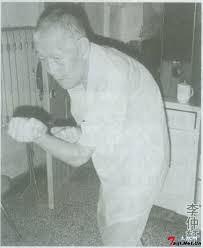
The beginning is the most difficult of all things. To practice Xingyi without understanding the beginning movement, one cannot master the Pi, Beng, Quan, Pao, and Heng. This time I will start from the beginning movement and end up with the Horse Form. The Horse Form is easy to learn and handy in application, perhaps it will increase my reader’s interest in Xingyi, I hope.
Before I begin I shall answer some of the recent mails from my readers.
(1) In Xue Dian's book, "Xiang Xing Shu" (“Imitation Boxing”, as Jarek in www.chinafrominside.com has translated), it says when one’s Kungfu has reached the highest level, his body can discharge electricity upon hitting somebody. Could you do so?
(2) You once mentioned that there are some difference between the Hunyuan Stance and Twenty-Four Requirements. Unfortunately, I don’t understand what you mean by “one is devoid of all desires while the other has specific goal”.
(3) My throat hurts every time I practice Xingyi, what’s the cure?
(4) One of your previous article suggests that once someone has mastered Pi Quan, he can naturally perform the Tiger Form. What’s the reason?
The martial arts circle is full of legends. I had a friend named Jin Dong-lin who was born with a crooked spine. Hadn’t seen him for a few years, I happened to run into him one day and found out that his spine was straightened. He said an old guy from the Xinjian province had cured him, which till this day I have never figured out how it was possible. Another legend was the rumored skill called “Eruption from the Mouth”.
In the old days it was a tradition for martial artists to visit other martial artists all over the country once they had graduated. They looked for whoever was the famous, they walked in and they fight. Learned a technique or two if they lost; walked out if they won. There was this strong guy going to test out an old man. The old man said, “Can you tell I am too old? I am not interested in competition any more.” But the younger fellow insisted on an exchange. Seeing someone was carrying two barrels of water passing by, the old guy said, “Okay, okay. But you have to let me drink some water.” So he stopped the water carrier. The bully young guy couldn’t believe his eyes, for the old man drank a whole barrel of water. Before the young guy realized what was going on, the old man suddenly opened his mouth, and the surging out water stream knocked the young guy on the ground.
I had never seen Xingyi people playing this stuff; I thought it was merely a legend. Then one time I went to an opera and watched the famous opera singer Guo Yue-lou demonstrating this skill on the stage. In the back of the stage he also performed this trick, a mouthful of water can be ejected to a long distance. If you were to stand next to him and have him spit the water at you, you would be like being punched with a small fist.
I was an opera fan when I was young, since then I haven’t been inside an opera house for some thirty to forty years. Hitting somebody with electricity is beyond my ability, so you cannot use me as the proof. But during martial art practice one must have “the feeling of electricity”, which is sensitivity.
Once Shang Yun-xiang and Chang Yan-hua [1] tried out each other, Shang was the one who started it. Master Shang was short and carrying a big belly. He went to visit Chang a New Year. Sitting behind a large table, he secretly bumped the table with his belly. Just when his force was about to move the table, Chang’s hand had landed on the table. Afterwards these two went into the courtyard to try out each other. Some said, “Chang Yan-hua has mystical power”, praising Chang’s sensitivity.
Sensitivity is the key in bringing out a number of Kungfu, or skills. Therefore the opening of Xingyi is the “opening” of sensitivity. The actual form goes like this: your two hands raise upward as if they are holding two bowls of water, turning slightly while passing your eye bows level, they reach the top of your head. Be careful not to spill the imaginary water. That caution leads to your sensitivity.
Once reaching the top, your hands came down like the receding tide, moving in front of your eye bows, you get the sensation of compressing air. The air is a big sponge - you have to squeeze the water out of it. You keep pressing until your hands reaching your thigh. At this point you have to bend your knees and close your kua (the inside of your thigh), your whole body squats down. As you are squatting down, your hands lift and pull towards your waist. You body is tied up in a bundle, so are your hands, as if they are to squeeze and twist something, all five fingers are closed up together to form a fist.
Note 1: Chang Yan-hua was the famous Bagua master.
As soon as the first movement begins, your whole body becomes sensitive. Lifting up your two arms, your mind is crispy clear; like the standing up mane in the back of a wild animal's head, your neck goes into an alert state. Bending your knees and squatting down, it charges you with energy; like the extending tail of a wild animal when it locks his jaws onto the target, your tail bone goes into an alert state. Human's eyes are located at the front of the head, people look at things in front of them, nobody's too slow for what's happening in front - only when you become sensitive to what's behind you can be faster than everybody else.
Xingyi's first movement offers many benefits, learning just this movement alone will give you plenty of practice material. Following the first movement you go into Pi, Beng, Zhuan, Pao and Heng, you should carry this sensitivity with you. The Hunyuan Stance also requires your sensitivity. Its posture looks like this: you put your two arms in front of you as if they are suspended in air with just a hint of hugging something, your left and right palms are facing your left and right chest respectively. Otherwise you do whatever is natural for you and don't worry about other requirements.
The key to the Hunyuan Stance is in the eyes, your eyes have to look up. The first thing about martial arts training is the training of your eyes, with the eyes it comes the the spirit, Shen, therefore the first thing about martial arts training is also the training of your spirit. Say you climb to the top of a mountain, you can be so tired that you are about to collapse. But as soon as you look into the distance your body is lighten up again. That is exactly the idea behind Hunyuan Stance.
There’s a saying, “The hearts have channels to communicate with one another”. The spirit in your eyes is that channel. You may stand for a long time to exercise your tendons and bones, but that only strengthen your tendons and bones – you haven’t done much standing yet. The relationship between the spirit of the eyes and the body is what you have to taste in a Hunyuan stance. Only when that channel is opened there is life. When winter is retreating and spring is coming back, life is returning to the soil, you can smell its fragrance. Holding a handful of soil, you can see every particle being alive. Same for standing, you have to feel the life in you.
When you stand in the Hunyuan posture, your body has to be led by your eyes, itself cannot have any artificial movement. Since the martial arts is an experimental science, I only wish to discuss Hunyuan stance with these sentences. On the other hand, the Twenty-Four Requirements analyze your body in great detail.
The Twenty-Four Requirements are rules for every part of the body, from head to toes, they are everywhere in every framework. Since it’s impossible to meet all twenty-four requirements completely in the beginning, in actual teaching the adjustments are made one at a time - eventually one has to meet all requirements at any given time. You may work on the adjustments in sessions, a few seconds or a few minutes at a time, or you may keep on standing like the way you do the Hunyuan stance. The older generations generally preferred to do them in sessions, for example, Li Cun-yi’s skillsdidn’t come from prolong standing.
If your throat hurts after your exercise, you haven’t meet the “tongue pushing upward” requirement. When your tongue is not touching the roof of your mouth, you loose energy as you practice, of course you will have a throat problem. A sore throat is still a small problem in comparison, Master Shang said, “You’ve got to watch over the young beginners, or they may get a crooked back.” Sports in general mostly work on your four limbs, whereas martial arts also work on your spine. If your don’t meet the Twenty-Four Requirements, your posture will be crooked no matter what form you do. As time goes on, your spine will suffer. While working on forms you get a lot of movement, whereas in standing you hold on to a posture, where it’s easy to injure your tendons and bones, therefore you need to know about the Twenty-Four Requirements to protect yourself.
When you are meeting the Twenty-Four Requirements, you feel light and floating. Don’t look for forces and play with Jings when you are standing. As you stand there and time is passing by, your body may start to play with the forces, you shall learn to relax and let it go. Xingyi is an art that thrives on relaxation but frowns upon tightness. Sensitivity is her first priority - once you use forces you slow down your own progress. As a matter of fact, only when you can feel light and weightless you are using your forces correctly. To empty your whole body is to bring your whole body alive.
Not only you have to meet the Twenty-Four Requirements while you are standing, you have to follow them when you speed up. They have to be in your movements. The transition from static postures to movements is a major barrier - therefore you need to learn the art of "moving in one centimeter".
Putting the Twenty-Four Requirements into your form is not the same as setting up showy postures that have no meaning. Once your posture is meeting the requirements, it has to become alive - something is to be born from the structure. Merely having an exact posture in terms of dimension is not enough; your static posture has to have a desire to move. For example, if your posture is a tiger pouncing forward, it has to be ready to pouncing forward, and also be ready to bouncing backward. Your posture has to compress this back and forth movement within one centimeter.
When you set up a posture, you seem to be stationary. Actually the bones and tendons are pushing and pulling each other when you "jump" in this one centimeter. A mountain valley has echoes; a human body generates returning forces. If you jump forward one center-meter, you will be bounced back one centimeter. When you take advantage of the returning forces, your Gang Jing, a power with the quality of steel will come naturally. The most painful part of standing is when the bones and tendons are tired. Once you learn this technique, however, your twenty minutes of standing is as fun as twenty minutes of doing the form. Soon you will learn to enjoy standing.
If you don’t follow the Twenty Four Requirements you will never find the key to martial arts; if you don’t study the form, you won’t get to a high level. The Five Elements form is a summary of a few hundred years of practice - it’s your lose if you don’t experience it firsthand. When you realize the Tiger Pouncing is springing forward with a bouncing backward force, your feet will be able to send you forward as well as backwards, because now you have understood the working of the Tiger Pouncing.
Seeing I became a disciple of Master Shang, my teacher Tang Wei-lu informed me, “Your teacher Shang is very street smart, he pays attention to details. So be a good student.” Master Shang was wise, he knew how to express his feelings subtly. If he didn’t like something, he wouldn’t say it, instead his face turned solemn and his student would get the hint. His solemn expression would come at the right place and at the right time, it wasn’t just for frightening people. He was otherwise easy going, yet I was often afraid of speaking in front of him.
Master Shang’s study was into details, because he had grasped the reason behind every form and framework clearly, his understanding went very deep. The form taught by Master Shang was about the same as Master Tang’s, not much difference there. His understanding on the reason behind the moves was sometimes different.
Once you have learned Pi-quan you will know how to do Tiger Pouncing, because a Tiger Pouncing is the same as a Pi-quan done with two hands. Pi-quan has one hand pouncing forward with another hand rounding up the back, whereas Tiger Pouncing has two hands pouncing forward and two hands rounding up the back. When you are learning how to move “in one centimeter”, you will find Tiger Pouncing to be easier, whereas Pi-quan to be slightly harder. Therefore you can also claim: once learning Tiger Pouncing, Pi-quan will come naturally. Practicing the “one centimeter” move is also a mental study. Using this technique, you can figure out the reason behind all the movements one by one.
Master Shang earned his reputation while he was alive and kept it after he passed away. However, after Xue Dian was gone, people voided talking about him. I’ve never been to his house. When I was learning from him I went to his martial arts school, as soon as I heard a couple of interesting points, I got hook right away and immediately looked for a place without people to practice. Back then he used to stay over night in his martial arts school, which was located inside Heibei Park. As long as the lights were still on in the school, the gangers who used to hang out in the park would not dare to do anything. Xue Dian is no god, but he did secure the safety of that area.
First Published by the July, 2003 issue of Wuhun, Copyright www.wuhun.com
(Note: I looked for the original translations and website of this material and they are gone. I think the information contained in the article is interesting, it is part of a series that i will post over the next few days. It was translated by Tomabey. I believe this a picture of Li Zhong-xuan if not let me know :)
The beginning is the most difficult of all things. To practice Xingyi without understanding the beginning movement, one cannot master the Pi, Beng, Quan, Pao, and Heng. This time I will start from the beginning movement and end up with the Horse Form. The Horse Form is easy to learn and handy in application, perhaps it will increase my reader’s interest in Xingyi, I hope.
Before I begin I shall answer some of the recent mails from my readers.
(1) In Xue Dian's book, "Xiang Xing Shu" (“Imitation Boxing”, as Jarek in www.chinafrominside.com has translated), it says when one’s Kungfu has reached the highest level, his body can discharge electricity upon hitting somebody. Could you do so?
(2) You once mentioned that there are some difference between the Hunyuan Stance and Twenty-Four Requirements. Unfortunately, I don’t understand what you mean by “one is devoid of all desires while the other has specific goal”.
(3) My throat hurts every time I practice Xingyi, what’s the cure?
(4) One of your previous article suggests that once someone has mastered Pi Quan, he can naturally perform the Tiger Form. What’s the reason?
The martial arts circle is full of legends. I had a friend named Jin Dong-lin who was born with a crooked spine. Hadn’t seen him for a few years, I happened to run into him one day and found out that his spine was straightened. He said an old guy from the Xinjian province had cured him, which till this day I have never figured out how it was possible. Another legend was the rumored skill called “Eruption from the Mouth”.
In the old days it was a tradition for martial artists to visit other martial artists all over the country once they had graduated. They looked for whoever was the famous, they walked in and they fight. Learned a technique or two if they lost; walked out if they won. There was this strong guy going to test out an old man. The old man said, “Can you tell I am too old? I am not interested in competition any more.” But the younger fellow insisted on an exchange. Seeing someone was carrying two barrels of water passing by, the old guy said, “Okay, okay. But you have to let me drink some water.” So he stopped the water carrier. The bully young guy couldn’t believe his eyes, for the old man drank a whole barrel of water. Before the young guy realized what was going on, the old man suddenly opened his mouth, and the surging out water stream knocked the young guy on the ground.
I had never seen Xingyi people playing this stuff; I thought it was merely a legend. Then one time I went to an opera and watched the famous opera singer Guo Yue-lou demonstrating this skill on the stage. In the back of the stage he also performed this trick, a mouthful of water can be ejected to a long distance. If you were to stand next to him and have him spit the water at you, you would be like being punched with a small fist.
I was an opera fan when I was young, since then I haven’t been inside an opera house for some thirty to forty years. Hitting somebody with electricity is beyond my ability, so you cannot use me as the proof. But during martial art practice one must have “the feeling of electricity”, which is sensitivity.
Once Shang Yun-xiang and Chang Yan-hua [1] tried out each other, Shang was the one who started it. Master Shang was short and carrying a big belly. He went to visit Chang a New Year. Sitting behind a large table, he secretly bumped the table with his belly. Just when his force was about to move the table, Chang’s hand had landed on the table. Afterwards these two went into the courtyard to try out each other. Some said, “Chang Yan-hua has mystical power”, praising Chang’s sensitivity.
Sensitivity is the key in bringing out a number of Kungfu, or skills. Therefore the opening of Xingyi is the “opening” of sensitivity. The actual form goes like this: your two hands raise upward as if they are holding two bowls of water, turning slightly while passing your eye bows level, they reach the top of your head. Be careful not to spill the imaginary water. That caution leads to your sensitivity.
Once reaching the top, your hands came down like the receding tide, moving in front of your eye bows, you get the sensation of compressing air. The air is a big sponge - you have to squeeze the water out of it. You keep pressing until your hands reaching your thigh. At this point you have to bend your knees and close your kua (the inside of your thigh), your whole body squats down. As you are squatting down, your hands lift and pull towards your waist. You body is tied up in a bundle, so are your hands, as if they are to squeeze and twist something, all five fingers are closed up together to form a fist.
Note 1: Chang Yan-hua was the famous Bagua master.
As soon as the first movement begins, your whole body becomes sensitive. Lifting up your two arms, your mind is crispy clear; like the standing up mane in the back of a wild animal's head, your neck goes into an alert state. Bending your knees and squatting down, it charges you with energy; like the extending tail of a wild animal when it locks his jaws onto the target, your tail bone goes into an alert state. Human's eyes are located at the front of the head, people look at things in front of them, nobody's too slow for what's happening in front - only when you become sensitive to what's behind you can be faster than everybody else.
Xingyi's first movement offers many benefits, learning just this movement alone will give you plenty of practice material. Following the first movement you go into Pi, Beng, Zhuan, Pao and Heng, you should carry this sensitivity with you. The Hunyuan Stance also requires your sensitivity. Its posture looks like this: you put your two arms in front of you as if they are suspended in air with just a hint of hugging something, your left and right palms are facing your left and right chest respectively. Otherwise you do whatever is natural for you and don't worry about other requirements.
The key to the Hunyuan Stance is in the eyes, your eyes have to look up. The first thing about martial arts training is the training of your eyes, with the eyes it comes the the spirit, Shen, therefore the first thing about martial arts training is also the training of your spirit. Say you climb to the top of a mountain, you can be so tired that you are about to collapse. But as soon as you look into the distance your body is lighten up again. That is exactly the idea behind Hunyuan Stance.
There’s a saying, “The hearts have channels to communicate with one another”. The spirit in your eyes is that channel. You may stand for a long time to exercise your tendons and bones, but that only strengthen your tendons and bones – you haven’t done much standing yet. The relationship between the spirit of the eyes and the body is what you have to taste in a Hunyuan stance. Only when that channel is opened there is life. When winter is retreating and spring is coming back, life is returning to the soil, you can smell its fragrance. Holding a handful of soil, you can see every particle being alive. Same for standing, you have to feel the life in you.
When you stand in the Hunyuan posture, your body has to be led by your eyes, itself cannot have any artificial movement. Since the martial arts is an experimental science, I only wish to discuss Hunyuan stance with these sentences. On the other hand, the Twenty-Four Requirements analyze your body in great detail.
The Twenty-Four Requirements are rules for every part of the body, from head to toes, they are everywhere in every framework. Since it’s impossible to meet all twenty-four requirements completely in the beginning, in actual teaching the adjustments are made one at a time - eventually one has to meet all requirements at any given time. You may work on the adjustments in sessions, a few seconds or a few minutes at a time, or you may keep on standing like the way you do the Hunyuan stance. The older generations generally preferred to do them in sessions, for example, Li Cun-yi’s skillsdidn’t come from prolong standing.
If your throat hurts after your exercise, you haven’t meet the “tongue pushing upward” requirement. When your tongue is not touching the roof of your mouth, you loose energy as you practice, of course you will have a throat problem. A sore throat is still a small problem in comparison, Master Shang said, “You’ve got to watch over the young beginners, or they may get a crooked back.” Sports in general mostly work on your four limbs, whereas martial arts also work on your spine. If your don’t meet the Twenty-Four Requirements, your posture will be crooked no matter what form you do. As time goes on, your spine will suffer. While working on forms you get a lot of movement, whereas in standing you hold on to a posture, where it’s easy to injure your tendons and bones, therefore you need to know about the Twenty-Four Requirements to protect yourself.
When you are meeting the Twenty-Four Requirements, you feel light and floating. Don’t look for forces and play with Jings when you are standing. As you stand there and time is passing by, your body may start to play with the forces, you shall learn to relax and let it go. Xingyi is an art that thrives on relaxation but frowns upon tightness. Sensitivity is her first priority - once you use forces you slow down your own progress. As a matter of fact, only when you can feel light and weightless you are using your forces correctly. To empty your whole body is to bring your whole body alive.
Not only you have to meet the Twenty-Four Requirements while you are standing, you have to follow them when you speed up. They have to be in your movements. The transition from static postures to movements is a major barrier - therefore you need to learn the art of "moving in one centimeter".
Putting the Twenty-Four Requirements into your form is not the same as setting up showy postures that have no meaning. Once your posture is meeting the requirements, it has to become alive - something is to be born from the structure. Merely having an exact posture in terms of dimension is not enough; your static posture has to have a desire to move. For example, if your posture is a tiger pouncing forward, it has to be ready to pouncing forward, and also be ready to bouncing backward. Your posture has to compress this back and forth movement within one centimeter.
When you set up a posture, you seem to be stationary. Actually the bones and tendons are pushing and pulling each other when you "jump" in this one centimeter. A mountain valley has echoes; a human body generates returning forces. If you jump forward one center-meter, you will be bounced back one centimeter. When you take advantage of the returning forces, your Gang Jing, a power with the quality of steel will come naturally. The most painful part of standing is when the bones and tendons are tired. Once you learn this technique, however, your twenty minutes of standing is as fun as twenty minutes of doing the form. Soon you will learn to enjoy standing.
If you don’t follow the Twenty Four Requirements you will never find the key to martial arts; if you don’t study the form, you won’t get to a high level. The Five Elements form is a summary of a few hundred years of practice - it’s your lose if you don’t experience it firsthand. When you realize the Tiger Pouncing is springing forward with a bouncing backward force, your feet will be able to send you forward as well as backwards, because now you have understood the working of the Tiger Pouncing.
Seeing I became a disciple of Master Shang, my teacher Tang Wei-lu informed me, “Your teacher Shang is very street smart, he pays attention to details. So be a good student.” Master Shang was wise, he knew how to express his feelings subtly. If he didn’t like something, he wouldn’t say it, instead his face turned solemn and his student would get the hint. His solemn expression would come at the right place and at the right time, it wasn’t just for frightening people. He was otherwise easy going, yet I was often afraid of speaking in front of him.
Master Shang’s study was into details, because he had grasped the reason behind every form and framework clearly, his understanding went very deep. The form taught by Master Shang was about the same as Master Tang’s, not much difference there. His understanding on the reason behind the moves was sometimes different.
Once you have learned Pi-quan you will know how to do Tiger Pouncing, because a Tiger Pouncing is the same as a Pi-quan done with two hands. Pi-quan has one hand pouncing forward with another hand rounding up the back, whereas Tiger Pouncing has two hands pouncing forward and two hands rounding up the back. When you are learning how to move “in one centimeter”, you will find Tiger Pouncing to be easier, whereas Pi-quan to be slightly harder. Therefore you can also claim: once learning Tiger Pouncing, Pi-quan will come naturally. Practicing the “one centimeter” move is also a mental study. Using this technique, you can figure out the reason behind all the movements one by one.
Master Shang earned his reputation while he was alive and kept it after he passed away. However, after Xue Dian was gone, people voided talking about him. I’ve never been to his house. When I was learning from him I went to his martial arts school, as soon as I heard a couple of interesting points, I got hook right away and immediately looked for a place without people to practice. Back then he used to stay over night in his martial arts school, which was located inside Heibei Park. As long as the lights were still on in the school, the gangers who used to hang out in the park would not dare to do anything. Xue Dian is no god, but he did secure the safety of that area.
Tuesday, May 3, 2011
Shang Yun-xiang’s Xingyi Quan pt1
Note: I looked for the original translations and website of this material and they are gone. I think the information contained in the article is interesting, it is part of a series that i will post over the next few days. It was translated by Tomabey.
Master Li Zhong-xuan discusses the essence of Shang's Style.
Narrated by Li Zhong-xuan
Recorded by Xu Hao-feng
First Published by the October, 2001 issue of Wuhun, Copyright www.wuhun.com

I studied Xingyi from Shang Yun-xiang when I was young. Many years later, I heard people referring his martial arts as the "Shang's Style of xingyi" in respect. Recently a visiting martial arts enthusiast asked me why his Xingyi was so different from others that it was named as "the Shang's Style" . I could not come up with a concise answer at the moment, because back then I was only looking for self improvement when I studied martial arts; I had never thought about this issue. I have chatted with my teacher often, but I don't recall him comparing his martial art with others.
How people at the present day are distinguishing Shang's Xingyi with other Xingyi is beyond me. For decades I was an ordinary man and was busy making a living, I had never got involved with any of such discussion. Based on my experience in being with my teacher, the xing(posture, form) and yi(intent, "heart") in the Shang's style of Xingyi can only be taught by a teacher in person, in order for the student to get a gut feeling about it. If I have to describe it with words, then I have to say that his "form" means "no form" and his "intent" means "no intent". This is not some old monks making useless zen speech, it is a fact in martial arts training.
Take the issue with xing, for example. Some martial arts enthusiasts would automatically believe that its postures must be dramatically different from others, once they hear the term "The Shang's Style of Xingyi". They got stuck with arguments such as whether the front foot is pointing straight or at an angle, or the rear hand is held in front of one's waist or behind the front elbow. Certainly, one of the reasons for calling it "the Shang's Style" must be that it has some unique forms, but that is not the essence. They were the habit Teacher Shang formed in his many years of practice, they were not there because he was trying to create his own school and made them up for the sake of being different. Being able to balance and coordinate is an inherited ability of the human body. Even if you drastically change the old postures, with consistent practice you can make it look like the real thing. If you so claim to have created a new style, surely must you be joking?
Teacher Shang’s famous saying was, “Do train on the power but not the form, do use Jing but not the force.” If all one sees is the postures but does not study the principles behind them, he is “marking the boat for the sword [1]”. Some analyze the Shang’s form from the point of mechanics, they believe the reason for the change is for a better power release; or they consider Shang’s body shape, believe that the form was changed to make it more suitable for short and heavy people, which perhaps has some true in it. Unfortunately, because Shang’s Xingyi uses Jing rather than force, to analyze it with mechanics is to start with the wrong foot.
If you study it from the point of application, take Sparrow, for example, you may see that other styles utilize the shoulders, whereas Shang’s style uses the foot. Since the targets are different, the postures are certainly not the same. The fact of the matter is that if Shang’s Sparrow comes out using the shoulders, what’s wrong with that? It’s not boxing, whose downward hook is only for the chin and a straight jab is aiming the face. Once you put out a posture, you can attack people with any part of your body. When a posture is as good as one hundred postures, only then it is Xingyi. Otherwise with only the few postures in Five Elements and Twelve Animals, how could it become one of the three major Neijing systems
More over, every posture in Xingyi can be manifested in three different ways: training, application, and demonstration, depending on the purpose. Books don’t talk about these. Only after you become a disciple, you may know them all. The so-called sets in the books are often a random mix of application, training methods and demonstration. If you use the sets to compare the difference and similarity between the Shang’s Style and others, how can you figure it out? For example, some styles start Piquan with the rear hand rubbing the inside of the front forearm. Because the forearm is covered with Jing Luo, or meridians, the rubbing motion has health benefits. Therefore it’s one of the training methods. Another example, some have the front arm extending high and level, and the two hands coming back slowly - they are for health considerations, no good in a fight. In order for comparison to work, we have to compare the three categories one-on-one. A rather complicated work it is, so we won’t delve into the details in the article.
Using Jing is like wrapping a pile of loose mandarin oranges (human body) with a net and throwing the whole thing out. Doing it this way the body weight will not be devalued, instead, it can take advantage of acceleration to project a force that’s larger than the body weight. Knowing such creative solution, Shang’s Xingyi certainly “uses Jing but not the force.”
Only when one lets’ go of the force will his training produce Jing, that’s because Jing is associated with the entire body. Once you use force, you are stuck with segments: you may gain sesames but you loose a watermelon. Some martial art enthusiasts read the sentence from boxing chronicles: “Xingyi has Ming (clear) Jing, An (hidden) Jing, and Hua (dissolved) Jing”, then reckon they must show some power at the beginning of their training. So they do a lot of Fali (power release) right away and go some obvious results, they can fight really well. They heard the cliché “A Xingyi student can kill somebody within a year” and believed they were on the right track. If that’s the truth, then how is it different from a boxer hitting sandbags? You can kill somebody after a year of boxing training. A good boxer’s punch can be 70 pounds. With that 70 pounds hitting one’s chest, of course it can kill him.
The fact is that the character “Ming” as Ming Jing in the boxing chronicles not only means clarity, but also means comprehension. You have to “observe the Jing within your own body”. Your punches will naturally become stronger in this stage. The word “An Jing” means a transition from clear to hidden, from awareness to subconsciousness: let go of your observations, let the Jing become an automatic reaction. Hua Jing is a state where you can switch between awareness and subconsciousness at will.
Since An Jing and Hua Jing are difficult to describe, I will only try to talk about Ming Jing. There’s a trick in Ming Jing training: look for it at the turning points. The Five Elements are not about techniques, but rather trainings on five different Jing. Therefore the turns are different for each element, the turning postures are designed to express their particular Jing. So work on your turns more often, it may help you figuring things out.
Legend used to say that whenever Sun Lu-tang run into difficulty in explaining Jing to his students, he would compare the Jings in Xingyi with those in Taiji to give them more inspiration. After a while he found it amusing himself so he created the Sun Style Taiji. Not sure about the accuracy of this story, but there were Xingyi people who made a lot of discoveries after seeing Sun Style Taiji.
In the process of practicing Jing, naturally you will run into the feeling of Shen-Qi, or the spirit. This is not the place for such discussion, only the practitioners know it themselves. If you study it from Fali (Power Explosion)’s point of view, there must be a posture that’s better than the others. Regardless, Shang’s Xingyi uses Jing, once you have the Jing, one posture is no good or worst than the others, therefore it is pointless to discuss the Xing, or the appearance.
Speaking of Yi, there are people who artificially introduce thoughts and imaging. The damages are beyond measure. In the old days some martial artists had no proper education. Before they had received quality instruction, they read the adjectives in the boxing chronicles and took them as secretes. For example, when they read the phrase “Four Ounces Moving A Thousand Pounds”, they started thinking about tricks in mechanics. Once they think like a thief and want to take shortcuts, they would never get the real Kungfu. These days some martial artists are influenced by Qigong, they add lots of thoughts and imaging into their practice, such as “holding up the entire ocean with your hands” while doing standing. How much does the ocean weight? Thoughts like this will create mental tension for no good reason. Doing it all the time will only shorten your life.
Another example, some read the line in a poem: “Enemy encountered, my body was like on fire”. They don’t understand “body on fire” is merely an analogym instead of the actually physical condition. Imagining your body catching fire when you go to a fight, you will ruin your reaction. You will loose for sure.
So really what does “Yi” refer to? A little girl in the gymnastics team doesn’t take much effort to do a somersault, she doesn’t need much thinking either; she only relies on her trained body feelings. When her feeling comes she will complete a somersault. The Yi in Xingyi is similar. It’s not some imagined pictures in your brain, so Yi means not thinking (translator: the original text says, “Yi equals no Yi”).
Master Shang always encouraged his students to get more education. He said people with education could pick up martial arts faster. A martial artist is a true martial artist only when he looks more like a scholar than a scholar. Most top generals in the ancient books had the portrait of a scholar. Same for people who study martial arts: if you spend the whole day looking angry, as if you are always playing with your swords and drawing bows with arrows, you won’t get the highest Kungfu. That’s because a lot of the stuff on the boxing chronicles were written between the lines. While scholars may get it in a second, martial artists can easily be confused. And so Master Shang himself was very easy going. His face had a creamy look; his skin was very soft. He didn’t have the look of frowning or staring like a typical martial artist. Only when people walked behind him, he might turn and cast a glance, which was quit frightening.
The Yi of Xingyi is like the casual creation of a painter. The composition and strokes are not arranged ahead of time, yet once the brush hits the paper everything becomes alive – only that is the real feeling. It comes before your movement, before your imagination, as if before a rain, the moisture carried by the breeze, it's here and there. Grasp this feeling and you may start to train in Shang’s style of Xingyi.
The Xing and Yi, the form and the heart of Shang’s style of Xingyi can be summarized by a poem, “Such subtlety, clear and pure, how many people will understand?”
(The End)
Master Li Zhong-xuan discusses the essence of Shang's Style.
Narrated by Li Zhong-xuan
Recorded by Xu Hao-feng
First Published by the October, 2001 issue of Wuhun, Copyright www.wuhun.com
I studied Xingyi from Shang Yun-xiang when I was young. Many years later, I heard people referring his martial arts as the "Shang's Style of xingyi" in respect. Recently a visiting martial arts enthusiast asked me why his Xingyi was so different from others that it was named as "the Shang's Style" . I could not come up with a concise answer at the moment, because back then I was only looking for self improvement when I studied martial arts; I had never thought about this issue. I have chatted with my teacher often, but I don't recall him comparing his martial art with others.
How people at the present day are distinguishing Shang's Xingyi with other Xingyi is beyond me. For decades I was an ordinary man and was busy making a living, I had never got involved with any of such discussion. Based on my experience in being with my teacher, the xing(posture, form) and yi(intent, "heart") in the Shang's style of Xingyi can only be taught by a teacher in person, in order for the student to get a gut feeling about it. If I have to describe it with words, then I have to say that his "form" means "no form" and his "intent" means "no intent". This is not some old monks making useless zen speech, it is a fact in martial arts training.
Take the issue with xing, for example. Some martial arts enthusiasts would automatically believe that its postures must be dramatically different from others, once they hear the term "The Shang's Style of Xingyi". They got stuck with arguments such as whether the front foot is pointing straight or at an angle, or the rear hand is held in front of one's waist or behind the front elbow. Certainly, one of the reasons for calling it "the Shang's Style" must be that it has some unique forms, but that is not the essence. They were the habit Teacher Shang formed in his many years of practice, they were not there because he was trying to create his own school and made them up for the sake of being different. Being able to balance and coordinate is an inherited ability of the human body. Even if you drastically change the old postures, with consistent practice you can make it look like the real thing. If you so claim to have created a new style, surely must you be joking?
Teacher Shang’s famous saying was, “Do train on the power but not the form, do use Jing but not the force.” If all one sees is the postures but does not study the principles behind them, he is “marking the boat for the sword [1]”. Some analyze the Shang’s form from the point of mechanics, they believe the reason for the change is for a better power release; or they consider Shang’s body shape, believe that the form was changed to make it more suitable for short and heavy people, which perhaps has some true in it. Unfortunately, because Shang’s Xingyi uses Jing rather than force, to analyze it with mechanics is to start with the wrong foot.
If you study it from the point of application, take Sparrow, for example, you may see that other styles utilize the shoulders, whereas Shang’s style uses the foot. Since the targets are different, the postures are certainly not the same. The fact of the matter is that if Shang’s Sparrow comes out using the shoulders, what’s wrong with that? It’s not boxing, whose downward hook is only for the chin and a straight jab is aiming the face. Once you put out a posture, you can attack people with any part of your body. When a posture is as good as one hundred postures, only then it is Xingyi. Otherwise with only the few postures in Five Elements and Twelve Animals, how could it become one of the three major Neijing systems
More over, every posture in Xingyi can be manifested in three different ways: training, application, and demonstration, depending on the purpose. Books don’t talk about these. Only after you become a disciple, you may know them all. The so-called sets in the books are often a random mix of application, training methods and demonstration. If you use the sets to compare the difference and similarity between the Shang’s Style and others, how can you figure it out? For example, some styles start Piquan with the rear hand rubbing the inside of the front forearm. Because the forearm is covered with Jing Luo, or meridians, the rubbing motion has health benefits. Therefore it’s one of the training methods. Another example, some have the front arm extending high and level, and the two hands coming back slowly - they are for health considerations, no good in a fight. In order for comparison to work, we have to compare the three categories one-on-one. A rather complicated work it is, so we won’t delve into the details in the article.
Using Jing is like wrapping a pile of loose mandarin oranges (human body) with a net and throwing the whole thing out. Doing it this way the body weight will not be devalued, instead, it can take advantage of acceleration to project a force that’s larger than the body weight. Knowing such creative solution, Shang’s Xingyi certainly “uses Jing but not the force.”
Only when one lets’ go of the force will his training produce Jing, that’s because Jing is associated with the entire body. Once you use force, you are stuck with segments: you may gain sesames but you loose a watermelon. Some martial art enthusiasts read the sentence from boxing chronicles: “Xingyi has Ming (clear) Jing, An (hidden) Jing, and Hua (dissolved) Jing”, then reckon they must show some power at the beginning of their training. So they do a lot of Fali (power release) right away and go some obvious results, they can fight really well. They heard the cliché “A Xingyi student can kill somebody within a year” and believed they were on the right track. If that’s the truth, then how is it different from a boxer hitting sandbags? You can kill somebody after a year of boxing training. A good boxer’s punch can be 70 pounds. With that 70 pounds hitting one’s chest, of course it can kill him.
The fact is that the character “Ming” as Ming Jing in the boxing chronicles not only means clarity, but also means comprehension. You have to “observe the Jing within your own body”. Your punches will naturally become stronger in this stage. The word “An Jing” means a transition from clear to hidden, from awareness to subconsciousness: let go of your observations, let the Jing become an automatic reaction. Hua Jing is a state where you can switch between awareness and subconsciousness at will.
Since An Jing and Hua Jing are difficult to describe, I will only try to talk about Ming Jing. There’s a trick in Ming Jing training: look for it at the turning points. The Five Elements are not about techniques, but rather trainings on five different Jing. Therefore the turns are different for each element, the turning postures are designed to express their particular Jing. So work on your turns more often, it may help you figuring things out.
Legend used to say that whenever Sun Lu-tang run into difficulty in explaining Jing to his students, he would compare the Jings in Xingyi with those in Taiji to give them more inspiration. After a while he found it amusing himself so he created the Sun Style Taiji. Not sure about the accuracy of this story, but there were Xingyi people who made a lot of discoveries after seeing Sun Style Taiji.
In the process of practicing Jing, naturally you will run into the feeling of Shen-Qi, or the spirit. This is not the place for such discussion, only the practitioners know it themselves. If you study it from Fali (Power Explosion)’s point of view, there must be a posture that’s better than the others. Regardless, Shang’s Xingyi uses Jing, once you have the Jing, one posture is no good or worst than the others, therefore it is pointless to discuss the Xing, or the appearance.
Speaking of Yi, there are people who artificially introduce thoughts and imaging. The damages are beyond measure. In the old days some martial artists had no proper education. Before they had received quality instruction, they read the adjectives in the boxing chronicles and took them as secretes. For example, when they read the phrase “Four Ounces Moving A Thousand Pounds”, they started thinking about tricks in mechanics. Once they think like a thief and want to take shortcuts, they would never get the real Kungfu. These days some martial artists are influenced by Qigong, they add lots of thoughts and imaging into their practice, such as “holding up the entire ocean with your hands” while doing standing. How much does the ocean weight? Thoughts like this will create mental tension for no good reason. Doing it all the time will only shorten your life.
Another example, some read the line in a poem: “Enemy encountered, my body was like on fire”. They don’t understand “body on fire” is merely an analogym instead of the actually physical condition. Imagining your body catching fire when you go to a fight, you will ruin your reaction. You will loose for sure.
So really what does “Yi” refer to? A little girl in the gymnastics team doesn’t take much effort to do a somersault, she doesn’t need much thinking either; she only relies on her trained body feelings. When her feeling comes she will complete a somersault. The Yi in Xingyi is similar. It’s not some imagined pictures in your brain, so Yi means not thinking (translator: the original text says, “Yi equals no Yi”).
Master Shang always encouraged his students to get more education. He said people with education could pick up martial arts faster. A martial artist is a true martial artist only when he looks more like a scholar than a scholar. Most top generals in the ancient books had the portrait of a scholar. Same for people who study martial arts: if you spend the whole day looking angry, as if you are always playing with your swords and drawing bows with arrows, you won’t get the highest Kungfu. That’s because a lot of the stuff on the boxing chronicles were written between the lines. While scholars may get it in a second, martial artists can easily be confused. And so Master Shang himself was very easy going. His face had a creamy look; his skin was very soft. He didn’t have the look of frowning or staring like a typical martial artist. Only when people walked behind him, he might turn and cast a glance, which was quit frightening.
The Yi of Xingyi is like the casual creation of a painter. The composition and strokes are not arranged ahead of time, yet once the brush hits the paper everything becomes alive – only that is the real feeling. It comes before your movement, before your imagination, as if before a rain, the moisture carried by the breeze, it's here and there. Grasp this feeling and you may start to train in Shang’s style of Xingyi.
The Xing and Yi, the form and the heart of Shang’s style of Xingyi can be summarized by a poem, “Such subtlety, clear and pure, how many people will understand?”
(The End)
Subscribe to:
Posts (Atom)
Boulder Internal Arts - Classes Ongoing in 2026
Although I don't post much here anymore. We are still training and teaching in Boulder, Colorado USA after 20 years! Boulder Internal A...

-
 FOUND HERE - Dragons Armory web site Jinyiwei: Ming Elite Guards 錦衣衛 1. Bloodhounds ...
 -
Here is Gao Style Bagua practitioner C.S. Tang performing his version of the Tian Gan - Heavenly Stems Nei Gong set.
-
Since i don't speak Chinese i assume these guy are martial artists.

