Showing posts with label Book Review. Show all posts

Friday, June 9, 2017

The Major Methods of Wudang Sword by Huang Yuan Xiou - Book Review

“Shaolin shadow boxing and the Wu Tang sword style, do you think your Wu Tang sword can defeat me?” Wu Tang Clan – Bring Da Ruckus - Enter the 36 Chambers - movie sample from Shaolin & Wu Tang 1981 (dubbed).

The Wu Tang/ Wudang sword method is famous in America because of the Hip-Hop group The Wu Tang Clan’s use of samples from, and love of, Chinese kung Fu movies. The book The Major Methods of Wudang Sword by Huang Yuan Xiou is a classic and a must have for anyone interested in Chinese straight sword (Jian) methods, philosophy or anyone interested in historical swordsmanship. This book translates the original text with pictures. It outlines the basics of the Wudang sword method but do not expect to learn something a complex as the Jian from a book. The book is a wonderful reference tool, but it is not meant to learn the real method from.  

The Jian is called the “king of weapons” because of its complexity and subtlety. It was traditionally thought it would take 10 years of consistent training to begin mastery. Because of its difficulty it was also referred to as a “scholar’s weapon” and traditionally depicted as the preferred weapon of the aristocracy of ancient China.

The Major Methods of Wudang Sword is an important work and even more important because it was one of the few English translations (until recently) of a Chinese Jian manual (check https://brennantranslation.wordpress.com for others). I believe the thing that sets this translation apart from other translations is the author and translator are both long time practitioners of the Wudang Jian method. They lend their insights to the translations and they help clarify some of the underlying principles of traditional Chinese swordsmanship.


There are several chapters devoted to the basic theory of the Jian. I think these chapters are some of the most insightful because they outline different practice methodologies. With names like “yin – yang sword circle method” and “triangular paired-practice method” there will need to be some explanation, and for the advanced practitioner I found some of these chapters to be most illuminating.

This is an excellent book and a must have for anyone interested in Chinese straight sword (Jian) methods, philosophy or anyone interested in historical swordsmanship. The biographies, history and discussion of the methods are rare in Chinese and even rarer in English.


Sunday, May 14, 2017

The Cheng School Gao Style Baguazhang Manual - Book Review

The Cheng School Gao Style Baguazhang Manual: Gao Yisheng's Bagua Twisting-Body Connected Palm Paperback by Gao Yisheng  (Author), Liu Fengcai (Editor), John Groschwitz (Translator)

The Chinese internal martial art of Bagua Zhang, the eight change of the palm, is an art with similarities to Tai Chi Chuan. The author of the book, Gao Yi Sheng, was a student of one the all-time greats of Bagua Zhang, Ching Ting Hua. Gao’s innovation to and standardization of the Cheng Bagua curriculum, as well as his well know fighting ability, earned him a branch of the Cheng school.

The recounting of Gao’s life is almost worth the price of the book. These types of martial histories, while not always accurate, give us insight into the developmental process Gao went through and how he innovated on what he learned. They may not be a way to explore motive but expand our thinking about the influences he was exposed to in the creation of the straight line sets. Also included is the life history of his nephew and student Liu Feng Cai and many of the students in his lineage.

This book is not a teaching book, it was written as a resource for the “in door” students and never meant to be published. If you had access to the book you were a long term, in door student who was already familiar with the basics postures, stances, and movements. This is why the book is heavy on theory, basic rules of the system, etc., and not a posture by posture teaching book. 

Also, you cannot learn a martial art as complex as Bagua Zhang (or Taiji Quan or Xingyi Quan for that matter) from a book. It is not possible unless you have years of experience with basic stancing, body mechanics, had position, application, etc. Learning these arts is time consuming and arduous. Even with a good, open teacher and a willing student it is difficult to learn and will take years of dedication and training.

This book is the official standard for the curriculum of the Gao lineage. Its contents are a must for all practitioner of Bagua Zhang in the Gao system or the Cheng Bagua school. 


I am a 20 year practitioner and teacher of Xingyi Quan, Gao Bagua Zhang and Tai Chi Quan

Wednesday, May 3, 2017

Fundamentals of the Wudang Sword Method - a Manual of Chinese Swordsmanship Translation by Scott M. Rodell

This book is a must have for any practitioner of the Chinese sword arts. Scott Rodell is one of the foremost experts of the Chinese Jian and has 40+ years of experience he brings to the table in his commentary and translation. 
The layout of the book is useful as well, he leaves the classical Chinese, the pinyin and the English translation on the page together. I like that because it gives me the opportunity to see the character (I don’t speak Chinese) and look at the tone in Pinyin as well as see the translated meaning in English.
This is not a book for a novice, although it can benefit someone who has no experience, this book is really for the person who has some background in Chinese swordsmanship. The insight and depth of the commentary helps to elucidate some of the finer points of theory and usage. 
I believe the introduction about Li Jinlin the “Sword Saint”, the history of Wu Dang Sword and Chinese history lesson alone is worth the $6 price tag. 

Wednesday, April 19, 2017

The Taijiquan Classics: A Martial Artist's Translation by Scott M. Rodell - Book Review

The Taijiquan Classics: A Martial Artist's Translation by Scott M. Rodell - Book Review

An amazing book by an expert well versed in Chinese Martial Arts, Chinese Internal Martial Arts (IMA) and Chinese history and culture. The depth of his 40+ years of practical experience in Taiji Quan brings these classic texts to life and gives them a context that make them both accessible and practical to the beginner or the advanced practitioner of any style of Taiji Quan.

I appreciated the candid outline of his translation process. The time and care Mr. Rodell took during the process reaffirmed my confidence in the work. The layout of the book is useful as well, he leaves the classical Chinese, the pinyin and the English translation on the page together. I like that because it gives me the opportunity to see the character (I don’t speak Chinese) and look at the tone in Pinyin as well as see the translated meaning in English.

The classics are enigmatic guidelines, sometimes couched in flowery language, designed to help practitioners to remember various important points of practice. Without guidance to elucidate them they become less useful and accessible to the lay practitioner. Mr. Rodell’s commentary is where this translation shines. His commentary is clear, concise and accessible even to the practitioner with a basic level of Taiji skill and vocabulary.

This book is a must for any Taiji practitioner. The content and execution make this book unique among translations of the Taiji classics.  


I am a 20+ year practitioner and teacher of Xingyi Quan, Bagua Zhang and Tai Chi Quan

Sunday, April 16, 2017

Bagua and Xingyi: An Intersection of the Straight and Curved

Bagua & Xingyi an Intersection of the straight and the curved: An anthology of Articles from the Journal of Asian Martial Arts Compiled by Michael A DeMarco, M.A. is an amazing book spanning years of in depth articles from the Journal of Asian Martial Arts about the Chinese Internal Arts of Bagua, Xingyi and Taiji.

In the name of full disclosure I am a lineage holder and teacher in the Gao Bagua Yi Zong lineage which is featured heavily in this book.

Over the last 20 + years of my learning, teaching and training these arts I have read or heard about most of the articles in this book but to see them finally collected in one edition is really a great resource for any practitioner of the Internal Marital Arts (IMA).

The articles span multiple generations of practitioners of Bagua Zhang/ Pa Kua Chang (the eight trigram palm) and Xingyi Quan/ Hsing I Chuan (mind-shape boxing) so the depth and breadth of the information can inform the new practitioner or the advanced student. I have read and re-read most of the articles included in the book countless times and have always gained a new perspective on the arts.

Owen Schilling is a 20 year practitioner and teacher of Xingyi Quan, Bagua Zhang and Tai Chi Quan, a lineage holder in the Yi Zong School and the lead instructor at Boulder Internal Arts in Boulder, CO.

Tuesday, February 10, 2015

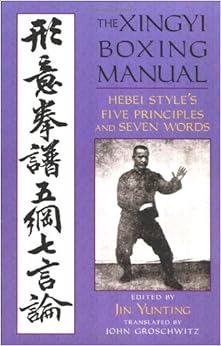
Xingyi Quan - The Xingyi Boxing Manual - Book Review


The Xingyi Boxing Manual, Revised and Expanded Edition by Jin Yunting (Author), John Groschwitz (Editor) – A Review
This revised and expanded edition of The Xingyi boxing Manual is worth the read although there is nothing groundbreaking or earth shattering about its content to the serious Xingyi practitioner in 2015. This edition has some differences from the original 2004 release. As I dug into my copy of the 2004 edition I realized the extent and significance of the recently revised and expanded release. As translator John Groschwitz explains in the introduction to the recent edition:               

“Only several years later did I discover that this short book (the 2004 edition of the Xingyi Boxing Manual), published in 1931, was itself an excerpted version of A Pictorial Explanation of Xingyi Five Element Boxing, published one year earlier in 1930. This earlier, longer version contained almost all of the material in the 1931 edition, but also offer more detailed discussions of theory, and step-by-step instructions…”.
The Xingyi Boxing Manual is a classic Chinese Martial Arts manual produced in the 1930’s by
Jin Yunting; a long time practitioner of Xingyi who learned from some of the greatest Xingyi masters who ever lived. The book is interesting because of its limited scope. It focuses specifically on teaching the Five Fists of Xingyi Quan and the “classics” (the theory that governs Xingyi practice and usage). The Summary of the Five Principles section is an edited summarization of the material covered in the original 2004 edition. The summary has hand drawn pictures of Jin in each posture of the Five Fists as well as an accompanying classic “song” or poem covering the basic requirements of each fist.
The “General Theory” section has a number of discussions of Xingyi theory including:
·         Xingyi Origins
·         Qi
·         Methods
·         Six Harmonies
·         Eight Postures
The following section was not included in the original 2004 book and is a welcome edition. The “Essential Teachings on Yue Wuming’s Xingyi Quan” is one of the more interesting parts of the book. It is a long section including Yue’s nine teachings and an extra section on “methods for crossing hands”. All of the commentary in this section is focused on Qi;  the meaning of Qi, the development of Qi, Qi and its relationship to Xingyi Quan, the mind, the meridians and body methods. Some of these sections contain gems of information and wisdom.
The explanation of the Five Fists is really the blow by blow of the five forms, how to perform the forms with their requirements using drawings and photos. I am not a fan of reproducing forms via pictures in books. But this is a classic manual produced in the 1930’s for mass consumption. I also believe that the intention was to help the Chinese people by providing a way to exercise, not teaching Xingyi Quan for fighting. This book is a classic and should be in the library of any serious Xingyi Quan practitioner or Internal Martial Arts player.

Owen Schilling is a 20 year practitioner and teacher of Xingyi Quan, Bagua Zhang and Tai Chi Quan, a lineage holder in the Yi Zong School and the lead instructor at Boulder Internal Arts in Boulder, CO.

Monday, January 26, 2015

Xingyi Quan - Authentic Xing Yi Quan by Gong Zhong Xiang - Book Review


  Authentic Xing Yi Quan by Gong Zhong Xiang (Author), Franklin Fick (Translator) – Book Review

While not being a book to enlighten or deepen the physical or theoretical practice of the long term Xingyi Quan practitioner, it is representative of a Xingyi masters life, practice and accomplishments. This book is what I refer to as a “survey”, meaning it surveys the length and breadth of a specific practitioner’s art without delving to deeply into any aspect of it. These types of books are valuable to beginners and people who want general or high level information about the art and the occasional gem can be gleaned from them by the long time practitioner as well.
The first 20% of the book is about Mr. Gong’s martial accomplishments. There are many pictures of various members of marital organizations he is associated with and pictures of him teaching his students. It also includes an interview with him and a history of his teachers and lineage.
       The following 20% of this book includes a number of translations of the Xingyi Classics. The classics are famous sayings handed down from more experienced practitioners to guide the younger generation. They are supposed to help teach the student to self govern during training and find the postural requirements. This book includes a lot of them, like:
·         Xingyi Quan’s Hand Method and Hand Position
·         Stances and Stepping Method
·         Kicking and Body Methods
·         Xingyi Quan’s Basic Boxing method
 The book continues with detailed descriptions of the five fists, twelve animals, linking forms and two man set. I believe an experienced Xingyi practitioner will enjoy the inclusion of the classics because they are paired with the various forms; from the Ma Xing - Horse shape “The horse steps are quick like flying, it’s called sudden steps. The Horse Form showcases the quality of the horse racing full speed…”.
To round out the survey of Mr. Gong’s art they have included a small section about the Bagua Zhang (8 Changes of the Palm), a sister art of Xingyi Quan, practiced by Mr. Gong. His Bagua Zhang comes from the Yin Fu lineage and while I disagree with the nonsense printed in the “Introduction to Gong Ting Bagua” (it always equals our school is the best school because……..) there is a nice outline of the palm changes and some of the other material included in the system.
       This book is a “survey” and is not meant to document every aspect of the art. Many people complain of the lack of clarity in the pictures or lack of applications. It is my opinion that the pictures in books are to be used as a reference by students receiving hands on training from a teacher. You cannot learn this art from a book; you cannot learn these arts from You Tube. You have to spent time with a real practitioner of the art. You can learn forms, you can even learn applications, but you will never achieve real understanding without the help of a teacher.

Owen Schilling is a 20 year practitioner and teacher of Xingyi Quan, Bagua Zhang and Tai Chi Quan, a lineage holder in the Yi Zong Internal Martial Arts School and the lead instructor at Boulder Internal Arts in Boulder, CO.

Wednesday, January 7, 2015

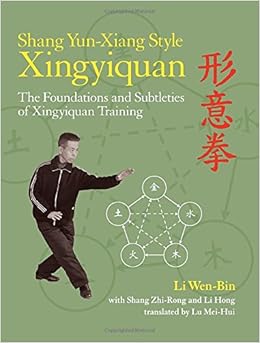
Xingyi Quan - Shang Yun-Xiang Style Xingyi Quan - Book Review


Shang Yun-Xiang Style Xingyiquan: The Foundations and Subtleties of Xingyiquan Training by Li Wen-Bin, translated by Lu Mei-Hui, is one of the few books in English on some of the deeper points of theory, practice and usage of Xingyi Quan (shape and mind boxing) Kung Fu available today. Shang Yun-Xiang was a student of famed master Li Cun Yi and founder of the Shang school of Xingyi Quan. His indoor students, Li Wen-Bin, Shang’s daughter Shang Zhi-Rong and Li’s son, Li Hong, have produced a very interesting book that lives up to its title “The Foundations and Subtleties of Xingyi Quan Training” by touching on, and adding depth too, a number of theoretical and practical areas of Xingyi practice. 

The opening section is about the history of Xingyi Quan and the meaning of the Xingyi Quan “classics” for the modern practitioner. An excellent high level overview of the history of Xingyi is included without the usual silliness about General Yue Fe, caves and lost scrolls. Perpetuating mythology is okay but it needs to be labeled as such, the facts are loose enough surrounding the origins and the players involved in the formation of Xingyi that increasing the confusion by adding mythological or non-related historical figures does not add to the art, or our understanding of it, in any way. By understanding the context and time these “classics” were written in and how and why their meaning has changed as Xingyi has matured and why they are still relevant are all addressed. The discussion of the Xingyi classics, their permutations over the centuries and their roll in modern Xingyi Quan alone is worth the price of the book.
The next section focuses on the stance requirements of the Shang Style. Shang style Xingyi Quan is a type of Hebei Xingyi Quan and, at a high level, uses many of the same training methods and requirements as other Hebei schools. The fascinating thing about this book is its discussion of the details specific to the Shang style discussed by high level, indoor, Shang style practitioners. Discussions of standing, weight distribution, hand position, internal power and their relation to the classics within the context of the Shang style are all touched on.
There are also a number of special topics or sections that may be of use to anyone practicing Hebei Xingyi Quan, a Li Cun Yi or Shang Yun-Xiang style, by discussing a number of variations of the five fists, weapons, Tuo Xing and Tai Xing from the Twelve Animals and San Ti Shi – Three Harmonies Postures to name a few.  The last third of the book covers the Wu Xing Quan (5 Elements Fist) and the Xingyi weapons, these sections provide less depth and detail and focus more on the forms illustrated in the book. This is where, if any where, this book falls short. I am not a fan of reproducing forms via pictures in books. That was useful in the 80’s and 90’s but I logged onto You Tube and in about five minutes I was watching Ms. Shang demonstrate the Wu Xing making the pictures less useful or necessary.
This is not a book for someone looking for a high level or general overview of Chinese Internal Martial Arts or Kung Fu. This book is targeted at an audience who has some connection, be it practical or academic, to Xingyi Quan in particular or Internal Martial Arts in general. That being said, this book is well worth the price, go buy it. 

Owen Schilling is a 20 year practitioner and teacher of Xingyi Quan, Bagua Zhang and Tai Chi Quan, a lineage holder in the Yi Zong School and the lead instructor at Boulder Internal Arts in Boulder, CO.

Thursday, July 26, 2012

A Good Read

If you are interested in the Chinese Internal Martial Arts read Jess O'brien's Nei Jia Quan. This excellent book contains numerous interviews with modern Internal Martial Arts Masters. I enjoyed his no bullshit approach and interviews of a wide variety of practitioners from a number of different Internal Martial Arts.


Boulder Internal Arts - Classes Ongoing in 2026

Although I don't post much here anymore. We are still training and teaching in Boulder, Colorado USA after 20 years!  Boulder Internal A...