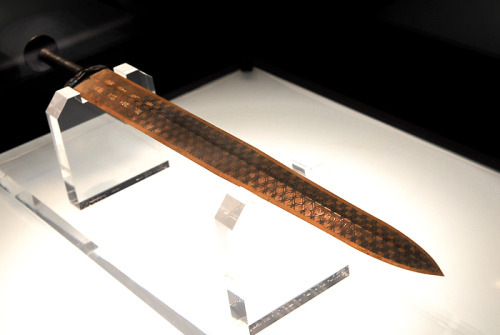
In ancient times, China had ten famous
swords. Accounts of the swords are often found in ancient books or
ancient legends, like the Records of the Grand Historian (Shiji), Lost History of Yue (Yuejueshu), Works of Lie Zi, and Annals of Wu and Yue.
Of the ten swords, some really existed in history, while some are
merely products of people’s imaginations. Nevertheless, Chinese sword
culture, as represented by the ten famous swords, symbolizes the Chinese
nation’s moral integrity and righteousness.
The sword of delicate elegance: Cheng Ying
It is said that Cheng Ying was a long
sword without a blade. Strangely enough, it projected a shadow upon the
wall in the dawn or the evening, when an alternation between daylight
and darkness occurred. This was the very sword appreciated by Lie Zi, as
was recorded in the Works of Lie Zi. It was made in the Shang
Dynasty (about 1600-1100 BC) and later owned by Kong Zhou, a man from
the State of Wei during the Spring and Autumn (770-476 BC). Cheng Ying
was a sword of delicate elegance.
The sword of majesty: Chun Jun
Chun Jun is a sword of majesty, and also
one possessed by Gou Jian, the King of the Yue State in the Spring and
Autumn Period. According to The Lost History of Yue, Gou Jian,
the King of Yue, once invited Xue Zhu, an expert at appreciating swords,
to come recognize and appreciate some valuable swords. Of all the
precious swords presented to him, Xue appreciated only one, called Chun
Jun. He advised the King not to exchange this sword with others even for
a combination of a thousand good horses, three rich towns, and two big
cities, reasoning that it was a unique joint creation of man and Heaven.
The King followed his advice and treasured it. Today the sword is kept
in the Hubei Provincial Museum.
The sword of bravery: Yu Chang
Yu Chang was a sword of bravery. According to the History of Assassins, a chapter of the Records of the Grand Historian, also known in English by the Chinese name Shiji,
when King Liao of the State of Wu, was enjoying some food served by
Zhuan Zhu, a cook dispatched to assassinate the king. Hardly had he
heard an eagle flying down to him when a sword came out from the fish he
was going to eat. With the sword, Zhuan Zhu wasted no time in pointing
it at King Liao. Although Liao’s well-trained guards protected him with
weapons, the sword still successfully reached him and stabbed into his
heart. Therefore, Yu Chang was a sword of bravery.
The swords of love: Gan Jiang and Mo Ye
Gan Jiang was the sword of a husband
named Gan Jiang; Mo Ye was the sword of his wife, named Mo Ye. Like the
inseparable couple, the two swords, one male and the other female, were
not able to be separated. The husband, Gan Jiang, a blacksmith, was
given a request to make a sword for the king. As the time of delivery
drew near, Gan Jiang got more worried, for his fire was still not hot
enough to forge the metal, and he feared he could not make the sword in
time. Having understood the reason for her husband’s distress, the wife
shed tears and knew that her husband would be executed if he could not
deliver the sword on schedule. She decided to save her husband by
throwing herself into the fire, thereby heating it enough to make the
sword. When the husband got to know what she intended to do, he could
not stop her, only to hear the wife saying, “we can meet again.”
After her wife’s death, the husband Gang
Jiang finally made two swords. He named the two swords Gan Jiang and Mo
Ye. Putting the sword Mo Ye aside for him, he gave the sword Gan Jiang
to the king. The news that Gan Jiang left the other sword for his own
use got to the ears of the king, who was outraged and decided to execute
him. “How can we unite?” asked Gan Jiang as he was being arrested. All
of a sudden, the Mo Ye sword turned into a beautiful dragon. Afterwards,
the Gan Jiang sword possessed by the king also disappeared.
Six hundred years later, in a remote
small town, the sword saw the dragon in the lake and immediately turned
into a dragon—and they united again! The next day, the people in the
town saw a new couple settle there. The husband was an excellent
blacksmith, who only made agricultural instruments for people while
steadfastly refusing to anyone, whether or not they asked, to make
valuable swords. When he was at work, his wife would cool him with a fan
and wipe sweat from his body. Therefore, Gan Jiang and Mo Ye were two
swords of love.
The sword of integrity: Qi Xing Long Yuan
Legend has it that this sword was the
joint work of two sword makers, Ou Yezi and Gan Jiang. In order to make
it, they brought stream water from Cishan Mountain to the seven ponds
around the sword-making fireplace. Because the seven ponds were shaped
like the seven stars of the Big Dipper, the sword was named Qi Xing
(seven stars). If you look down the sword, it looks ethereal and
profound, as if you are in a high position overlooking a valley where a
huge dragon lives, which is why the sword was also named Long Yuan (an
abyss with a dragon).
According to the Annals of Wu and Yue,
another factor that made this sword famous was a fisherman whose name
is unknown. He saved Wu Zixu’s life. In order to express his gratitude
to the fisherman, who refused to tell his name, Wu sent him the sword,
Qi Xing Long Yuan. The fisherman sighed and said, “I saved your life
because you are a loyal official of the country, not because I wanted
your reward. Now that you think I am a man longing for profits, I have
to show my nobleness with this sword.” With these words, he committed
suicide with the sword. Therefore, Qi Xing Long Yuan was a sword of
integrity.
The sword of prestige: Tai E
According to the Lost History of Yue,
the valuable sword Tai E was naturally made in the State of Chu. The
King of the State of Jin, which was the strongest state then, was not
happy about this and attempted to take possession of the sword by
invading Chu. Besieged by the troops of Jin, the King of Chu was told to
surrender and give the sword to Jin. Otherwise, his country would be
doomed the next day. Instead of giving out the sword, the King of Chu,
with the sword, led his army to defend his country.
It was a matter of minutes before Chu
would be wholly occupied by Jin. On the verge of defeat, the King of Chu
let out a long sigh and said to the sword: “Tai E, Tai E, today my
blood will be offered as a sacrifice to you.” With these words, he took
out the sword. The moment the blade was out, a miracle occurred: the
soldiers of Jin were frightened into disarray, and killed with no one
left alive. Surprised at this, the King of Chu asked: “Why was the sword
so powerful?” and an advisor told him that its magic power was drawn
from his own inner power—the courage to stand firm before a formidable
enemy. Tai E was thus a sword of prestige.
The sword of sovereignty: Chi Xiao
In the Qin Dynasty (221-207 BC), there
was a young man who liked to talk big. One day he got a rotten steel rod
and told people that it was a sword he got from an immortal living in
Nanshan Mountain, and named it Chi Xiao, always carrying his “sword.” He
also boasted that he was the incarnation of a red dragon from Heaven,
and that he had known Emperor Qin, who, according to him, was the
incarnation of a white dragon. He even said that the incarnation of the
Emperor had turned from a white dragon into a white snake wandering
around Feng Xize, claiming that he, with more magic power now than the
Emperor Qin, would replace him as the emperor.
People all around knew that he was a
braggart and did not believe his nonsense. However, people’s distrust
toward him changed after what happened one night. On that night, a few
dozen young people, including the braggart, carrying his sword, went to
the town of Feng Xize to do some apprentice work. On the way there, they
were confronted by a huge white snake. Terrified by it, no one dared to
move. It was the braggart who volunteered to kill the snake, chasing it
into the woods. The others waited for him to return, but he did not
come back that night. Finally, they returned home, believing that he had
become the supper of the snake.
The next day, people found the snake
killed and the young man lying nearby. His rotten steel rod had been
replaced by a glittering sword, with two characters on it reading: “Chi
Xiao.” Astounded by this scene, people realized that what the braggart
said was all true. The young man was Liu Bang, who later defeated
Emperor Qin and founded the Han Dynasty. The sword Chi Xiao was the one
he used to kill the snake and lead battles in his revolution against the
emperor. Hence, the white dragon was replaced by Liu’s red dragon, and
Chi Xiao became known as a sword of sovereignty.
The sword of kindness: Zhan Lu
Zhan Lu was more like a pair of eyes
than a sword. Black in color, the long, unmarked sword gave a sense of
kindness and benevolence, rather than sharpness. Like Heaven’s deep and
discernable eyes, the sword watched the behavior of kings. If a king had
moral integrity, then the sword would be with him and his country would
be prosperous; if the king didn’t have moral integrity, the sword would
leave him and his country would fall apart. Upon finishing the sword,
Ou Yezi could not help shedding tears, for he finally realized his
lifelong dream: casting an unparalleled strong sword without a murderous
appearance. Benevolence knows no enemy. Zhan Lu was a sword of
kindness.
The sword of divinity: Xuan Yuan
The sword Xuan Yuan was made for the
Yellow Emperor by immortals with copper from Shoushan Mountain, and
later passed on to Emperor Yu of the Xia Dynasty. On one side of the
blade were carved the sun, the moon, and the stars; on the other side
mountains, rivers, and trees. On one side of the handle, know-how of
farming and husbandry was recorded; on the other side, policies of
unification were described. Xuan Yuan was a sword of divinity.