Showing posts with label History. Show all posts

Thursday, July 2, 2020

History of Kung Fu Fighting


"Sanda 散打 is a Chinese combat sport that has been around since 1979. We're using the term Sanda to refer to the modern iteration of the sport. A similar term Sanshou 散手 is often used interchangeably with Sanda, but Sanshou is usually more broad in its application and can refer to more than just the combat sport of Chinese kickboxing, so we will use Sanda here. In this interview translation and analysis, we have one of the first Sanda fighters and the first Sanda National Team head coach talk about the founding of Sanda and some of its intricacies and initial challenges. This interview is mindblowing because it sheds some light on the influences of Sanda. We have one of the first Sanda fighters talking so candidly. The guy's name according to the video is Qian Ren Biao. "


THE RESPONSE FROM DAVID ROSS


"A history of kung fu fighting! NSW. The good, the bad and the ugly. Those who could fight, those who didn't fight, those who THOUGHT they could fight. 1954 Macau Chan Hak Fu vs Wu Kung Yi, Kung Fu vs Muay Thai matches 1921 to 1974, South East Asian Cup, Kuoshu Lei Tai in the 1920's and 1930's. Chang Dongsheng, Hong Yixiang, Chan Tai San, Wang Zi Qing, Zhao Dao Xin, Zhu Guo Lu. Truth is not black and white. There are no easy answers."

Saturday, June 18, 2016

Ming Dynasty Elite Guards 錦衣衛- Jinyiwei


FOUND HERE  - Dragons Armory web site 


Jinyiwei: Ming Elite Guards 錦衣衛 1. Bloodhounds


The Jinyiwei 锦衣卫, (literally "brocade clad guards)- were elite bodyguards and secret police that directly served the Ming Emperors. Functionally they were reminiscent of the Roman Praetorian Guards, and the Shinsengumi at the twilight of Japan's Tokugawa Shogunate. 

The Jinyiwei was founded by the Hongwu Emperor in 1368 to serve as his personal bodyguards and it developed into a military organisation the following year. They were authorized to overrule judicial proceedings in prosecutions, with full autonomy granted in arresting, interrogating and punishing anyone, including nobles and the emperor's relatives~ in time they would become synonymous with imperial assassins. 

The Jinyiwei were also tasked with collecting military intelligence on the enemy and participated in battle planning stages. A Jinyiwei is distinguished by his distinctive dragon embroidered uniform, an ivory tablet (非象牙腰牌) worn on his torso, and a special blade (繡春刀.)

A military official in court robes. Most of the guard captains would have worn similar attires~ 
including the hat of an mandarin official designating his rank. 

The Jinyiwei was created as a direct result of the centralized nature of Ming monarchy. The Hongwu Emperor, the progenitor of the dynasty had always felt that what had led to previous Chinese dynasty's decline was unchecked infighting, factionalism, and rampant corruption that fundamentally weakened the court from within. In every such cycle, the poor's plight were blocked from the supreme rulers of the land, the essential truths from the provinces were tampered with, the powerful factions would monopolize power while leaving the empire blind and misguided, ultimately culminating in the destruction of the empire. To prevent this, he must be assured that he can always pierce the veil of misinformation.


Details of the brocade robes worn by the guards~ Note that they were one of
the few group of people privileged enough to don golden robes (usually reserved for the
emperor himself and his family members) ~ and to have the sacred dragon emblems sown on
their uniforms. They had originally started as honor guards, but slowly became a 
secret police solely loyal to the emperor. At the end of the dynasty they were virtually 
a vast intelligence bureau of their own.

The Hongwu emperor had been born a peasant named Zhu YuanZhang and had lost both of his parents to famine in his infancy. When he was a child, China was still ruled by the mongol overlords~ who had by this point became both inept and tyrannical, often ignoring the famines in southern China that led to millions of deaths. In the emperor's youth he had lived a shockingly destitute existence, from a penniless beggar, to an urchin hooligan, until he ended up at the head of one of the many rebel armies sick and tired of the Mongol yoke. Thus when he finally ascended to the throne, he was fully aware of the cyclical plight of the lowborn and the threat of a bickering, lying court filled with privilidged officials' intrigue. 

The Jinyiwei walking directly before the emperor (off screen) in the procession

To him: if he does not lead at the front, forcing his dictatorial edits across the empire, he'd be letting the imperial power delegate itself out of existence, (as it had been for countless "soft" dynasties before him.) To do something that lasts, forge a dynasty that lasts, and have works for the peasants done "right," with constant supervision, he would need enforcers and informers. 

He needed a force directly loyal to him that could step in and exert imperial power~ whenever there are too many factions deadlocking policies or whenever there are too many contradictory reports from untrustworthy frontiers. The Jinyiwei would act and serve as his private eyes and ears and would pierce the cocoons of lies around the court to provide direct reports "for His Majesty's eyes only." 


Multiple views of the Jinyiwei uniform, the dragon robe, the sword and the cap

The earliest days of the Jinyiwei was just that, a loyal cohort of bodyguards~ similar to the Praetorian guards or the Ottoman Janisarries that fought regularly in the field in conjuncture with campaigns. When Zhu YuanZhang was still consolidating his power in the massive rebellion against the mongol emperors, the Jinyiwei served as his aides and defended him on his campaigns.

But over time, their roles and their numbers changed accordingly to the politics of the dynasty. After Zhu founded the Ming dynasty and became the Hongwu Emperor, he doubted his general's loyalties and was constantly on guard against possible rebellions and assassinations. One of the early duties of the Jinyiwei was to help the emperor spy on his ministers. The Hongwu Emperor increased the Jinyiwei's duties later, allowing them to inspect his officials at work in the capital city, before formally establishing the organisation in 1382, with about 500 members. Their numbers increased to around 14,000 in three years.


By now it had become amply clear they have became a corp of assassins and secret police that actively hunted down disloyal generals and suspected ministers in broad daylight. Their garrisons and barracks were soon expanded with prison cells and interrogation rooms. In time, their operation was given free reign to prosecute any officials on their own initiative within minimal imperial oversight. 

Over these years, they would be feared throughout the empire: for the modern reader~ their singular zeal to their master, their prosecution of all their master's enemies would conjure up images of the Tsar Ivan the Terrible's Oprichniks~ all dreaded bloodhounds sniffing after hidden foes. 


However, in 1393, after presiding two decades over their service, the Hongwu Emperor suddenly reduced the Jinyiwei's duties after they allegedly abused their authority during the investigation of a rebellion plot by Lan Yu, in which nearly 40,000 people were implicated and summarily executed. From then on, the guard corp languished under close imperial supervision. For the remainder of the Hongwu Emperor's reign they acted as little more than glorified policemen. 

Despite this reversal, in the chaotic decades to come, the Jinyiwei would rise again to new savage heights. 


Leap attack and draw slash with 繡春刀, there are a numbers of disagreements among
historians as to the exappearance of the blade, except the fact that it is curved. Some 
versions proposed a reminiscent of the curved sabers shown above in the Ming painting
while others point to the fact that the Ming records have described them with a 
long handle~ so long that it was described as a pole~

Two possible versions of the Jinyiwei saber, one possesses a longer handle.


To be continued in Part 2. 

Sunday, May 19, 2013

Hsing Yi Chuan - History Lesson - Guo Yunshen


Hsing I History 
Translated by Robert Brewer

Throughout the history of Hsing-I, Pa Kua and Tai Chi Chuan there have been many masters of legendary stature. The stories about them, while not always based in verifiable historical fact, are nonetheless important for what they tell us about the sp irit of each master's art, as well as giving us a wonderful glimpse of times and traditions of a bygone age.

Kuo Yun-Shen

                Kuo Yun-Shen's given name was Yu-Sheng. He was born in China's Hebei Province, in a town called Hsi Luo Ma Chuang. He was short in stature, standing only about shoulder-high to most men, but he was strong and healthy by nature. He is said to have been the best disciple to ever have studied under Master Li Luo-Neng. No matter when he fought, using Peng Chuan ("Crushing Fist"; one of the five elemental forms of Hsing-I) and its half-step he could fell any opponent. No-one could stand against his use of P eng Chuan, and he was known throughout the Empire as Ban Bu Peng Kuo; Kuo of the Half-Stepped Crushing-Fist.

Kuo was a violent man who loved to fight. Because of this, he committed not a few violent acts, as we will see below.

                 In the beginning, he wanted to study Hsing-I, and so went to pay his respects to the famous master Li Luo-Neng in hopes of becoming a student. However, Master Li despised his rough and violent nature, and refused to teach him. But with all his heart he wanted to study Hsing-I. So he disguised himself as a workman to be able to come and go in Master Li's house, and in his spare time practiced what he had seen Master Li teach.
At the time it so happened that Peng Chuan was very popular. So it was that Kuo studied this particular form with the utmost dedication. After diligently studying for three years, he had perfected Peng Chuan.

                 One day, Kuo again went to pay his respects to LiLuo-Neng, and showed him Peng Chuan as he had been practicing it. His style was in almost all aspects in accord with the principles of Hsing-I. When Master Li saw that his determination and dedication we re so great, he agreed to teach Kuo all of the secrets of Hsing-I.

                  Among the great masters of Hsing-I, there are more stories about Kuo Yun-Shen than any other. Kuo's strength was without equal. It didn't matter how his opponent attacked; at his first move with Peng Chuan, they would drop to the ground. It didn't matter how powerful the enemy he faced - he could easily defeat them all. There was a saying among the people: "Under all of Heaven, nothing may prevail against Peng Chuan" Kuo was the embodiment of this saying. Kuo was righteous in actions a nd truthful in speech. His disciples and succeeding generations in general all thought of him with the utmost veneration. In his later years he wrote a book called An Explanation of Hsing-I Chuan. Thanks to this book we have some taste of what kind of man he was.

The following are just a few of the stories concerning him...

"The Tiger Fist"
                   According to Master Wang Shu-Jin, one day Kuo Yun-Shen was sparring with a master of another style. In the course of the fight he was too forceful in his use of Peng Chuan; his opponent began to spit blood, and died. Because of this, Kuo was sent to prison. After three years he was finally released. One of the top students of the Master he had killed came and declared his intention to avenge his teacher's death, inviting Kuo to compete with him. People knew that for the three years he had been in prison, Kuo had been manacled hand and foot, unable to move with much freedom, and so unable to fully practice his art. All thought that his health was probably weakened, and his vehemence doubtless dimi nished from its former state. His opponent was undoubtedly taking advantage of all this to get his revenge.
                  As soon as they crossed arms, however, Kuo struck violently with both fists, and his opponent was actually thrown back some fifteen to twenty feet and collapsed. It was very obvious that everybody was mistaken in their belief. During the time that he w as in prison, even though Kuo Yun-Shen did not have complete freedom of movement, he thought incessantly about his fighting style; although his hands were chained, borrowing from Hu Hsing Hsing-I's Tiger Form) he was able to come up with a new hand style. Morning and night he developed and practiced his "Tiger Striking Hand".
There exists yet another version of this same story, told in A Biographical Sketch of Master Kuo.
                   Kuo Yun-Shen was appointed as warden of Shen County. When he went to take over his post, the county magistrate presented him with money and gifts in recognition of his achievements. Because of this he drew the ill-will of the local bandits, who took every opportunity to make trouble for him.
                  One day, Kuo found himself face-to-face with a sword-brandishing brigand. He easily took the sword from him, and using it to return the attack hacked him to death. The penalty for killing a man was very severe, and Kuo found himself facing this penalty . But the county magistrate was fond of Kuo and so lightened his sentence to only three years imprisonment.
                  When the day for his release arrived, Magistrate Ch'ien asked, "Have you lost your kung-fu?" Kuo Yun-Shen declared "Absolutely not." His glance happened to fall on the courtyard wall. He struck it with his "Tiger Fist", and with just this one blow, the wall collapsed in a thunderous roar. For the three years that he was in prison, even though manacled, he found a way to practice, and created his "Tiger Fist". For this reason, his fame shines even today.

"Battle with the Shaolin Priest"

                  In an unnamed temple at the end of Steel Alley in Beijing, there lived a priest whose strength was without equal. It was said that he could lift a stone lion weighing 600 jin. He had wanted very much to study Hsing-I Chuan, but was refused as a student; instead he studied the Shaolin style. His skill was known far and wide. Everyone thought that someone this skillful and powerful would be able to defeat a Hsing-I practitioner with one blow. In order to prove this, the priest went to Beijing.
                At that time, Liu Ch'i-Lan's chief student, Li Tsun-I had established a studio in Deck Alley. He accepted the priest's challenge, and was defeated. Thinking of the disgrace this must surely bring to Hsing-I Chuan, he asked Kuo Yun-Shen to face the chal lenge.
Kuo Yun-Shen stepped up and began to demonstrate his Peng Chuan. Advancing with the half-step, he attacked the Shaolin priest. The priest flew back some ten feet and fell at the base of a wall. "Come try again", Kuo said. The priest came forward and Ku o advanced again, adding even more strength and ferocity to his half-step, and again attacked with Peng Chuan. He hit him in the chest so hard that he hurt the ribs in the priest's back, leaving him in such pain that he was unable to stand.
               Kuo pulled some medicine from within the folds of his robe, saying "Take this medicine, Priest, and after you apply it rest gently while you heal." He then walked away. The next day, this Shaolin priest prepared lavish gifts and went to pay his respect s to Kuo Yun-Shen, acknowledging him as a teacher.
                Later, Kuo Yun-Shen was heard to say, "When I first saw the priest, I could tell that he had potential, was teachable. Because of this, I only used the Chi from my lungs to steal the strength from his; this was curable with medicine. Had I used Chi from my kidneys to sap the strength in his arms, he would have never recovered." The listening crowd all clamored their approval.

"Kuo Yun-Shen and Tung Hai Chuan"

                At the time, there was a Pa-Kua practitioner named Tung Hai-Chuan, whose skill was renowned. Kuo went to pay his respects to Tung Hai-Chuan, asking that they compare skill in fighting. They fought for three days and three nights without rest, neither g aining a clear advantage over the other. Later, when. talking together, they discovered that there were many similarities in the underlying Theories behind their two respective styles, and so decided to combine both into one school; those who studied Hsin g-I must study Pa-Kua, and those who studied Pa-Kua must study Hsing-I.
                So the disciples of Li Tsun-I and Tung Hai-Chuan worked with Masters Kuo and Tung to combine Hsing-I and Pa-Kua into one school. This feat was something that no ordinary person could have accomplished: only Masters Kuo and Tung could have brought it ab out. And in fact even to this day, the tradition remains unchanged.
Found HERE

Tuesday, February 5, 2013

Sword Seller

"This is a late 19th century stereoscopic image of a junk seller at a market place. Note the swords on the left side of the image. Cards like this were commonly bought and collected at the turn of the century. When looked at through a special viewer with a different lens for each eye, the customer could see a single three dimensional image."
Find the rest of the article: Here

Sunday, February 3, 2013

Ten Famous Swords in China's Ancient Times


In ancient times, China had ten famous swords. Accounts of the swords are often found in ancient books or ancient legends, like the Records of the Grand Historian (Shiji), Lost History of Yue (Yuejueshu), Works of Lie Zi, and Annals of Wu and Yue. Of the ten swords, some really existed in history, while some are merely products of people’s imaginations. Nevertheless, Chinese sword culture, as represented by the ten famous swords, symbolizes the Chinese nation’s moral integrity and righteousness.
The sword of delicate elegance: Cheng Ying

It is said that Cheng Ying was a long sword without a blade. Strangely enough, it projected a shadow upon the wall in the dawn or the evening, when an alternation between daylight and darkness occurred. This was the very sword appreciated by Lie Zi, as was recorded in the Works of Lie Zi. It was made in the Shang Dynasty (about 1600-1100 BC) and later owned by Kong Zhou, a man from the State of Wei during the Spring and Autumn (770-476 BC). Cheng Ying was a sword of delicate elegance.
The sword of majesty: Chun Jun

Chun Jun is a sword of majesty, and also one possessed by Gou Jian, the King of the Yue State in the Spring and Autumn Period. According to The Lost History of Yue, Gou Jian, the King of Yue, once invited Xue Zhu, an expert at appreciating swords, to come recognize and appreciate some valuable swords. Of all the precious swords presented to him, Xue appreciated only one, called Chun Jun. He advised the King not to exchange this sword with others even for a combination of a thousand good horses, three rich towns, and two big cities, reasoning that it was a unique joint creation of man and Heaven. The King followed his advice and treasured it. Today the sword is kept in the Hubei Provincial Museum.
The sword of bravery: Yu Chang

Yu Chang was a sword of bravery. According to the History of Assassins, a chapter of the Records of the Grand Historian, also known in English by the Chinese name Shiji, when King Liao of the State of Wu, was enjoying some food served by Zhuan Zhu, a cook dispatched to assassinate the king. Hardly had he heard an eagle flying down to him when a sword came out from the fish he was going to eat. With the sword, Zhuan Zhu wasted no time in pointing it at King Liao. Although Liao’s well-trained guards protected him with weapons, the sword still successfully reached him and stabbed into his heart. Therefore, Yu Chang was a sword of bravery.
The swords of love: Gan Jiang and Mo Ye
Gan Jiang was the sword of a husband named Gan Jiang; Mo Ye was the sword of his wife, named Mo Ye. Like the inseparable couple, the two swords, one male and the other female, were not able to be separated. The husband, Gan Jiang, a blacksmith, was given a request to make a sword for the king. As the time of delivery drew near, Gan Jiang got more worried, for his fire was still not hot enough to forge the metal, and he feared he could not make the sword in time. Having understood the reason for her husband’s distress, the wife shed tears and knew that her husband would be executed if he could not deliver the sword on schedule. She decided to save her husband by throwing herself into the fire, thereby heating it enough to make the sword. When the husband got to know what she intended to do, he could not stop her, only to hear the wife saying, “we can meet again.”
After her wife’s death, the husband Gang Jiang finally made two swords. He named the two swords Gan Jiang and Mo Ye. Putting the sword Mo Ye aside for him, he gave the sword Gan Jiang to the king. The news that Gan Jiang left the other sword for his own use got to the ears of the king, who was outraged and decided to execute him. “How can we unite?” asked Gan Jiang as he was being arrested. All of a sudden, the Mo Ye sword turned into a beautiful dragon. Afterwards, the Gan Jiang sword possessed by the king also disappeared.
Six hundred years later, in a remote small town, the sword saw the dragon in the lake and immediately turned into a dragon—and they united again! The next day, the people in the town saw a new couple settle there. The husband was an excellent blacksmith, who only made agricultural instruments for people while steadfastly refusing to anyone, whether or not they asked, to make valuable swords. When he was at work, his wife would cool him with a fan and wipe sweat from his body. Therefore, Gan Jiang and Mo Ye were two swords of love.
The sword of integrity: Qi Xing Long Yuan

Legend has it that this sword was the joint work of two sword makers, Ou Yezi and Gan Jiang. In order to make it, they brought stream water from Cishan Mountain to the seven ponds around the sword-making fireplace. Because the seven ponds were shaped like the seven stars of the Big Dipper, the sword was named Qi Xing (seven stars). If you look down the sword, it looks ethereal and profound, as if you are in a high position overlooking a valley where a huge dragon lives, which is why the sword was also named Long Yuan (an abyss with a dragon).
According to the Annals of Wu and Yue, another factor that made this sword famous was a fisherman whose name is unknown. He saved Wu Zixu’s life. In order to express his gratitude to the fisherman, who refused to tell his name, Wu sent him the sword, Qi Xing Long Yuan. The fisherman sighed and said, “I saved your life because you are a loyal official of the country, not because I wanted your reward. Now that you think I am a man longing for profits, I have to show my nobleness with this sword.” With these words, he committed suicide with the sword. Therefore, Qi Xing Long Yuan was a sword of integrity.
The sword of prestige: Tai E

According to the Lost History of Yue, the valuable sword Tai E was naturally made in the State of Chu. The King of the State of Jin, which was the strongest state then, was not happy about this and attempted to take possession of the sword by invading Chu. Besieged by the troops of Jin, the King of Chu was told to surrender and give the sword to Jin. Otherwise, his country would be doomed the next day. Instead of giving out the sword, the King of Chu, with the sword, led his army to defend his country.
It was a matter of minutes before Chu would be wholly occupied by Jin. On the verge of defeat, the King of Chu let out a long sigh and said to the sword: “Tai E, Tai E, today my blood will be offered as a sacrifice to you.” With these words, he took out the sword. The moment the blade was out, a miracle occurred: the soldiers of Jin were frightened into disarray, and killed with no one left alive. Surprised at this, the King of Chu asked: “Why was the sword so powerful?” and an advisor told him that its magic power was drawn from his own inner power—the courage to stand firm before a formidable enemy. Tai E was thus a sword of prestige.
The sword of sovereignty: Chi Xiao

In the Qin Dynasty (221-207 BC), there was a young man who liked to talk big. One day he got a rotten steel rod and told people that it was a sword he got from an immortal living in Nanshan Mountain, and named it Chi Xiao, always carrying his “sword.” He also boasted that he was the incarnation of a red dragon from Heaven, and that he had known Emperor Qin, who, according to him, was the incarnation of a white dragon. He even said that the incarnation of the Emperor had turned from a white dragon into a white snake wandering around Feng Xize, claiming that he, with more magic power now than the Emperor Qin, would replace him as the emperor.
People all around knew that he was a braggart and did not believe his nonsense. However, people’s distrust toward him changed after what happened one night. On that night, a few dozen young people, including the braggart, carrying his sword, went to the town of Feng Xize to do some apprentice work. On the way there, they were confronted by a huge white snake. Terrified by it, no one dared to move. It was the braggart who volunteered to kill the snake, chasing it into the woods. The others waited for him to return, but he did not come back that night. Finally, they returned home, believing that he had become the supper of the snake.
The next day, people found the snake killed and the young man lying nearby. His rotten steel rod had been replaced by a glittering sword, with two characters on it reading: “Chi Xiao.” Astounded by this scene, people realized that what the braggart said was all true. The young man was Liu Bang, who later defeated Emperor Qin and founded the Han Dynasty. The sword Chi Xiao was the one he used to kill the snake and lead battles in his revolution against the emperor. Hence, the white dragon was replaced by Liu’s red dragon, and Chi Xiao became known as a sword of sovereignty.
The sword of kindness: Zhan Lu

Zhan Lu was more like a pair of eyes than a sword. Black in color, the long, unmarked sword gave a sense of kindness and benevolence, rather than sharpness. Like Heaven’s deep and discernable eyes, the sword watched the behavior of kings. If a king had moral integrity, then the sword would be with him and his country would be prosperous; if the king didn’t have moral integrity, the sword would leave him and his country would fall apart. Upon finishing the sword, Ou Yezi could not help shedding tears, for he finally realized his lifelong dream: casting an unparalleled strong sword without a murderous appearance. Benevolence knows no enemy. Zhan Lu was a sword of kindness.
The sword of divinity: Xuan Yuan

The sword Xuan Yuan was made for the Yellow Emperor by immortals with copper from Shoushan Mountain, and later passed on to Emperor Yu of the Xia Dynasty. On one side of the blade were carved the sun, the moon, and the stars; on the other side mountains, rivers, and trees. On one side of the handle, know-how of farming and husbandry was recorded; on the other side, policies of unification were described. Xuan Yuan was a sword of divinity.
By Yang Ping found here


Tuesday, December 11, 2012

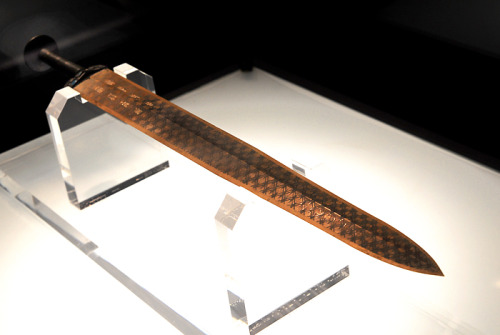
Sword of Goujian


The Sword of Goujian,
Unearthed by Chinese Archeologists in 1965, the Sword of Guijan is an ancient bronze sword dating to the Spring and Autumn period of Chinese history (771 to 403 BCE).  The most amazing aspects of this sword are its beautiful etchings and its state of preservation.  After over 2,500 years the sword has no corrosion or tarnish and is still razor sharp.  Scientists theorize that its preservation was due to a special alloy of bronze containing copper, tin, lead, iron, arsenic, and sulfur. It was also contained within a well crafted airtight scabbard.  Today the Sword Guijian can be found at the Hubei Provincial Museum.

Wednesday, October 10, 2012

Legend of Tea

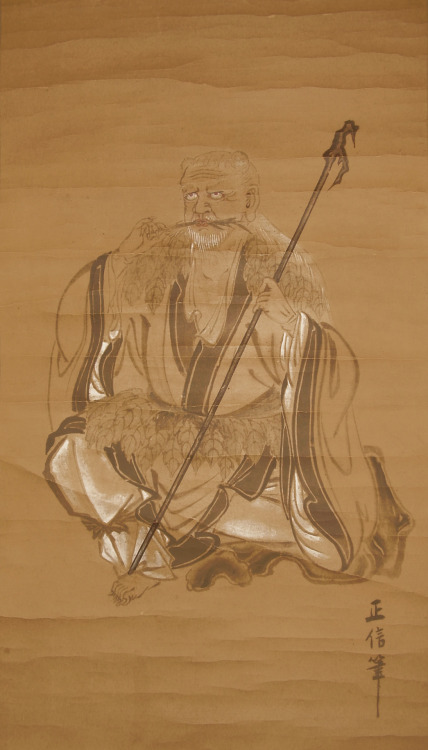
"In one popular Chinese legend, Shennong, the legendary Emperor of China and inventor of agriculture and Chinese medicine was drinking a bowl of just boiled water some time around 2737 BC when a few leaves were blown from a nearby tree into his water, changing the color. The emperor took a sip of the brew and was pleasantly surprised by its flavor and restorative properties. A variant of the legend tells that the emperor tested the medical properties of various herbs on himself, some of them poisonous, and found tea to work as an antidote." collective-history.tumblr.com

Friday, January 13, 2012

Gao Bagua Article Now Online!

Here is a link to an older article written by the Tang Sho Tao School about their Gao Style Bagua and its history. Enjoy.

Lui Feng Cai's Gao Style Bagua

Monday, January 2, 2012

Tang Sho Tao and Xu Hong Ji Remembered

Gan Hsin - My Teacher, My Mentor, My Friend - By: Shr Fu Mike Patterson


I am frequently asked, by a variety of individuals, to share tales and stories of my teacher, Hsu Hong Chi, and my days on Taiwan.

The difficulty lies not in the telling of such tales, for there are so many accumulated over those fifteen years of knowing and learning from the man, but in which excerpts to pick. What snapshots to show someone in an attempt to illustrate such a multifaceted and, to me, larger than life human being. It seems so futile a method of communication, when attempting to describe such a beautiful spirit. Like showing someone a slide of the Grand Canyon. The picture cannot begin to compare to the experience of being there, involved with and awed by the moment(s) of direct interaction.


When I first met Master Hsu, he was standing outside of a movie theatre in Shi Men Ting, the shopping district of Downtown Taipei city. It just so happened that I had arrived on an afternoon where there had been arranged a screening of his first Kung Fu movie titled "Major Brother." It was a private screening, arranged solely for his students and close friends.
I remember thinking to myself, "This is a Kung Fu Master"? Where are the Dragon and Tiger brands on the forearms, the bald head, the bulging muscles? My Kung fu experience to date having been only with David Carradines original series, I was expecting these things. I was disappointed to say the least.

Seeing the movie, however, went along way toward restoring my dwindled faith in my future teacher. It was good. And he was great. My thirteen year old awareness had been vindicated, temporarily. However, I was still skeptical. After all, I had studied Karate, and Judo. I knew about the Martial Arts. (not)

The next day in the School, off of Chung Shan North Road in downtown Taipei, not far from the famous Grand Hotel, I had my formal introduction to the Master. He knew about my limited experience in Martial Arts by way of my father. He walked directly up to me and said in his broken English, "So, you before study Karate, Judo, eh?" I nodded, and he continued. "So, you understanda power, eh?" This he said while executing a couple of Karate-like reverse punches, exaggerating the rotation of the hips and the extension of the rear leg for mechanical force. "Yes, yes!" I said excitedly. "That is what I learned before!" I had a warm feeling that the master had acknowledged that what I did was correct. That feeling lasted about five seconds. "This nota true power." he said, bursting by bubble of euphoria. "Come here. I show you true power."

He led me to the middle of the floor and turned me so that my back was oriented toward the far wall where there were rows of tatami (woven straw mats about two inches thick) mounted to the wall. I had silently wondered what purpose these pads on the wall would have when I had seen them earlier that night. I was about to find out. The master told me to prepare myself so that I would not be harmed, by closing my teeth tightly and bracing my neck and spine muscularly. "Watch," he said. And I watched as he lightly placed both his hands on my chest. Then, it seemed to me, that he sort of effortlessly flicked his wrists and I was suddenly airborne. I was literally hurled completely across the room and slammed into the tatami, their purpose now registering vaguely on my rattled awareness. I was unable to understand how a human being could generate so much power with so small a movement. It seemed to defy all logic and normal mechanics. It truly seemed like magic. And I resolved then and there that I had to stay with the man until I learned how he did that to me. Thus began a relationship that spanned nearly fifteen years.

It was not always easy in the beginning. The training consisted of Tien Kan (Heavenly Stem Linear Pa Kua) in sufficient repetition to drive the point home, 25 each side of each of the 24 exercises to warm up, interspersed with 200-300 pushups of various types, crane dips (a one-legged knee bend), and standing meditation. This was followed by tumbling and floor-work exercises, kicking drills, push hands, and sometimes sparring. Very little technique was ever taught in the classes, which lasted from 8-10 p.m. nightly. If you wished to learn techniques, you had to be inner door.

By the time I arrived on Taiwan, my father and Hsu Hong Chi had become very close, and my father was his top American Student at that time. Therefore, I was allowed in on his good graces. (Besides, he was my ride, I couldn't get home without him.) To say that I was extremely lucky, in this regard, would be a gross understatement. I have often counted my blessings.

If allowed, you stayed until sometimes as late as 2 a.m. in the morning and this is when Master Hsu taught other things. Amazing things sometimes. He told many stories in the wee hours about a vast panorama of subject matter and he would punctuate lessons with physical and martial narrative and this is when the best techniques would come out.

Master Hsu could be a harsh man at times, in those days. When I first "pushed hands" with my teacher, I had little or no skill and as such suffered all of the problems that a new student faces in trying to perform the exercise properly. I was too stiff and I continuously floated my elbows too high. My teacher pointed this out right away, "No lift elbow up, riba open, understan?" He said. I did not understand until a few moments later when WHAM! Down came his right fingertips across my left ribs. I felt like I had been whipped with four steel rods. "I told you, no lift elbow, understan?" Being thus stimulated, I thought I really had the idea now. But, WHAM! Again the steel rods came snaking down through my left ribs. And again, the soft voice, "Elbow must no up, understanduh?" I never lifted my elbows again during push hands, EVER. "Pain good teacher." Master Hsu would always say. "You have pain, you learn to MOVE, quick!"


Another time, when I was a Green Belt, a student questioned Master Hsu about the power of Pi Chuan (Splitting). It seemed that he could not derive any power from the movement so he felt it invalid. I must confess, I was having difficulty myself, but by this time I had acquired a healthy respect (and fear) for my teacher's hand. Hence, I did not ask too many questions that I felt might result in a direct demonstration. Preferring, rather to observe the effects of his power clinically.. from a distance.., on another pupil. I swear that sometimes my teacher was psychic. "Syau Mike!" "Lai, Lai!" (which means come here, but to me it meant oh no) I walked dutifully over to him. "Punch!" he commanded... I knew my teacher well enough by now to know that when given such an order, he meant it. And he meant it in the most sincere way. So I launched a well rooted Peng Chuan (Crushing fist) at his heart.

In a surrealistic fashion I watched as my teachers hands descended in a blur toward my right arm. He lightly hooked only his pinkies on my arm, one at the inner wrist, and the other at the outer elbow, and with a 'loud CRACK, promptly dislocated my shoulder. This happened with less than six inches of movement on his part. I immediately hit the floor. Both from the force of the blow and the pain it caused.

Without even a moment's hesitation, Master Hsu jumped down next to me, sat me up, and promptly realigned the same dislocated shoulder with another, less painful crack. Then, after seeing that I was fine, he turned to the other pupil who had asked the question in the first place, and asked, "Understand?"

I learned both how to dislocate and relocate a shoulder on the same day. What about the other pupil, you might ask? Well, he learned his own lessons. My teacher always taught on several levels at once. Everyone involved with the lesson learned something, each according to his/her own level. And he had this frightening (sometimes) ability to look into your innermost hidden thoughts and expose you to yourself, saying Look! This is what you are! I remember once, at a seminar at my house in Lakeside, California, one of the second generation pupils was asked a direct question to test his heart concerning how much money he had left in his wallet. The man began fanning the apparently pitiful amount of money he had in his wallet and attempting to count it. Suddenly, Master Hsu snatched the wallet out of his hand and started thumbing out a bunch of big bills from deeper in the wallet, opened secret panels in the wallet to reveal other big bills all the while saying "Oh. not too much money eh? Oh, Oh!" all the while laughing and giggling. Sometimes people left as a result of his penetrating insight, but if they listened to what he was trying to tell them, they generally profited from his attempt to guide them.

Master Hsu had a tremendous dedication to his pupils. He sincerely believed in trying to teach something to everyone, no matter how minimal his interaction with them. I remember a time when upon leaving a demonstration at a Chinese Military base, a belligerent M.P. questioned validity of what we had demonstrated. He specifically taunted Master Hsu about the "Iron Body" demonstrations, saying that he did not believe that it was possible and casting aspersions or Chinese Kung Fu in general. Master Hsu dearly loved his Art and he could see the bully mentality in the M.P., so he casually invited the M.P. to strike the Black Belt of his choice as many times as he desired to quell his doubts. The M.P. chose Ah Huan, the smallest of us all (105 lbs.) My teacher, always the showman, did his best to egg the bully on, saying things like "Come on my grandma can hit harder than that." When the bully was sufficiently aroused and literally pounding on Ah Huan's body, Master Hsu gave Ah Huan the "High Sign" meaning to give the man "a lesson." On the next blow, the belligerent M.P. broke his wrist while punching Ah Huan in the stomach. As the M.P. knelt there on the road howling in despair, my teacher sidled up to him and said in a low, calm voice; "Now you believe, eh." Then he turned, as did we, and walked away.

I wish to emphasize at this point that my teacher was not as harsh as he was fair. It took awhile to see that. But the longer you were around the man, the more apparent this fact became. He just had very strongly etched way of looking at things. He used to say that he hated deceit. He would say, "I like everything cut and dried! I no like back door style!"

I once saw a man crippled with a spinal problem. The man had been to all the specialists according to his own words. But, alas! He had had no results. A pupil brought the man to Master Hsu. He had only heard of my teacher (nicknamed Magic Hands) by his pupils and hoped that he might find help. He had very little money. My teacher asked him some cursory questions about his injury and then said, "Okay. You give me two dollah, give Temple, I fix you." "Hou bu Hou?" (okay not okay) The man complied willingly. My teacher gently worked on this man's back. Ten minutes later he was pain free.

Another time, a man came to my teacher because of a chronic jaw dislocation. The man was very rich, liked everyone to know it, and had a $100.00 bill sticking out of his shirt pocket. My teacher asked him, "How much you pay?" The man said, "I have a $100.00." My teacher, knowing the man was trying to buy him, and resenting the man's perspective, gave him a swift slap on the right side of his jaw, and took the money from his pocket in one smooth movement, saying "Okay, fix now." as he did it. The jaw was indeed fixed, and so had been the man.

I saw my teacher give of himself and his medicinal skills on countless occasions on Taiwan. I never saw him turn anyone away, nor did I ever see him fail to help someone.

He used to say that to learn to fight, to hurt people was easy. Anyone could learn this in two to three years. But, to learn such skills is to become obligated to learn to help also. He used to say "If know enough to take life, must know enough to save life." "That is true mastery." "Any less you only practice Kung Fu, no master yet."

I was one of the few "round eyes" fortunate enough to learn Master Hsu's Tui-Na Bone Setting Skills. He used to teach by direct experience. A student would be injured, and barring any emergency, he would call me over. "Syau Mike, Lai." Then he would demonstrate what he wanted me to do on me, so that I could feel the technique. "Lai, Lai, okay now you fix." he would say... Yeah, right I would think. "No worry." he would say. "You mistake, I fix" he would wink. "Try, Try." He would urge. And so I would.

His fighting philosophy was direct, like the man. "Danger? Go!" he used to say while we were engaged in sparring practice. His great tactical knowledge was impressive to say the least. One time, a student was called up so that Shr Fu would be able to demonstrate the pyan (changing angles) attack of Pa Kua. The student described later how he was very excited at one point because he thought he was actually going to strike Shr Fu, and suddenly Master Hsu was behind him tapping him on the shoulder.

He was also very big on proper etiquette. My teacher's desk had a number of chairs around it arranged from nearer him to further away. I had many times as a young student in the school witnessed the game of musical chairs that the elder students played every time one of them walked in. You see, it was the tradition that the eldest present sit next to the Master. And then the next eldest, and so forth. Much like you see in traditional kung fu family photos, with the eldest next to the master, on the near right, and the next on the nearest left, and then alternate back and forth until all are seated, with the youngest students sitting the furthest away.

And so one day, Mr. Heh did not get up and move when Mr. Lai, his senior, came in to the room. This caused Mr. Lai (known for his Iron Palm) to anger and strike Mr. Heh most strongly. Mr. Heh went down gasping for air. This caused Master Hsu's son, Hong Yi, to run upstairs to get his father. Moments later, we heard Master Hsu's flip flops coming quickly down the stairs. He ran right over to Mr. Heh and began to resuscitate him. After the crises, was abated, and Mr. Heh was alright with breathing normal, he rebuked Mr. Lai lightly for losing his temper to such a degree. But then he really got angry at Mr. Heh for not paying proper respect to an elder brother under his tutelage. This was very important.

Master Hsu's perspective of the Student/Teacher relationship can best be summed up in his own words: "You like study, I like teach. As long as you like study, I like teach. You no like study? Who lose? I lose? I no think so. I already know." I firmly believe that. And I feel very fortunate to have had the opportunity and good fortune to have studied with such an extraordinary man for nearly 15 years of my life. I will carry him with me for the rest of my days.

Re-Blogged from Hsingi.Com

Boulder Internal Arts - Classes Ongoing in 2026

Although I don't post much here anymore. We are still training and teaching in Boulder, Colorado USA after 20 years!  Boulder Internal A...