Showing posts with label China. Show all posts

Saturday, May 30, 2020

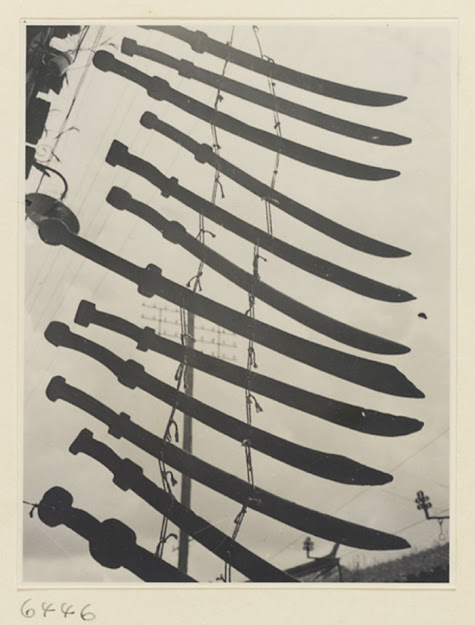
China - 1913 Sword Competition - Scott Rodell

China - 1913 Sword Competition - Scott Rodell


當時,傳統的鑄劍用的是毛鐵夾鋼
沈庭璋為了參加縣里的大賽,特地用全鋼鑄造了一把寶劍
寶劍既鋒利又漂亮,能輕鬆斬斷三枚銅板,並將對手所鑄之劍斬為二截
奪得了第一名,被舉為“劍魁”
知縣贈予沈庭璋‘沈廣隆劍鋪’的墨寶
墨寶做成了牌匾,至今仍掛在劍鋪門前

At that time, the traditional swords were made of iron and steel
In order to participate in the county competition, (swordsmith) Shen Tingzhang forged a special. This sword was sharp and beautiful, easily cutting through three copper plates, swords made by other contestants cut through two pieces.
Shen won first place, being was named "Jian Kui.”

Translation by Scott Rodell

Found HERE 

Friday, September 8, 2017

Man with Hook Sickle Spear


                                                        Man with Hook Sickle Spear

Saturday, February 4, 2017

Ming Sword

To celebrate the Chinese New Year and Spring Festival, and to kick-off our Eastern Warriors: China theme for February half-term, the Ming sword has been chosen as February’s Object of the Month by Natasha Bennett, Acting Curator of Oriental Collections.

The Ming Sword

This sword is one of the greatest treasures in the Oriental Collection at the Royal Armouries. It is heralded as one of the most beautiful, detailed, and intricate examples of ornate metalwork still in existence from the early Ming period. It is particularly precious because armour and weapons from the time of the Ming dynasty (1368 to 1644) rarely survive. The name ‘Ming’ was adopted as a dynastic title because it means ‘bright’ or ‘shining’, and this stunning sword certainly lives up to that association.

A Sword can mean many things…
Chinese swords tended to fall into two main types; the straight, double-edged jian, and the single-edged dao. By the time of the Ming era, the dao dominated as the practical choice for both military and civilian use, but the more archaic jian retained great significance as a symbolic object. It could be used to demonstrate social and professional rank, respect, power, wealth, favour, and artistic taste. Swords such as this played an important role in courtly culture and diplomacy, helping to forge and even sever links through the processes of gift-giving or intimidation.
This particular sword is clearly a high-status object. The hilt and scabbard are richly ornamented in gold, silver and semi-precious stones. The three-dimensional monster-mask forming the guard is exquisitely worked with its flaming, curling mane and jaws which seem to clamp around the top of the blade. Sinuous, beautifully detailed dragons furl within cartouches on the pommel and scabbard.
At either side of the pommel are the Eight Buddhist Emblems of Good Augury (‘ba jixiang’): the wheel of law, the standard, the treasure jar, the pair of fish, the endless knot, the lotus, the parasol, and the conch shell of victory. The Sanskrit inscription halfway down the scabbard has been translated by specialists in the past as ‘Honorific Sword’ or ‘Precious Sword’; this could be a reference to Buddhist symbolism and the jewels or emblems associated with monarchy.

Tibetan Buddhism had become established in China during the Mongol Yuan dynasty (1279–1367) and became further entrenched during the early Ming period.
Features of the decoration present on the hilt and scabbard are closely aligned with the ornamentation of other iron ritual objects which were commissioned by the early Ming emperors to send as gifts to one or other of the great Tibetan monasteries.
It is therefore highly likely that this sword was produced in the court workshops of the Yongle emperor (1403–24). Moreover, the sword suggests distinct Tibetan influence in its overall form, and the pattern-welded blade is probably a later replacement which seems to be of Tibetan manufacture. It may well have been bestowed on an allied Tibetan ruler to promote diplomatic relations, or presented to a powerful monastery to gain favour. Alternatively, it may have been made for the Yongle emperor himself.

FOUND HERE

Thursday, February 2, 2017

Myths about Chinese Swordsmanship - Scott M Rodell

Myths about Chinese swordsmanship


Chinese jian with dual rows of huawen

Damascus steel with lamelae of twists running obliquely toward the point on
either side of the median ridge.

Preface

There are many widely-held misconceptions about Chinese swords. I have
selected five of the most commonly repeated. I will attempt to dispel them.
Most of the stories have been passed down from generation-to-generation
by the Chinese themselves. These stories are based on “fairy-tales”.
Indeed, frequently these stories are repeated by people who have never handled
an antique sword and who know nothing about Chinese swords, or about metallurgy
or about the art of the swordsmith.

Misconception 1:
The Chinese carried “Belt Swords” which they wore around their waists

Tales of whip-like ‘belt’ swords are nonsense and show an ignorance of
metallurgy and battlefield combat. Whatever “belt swords” may have
existed (and the collecting and museum community have yet to see a single
authentic one) would have only been useful as an assassin’s weapon used to
slash an unsuspecting victim. There is no way to combine the three important
sword qualities in a flimsy, whip-like blade. An overly flexible sword would
lack the structural integrity to thrust or cut with accuracy and control or to
effectively deflect a blow from even a stick, never mind a larger weapon like
a spear, halberd, glaive, or fauchard. Only a fool of a swordsman would want
to meet an irate farmer swinging a chunk of 2X4 with a thin, flimsy jian.

Misconception 2:
There is a special taiji jian designed specifically for this art

Today jian are commonly referred to as “taiji swords”
in martial arts equipment catalogs and by the general public. This implies
there is a jian tailored especially for the art of taiji jian.
Aside from the fact that what makes a good sword tends to apply universally
to everyone, the principles discussed above allow for only slight variations
in possible serviceable variations.
Historically in China, there were just never enough taiji jian
practitioners to form a market to which sword smiths could cater.
Before Yang Luchan brought taijiquan to Guangping and then
Beijing in the mid-nineteenth century, it was limited to just one
small place, the Chen Family Village (Chenjiagou).
Taijiquan practitioners required swords with the same characteristics
as any other fencing system. They were (are) also constrained in the same
way any other martial art was, by the laws of metallurgy. Nineteenth century
taiji jian swordsmen adopted existing sword types, rather than
inventing new ones.


Chinese suishu peidao of
giangang with the vein distinguished
from the gu of the blade by way of a serrated
delineation.

READ THE REST - HERE

Saturday, June 18, 2016

Ming Dynasty Elite Guards 錦衣衛- Jinyiwei


FOUND HERE  - Dragons Armory web site 


Jinyiwei: Ming Elite Guards 錦衣衛 1. Bloodhounds


The Jinyiwei 锦衣卫, (literally "brocade clad guards)- were elite bodyguards and secret police that directly served the Ming Emperors. Functionally they were reminiscent of the Roman Praetorian Guards, and the Shinsengumi at the twilight of Japan's Tokugawa Shogunate. 

The Jinyiwei was founded by the Hongwu Emperor in 1368 to serve as his personal bodyguards and it developed into a military organisation the following year. They were authorized to overrule judicial proceedings in prosecutions, with full autonomy granted in arresting, interrogating and punishing anyone, including nobles and the emperor's relatives~ in time they would become synonymous with imperial assassins. 

The Jinyiwei were also tasked with collecting military intelligence on the enemy and participated in battle planning stages. A Jinyiwei is distinguished by his distinctive dragon embroidered uniform, an ivory tablet (非象牙腰牌) worn on his torso, and a special blade (繡春刀.)

A military official in court robes. Most of the guard captains would have worn similar attires~ 
including the hat of an mandarin official designating his rank. 

The Jinyiwei was created as a direct result of the centralized nature of Ming monarchy. The Hongwu Emperor, the progenitor of the dynasty had always felt that what had led to previous Chinese dynasty's decline was unchecked infighting, factionalism, and rampant corruption that fundamentally weakened the court from within. In every such cycle, the poor's plight were blocked from the supreme rulers of the land, the essential truths from the provinces were tampered with, the powerful factions would monopolize power while leaving the empire blind and misguided, ultimately culminating in the destruction of the empire. To prevent this, he must be assured that he can always pierce the veil of misinformation.


Details of the brocade robes worn by the guards~ Note that they were one of
the few group of people privileged enough to don golden robes (usually reserved for the
emperor himself and his family members) ~ and to have the sacred dragon emblems sown on
their uniforms. They had originally started as honor guards, but slowly became a 
secret police solely loyal to the emperor. At the end of the dynasty they were virtually 
a vast intelligence bureau of their own.

The Hongwu emperor had been born a peasant named Zhu YuanZhang and had lost both of his parents to famine in his infancy. When he was a child, China was still ruled by the mongol overlords~ who had by this point became both inept and tyrannical, often ignoring the famines in southern China that led to millions of deaths. In the emperor's youth he had lived a shockingly destitute existence, from a penniless beggar, to an urchin hooligan, until he ended up at the head of one of the many rebel armies sick and tired of the Mongol yoke. Thus when he finally ascended to the throne, he was fully aware of the cyclical plight of the lowborn and the threat of a bickering, lying court filled with privilidged officials' intrigue. 

The Jinyiwei walking directly before the emperor (off screen) in the procession

To him: if he does not lead at the front, forcing his dictatorial edits across the empire, he'd be letting the imperial power delegate itself out of existence, (as it had been for countless "soft" dynasties before him.) To do something that lasts, forge a dynasty that lasts, and have works for the peasants done "right," with constant supervision, he would need enforcers and informers. 

He needed a force directly loyal to him that could step in and exert imperial power~ whenever there are too many factions deadlocking policies or whenever there are too many contradictory reports from untrustworthy frontiers. The Jinyiwei would act and serve as his private eyes and ears and would pierce the cocoons of lies around the court to provide direct reports "for His Majesty's eyes only." 


Multiple views of the Jinyiwei uniform, the dragon robe, the sword and the cap

The earliest days of the Jinyiwei was just that, a loyal cohort of bodyguards~ similar to the Praetorian guards or the Ottoman Janisarries that fought regularly in the field in conjuncture with campaigns. When Zhu YuanZhang was still consolidating his power in the massive rebellion against the mongol emperors, the Jinyiwei served as his aides and defended him on his campaigns.

But over time, their roles and their numbers changed accordingly to the politics of the dynasty. After Zhu founded the Ming dynasty and became the Hongwu Emperor, he doubted his general's loyalties and was constantly on guard against possible rebellions and assassinations. One of the early duties of the Jinyiwei was to help the emperor spy on his ministers. The Hongwu Emperor increased the Jinyiwei's duties later, allowing them to inspect his officials at work in the capital city, before formally establishing the organisation in 1382, with about 500 members. Their numbers increased to around 14,000 in three years.


By now it had become amply clear they have became a corp of assassins and secret police that actively hunted down disloyal generals and suspected ministers in broad daylight. Their garrisons and barracks were soon expanded with prison cells and interrogation rooms. In time, their operation was given free reign to prosecute any officials on their own initiative within minimal imperial oversight. 

Over these years, they would be feared throughout the empire: for the modern reader~ their singular zeal to their master, their prosecution of all their master's enemies would conjure up images of the Tsar Ivan the Terrible's Oprichniks~ all dreaded bloodhounds sniffing after hidden foes. 


However, in 1393, after presiding two decades over their service, the Hongwu Emperor suddenly reduced the Jinyiwei's duties after they allegedly abused their authority during the investigation of a rebellion plot by Lan Yu, in which nearly 40,000 people were implicated and summarily executed. From then on, the guard corp languished under close imperial supervision. For the remainder of the Hongwu Emperor's reign they acted as little more than glorified policemen. 

Despite this reversal, in the chaotic decades to come, the Jinyiwei would rise again to new savage heights. 


Leap attack and draw slash with 繡春刀, there are a numbers of disagreements among
historians as to the exappearance of the blade, except the fact that it is curved. Some 
versions proposed a reminiscent of the curved sabers shown above in the Ming painting
while others point to the fact that the Ming records have described them with a 
long handle~ so long that it was described as a pole~

Two possible versions of the Jinyiwei saber, one possesses a longer handle.


To be continued in Part 2. 
Saturday, June 6, 2015

Boulder Internal Arts - Classes Ongoing in 2026

Although I don't post much here anymore. We are still training and teaching in Boulder, Colorado USA after 20 years!  Boulder Internal A...