Chinese Internal Martial Arts Master - Tim Cartmell
Showing posts with label Tim Cartmell. Show all posts
Showing posts with label Tim Cartmell. Show all posts
Saturday, January 23, 2021


Wednesday, July 22, 2020
Saturday, February 15, 2020
Tim Cartmell On What It Means to Train Martial Arts
Tim Cartmell On What It Means to Train Martial Arts
Thursday, December 26, 2019
Saturday, May 25, 2019
Saturday, December 15, 2018
Gao Bagua - Yi Zong School 2 Person Set - Luo Dexiu and Tim Cartmell
Gao Bagua - Yi Zong School 2 Person Set - Luo Dexiu and Tim Cartmell
Thursday, December 28, 2017
XINGYI, BAGUA, TAIJI: TIM CARTMELL - An interview
Tim began training in Kung Fu San Soo in New York at the age of 11. At the age of 23, he moved to Taiwan to study the fighting aspect of internal martial arts, something he had failed to find in the US.

Enrolling at the Taiwan Normal University to study Mandarin for five years, Tim spent his spare time seeking out practical minded teachers, “for methods that were not based solely on brute strength, speed and superior size; I was looking for arts in which the soft could really overcome the hard.”
Among others, he studied He Bei Xing Yi Quan with Xu Hong Ji and his son Xu Zhen Wang as well as Yi Quan with Gao Liu De. In Tai Ji Quan, he studied old Yang style with Chen Zhuo Zhen. In Chen style, he studied Zhao Bao with Lin Ah Long and the old frame with Xu Fu Jin. In Bagua Zhang, he studied Gao style with Luo De Xiu, who also taught him Chen Pan Ling Tai Ji.
In 1985, Tim visited the mainland for the first time. Several years later, he accompanied Dan Miller (who was then publishing the Ba Gua Journal) as his interpreter, meeting a number of well known martial artists. This trip led to Tim studying Sun Style Tai Ji Quan and Ba Gua Zhang with Sun Jian Yun, Sun Bao An and Liu Yan Long in Beijing. He also learned Shan Xi Xing Yi with Mao Ming Chun.
After about six months in Taiwan, Tim entered his full contact tournament. Though he lost he gained valuable experience and insights which led him to revise his approach to training. From then on, his training emphasized the importance of really mastering fundamental techniques that can be used in a real fight; the importance of being well rounded in striking, wrestling and grappling arts; and the need to spar regularly with skilled, non-cooperative opponents.
A few months after his first tournament, Tim entered and won another full contact competition. The following year, he took first place in the middleweight division of the Asian Full Contact tournament.
In 1994, after 11 years in China, Tim returned to the US. Soon after, he began practising and competing in Brazilian Jiu Jitsu under Nelson Monteiro, an art which he found complemented his Chinese martial arts experience perfectly.
Tim has also published several instructional books and DVDs. More information can be found at ShenWu
Here he talks about why the method is more important than the art; the benefits of the traditional methods; why he emphasizes striking, clinching and then the takedown; how to use Chinese throws and Xingyi striking drills for MMA; why Tai Ji Quan is best thought of as a grappling art; why forms used to be taught after you could fight, not before; physicality and specific strength vs technique; how to balance sparring and forms practice; how he got into BJJ and its similarities to the internal arts; BJJ’s usefulness in street situations and sport; the role of tradition, the ‘laboratory’ of MMA and the future of Chinese martial arts.
So, Tim, what makes a martial art traditional?
Basically there’s only one thing that makes a martial art traditional, and that’s time, because it’s been around a long time. It just means that whoever invented it lived a long time ago, and over time the new becomes traditional.
You go back 300 years in China and someone was practising a martial art that was even older. He creates a synthesis of the disparate martial arts he studied, comes up with a unifying theory and if his new combined style takes off, a couple of hundred years later it’s become ‘traditional’. In that sense, every single martial art in existence started off as a mixed martial art. So it depends on how you define the terms.
What we have now is the same thing, but on a bigger scale. For most traditional martial arts you have one guy who was the founder. Modern MMA is different, it’s superior in that it wasn’t founded by any single individual or even small group, it was founded by an almost completely open laboratory of fighting.
One guy could never hope to experiment as much as hundreds of thousands of people can. One person will always be limited to his own environment and his own teachers, his access to instruction; whereas modern martial arts are not limited in this way: with MMA, thousands of martial artists and fighters got together and actually fought to see what works best.
It didn’t take long to work out what would work, at least in the venue of MMA. Within 15 years it became pretty much solidified. Modern MMA draws on a huge sample of people who are actually fighting one another.
You go back in time and hear stories about who fought this guy and or the other. But who knows the truth? Obviously if said person had students, he most likely had something going on, he likely wasn’t pulling in students without at least some level of success as a fighter. But who knows what his experience really was: maybe he was from some small area, where nobody knew how to fight and he came up with his own thing, was a bit better than everyone else and got famous. But MMA’s not like that: everyone gets to watch. So there’s no way you can bullshit your way into a reputation.
Another advantage MMA has over traditional arts is traditionally you only had access to what was in your culture. If I live in northern China in 1700 I’m not going to see Muay Thai, I’m not going to see Japanese arts , I’m not going to see Western boxing, I’m going to see Long Fist and Shuai Jiao. There was way less of a sampling of things to choose from. Now you can go on YouTube and in an hour see more types of martial arts in five minutes than anyone back in the day could see if they travelled their entire life.
With the crucible of the entire world fighting and access to video and all this talent and all these styles coming in, it’s on a much bigger global scale. That’s how modern things are: it’s better. You have more access to information. Traditional martial arts were all ‘mixed martial arts’ at their founding, but with modern MMA there are more scientists on the job and anyone can see it on video.
READ THE REST HERE
XINGYI, BAGUA, TAIJI: TIM CARTMELL - An interview
Monday, November 14, 2016
Friday, September 23, 2016
Friday, January 8, 2016
Sunday, January 11, 2015
Sunday, December 29, 2013
Chin Na/ Qin Na Kung Fu (Joint Locking Kung Fu ) - Tim Cartmell - Practical Chin Na Video - Online!
Someone has uploaded Tim Cartmell's - Practical Chin Na/ Qin Na instructional video. Watch the first two videos for some good theory and conceptual ideas about joint locking. The rest of the series (both volumes are here) are an excellent introduction to the "how to and when" of Chinese Joint Locking. (Found: HERE)
Learn Chin Na/ Qin Na - Internal Kung Fu - in Boulder, Colorado Check: HERE
Wednesday, August 14, 2013
Tim Cartmell - Brazilian Jiu Jitsu
TIM CARTMELL – True to the Original Directive by AWMA BLOG
When I first drove to Tim Cartmell’s Shen Wu school in Garden Grove I really didn’t know what to expect. I had heard of Tim through a martial arts internet board, Emptyflower.com and there was a general consensus amongst the members that he was the man to see in California if you were looking for the Chinese Internal Martial Arts. This was back in 2004.
California freeways can be anything but free at certain times. That particular day, they were a parking lot. I gave myself an hour and a half to get there from LA and it took nearly all of that.
The school was in the back of a strip mall. All other stores were closed at that hour. It was kind of eerie actually. I remember thinking: “Hell, this better be good.”
The only two other people in the lot were a couple of guys loading what appeared to be an endless amount of shady boxes into the back of a van.
I had lived in LA all of two months. The soundtrack from the movie Boyz in the Hood seemed to be coming out of my radio.
Apprehensive, I waited.
I was looking for a good Ba Gua teacher. About a year before I had become enamored with the art through Kumar Franzis’ book The Power of Internal Martial Arts.
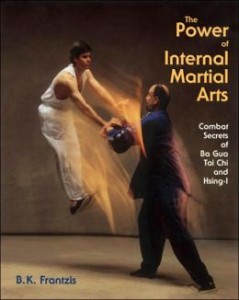
I had dreams of vanquishing opponents with my chi. I was in for a rude awakening.
Tim got there a few minutes before class. The small group of students that had gathered went into the studio and soon we were warming up. Everything was done very simply, without ceremony.
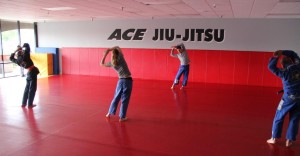
What followed was the complete destruction of what I had previously considered to be true martial art. I had been training already back then for 20+ years. But I was not prepared for the display of practical, no-nonsense knowledge that ensued.
The class literally floored me.
Tim gave no lectures about chi or the gathering of energy or anything like that. What we got was practical applications, one after the other, delivered with clear precision and superior understanding.
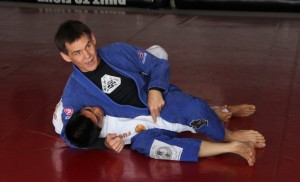
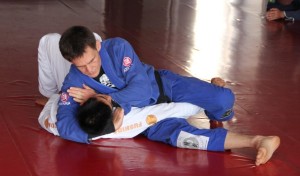
I “was convinced” I had trained hard in many classes before this one. I just didn’t know what training hard was. It wasn’t just an ignorance of the endurance and physical requirements. It was a revelation as to what it really took to be effective.
Some teachers can talk themselves silly about power and martial application. Tim, in truth, didn’t talk much. He showed.
He threw guys twice his size with little effort. He maneuvered around them, took them down, and made them tap in seconds. He was able to apply his skills and leverage with superior effectiveness on dudes that looked like they could lift Buicks. It was uncanny.
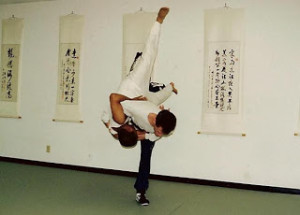
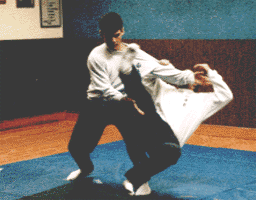
The martial arts are designed to allow a smaller person to be able to defeat or at least have a chance against a larger opponent. That’s their “original directive.” Tim is the embodiment of that purpose.
It’s been a while since I’ve trained with Tim. We talked recently about his career, the “original objective” of the martial arts, and his plans for the future. “I actually started practicing TKD and Hapkido when I was 10,” Tim said to me. “A couple years later, I visited a Kung Fu San Soo school and liked the way they trained, it was all about self-defense techniques and most of the time was spent drilling the techniques with a partner. Even at a young age, what I was really interested in was developing some practical fighting skills.”
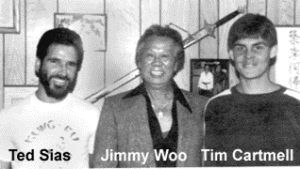
San Soo is a non sportive, purely fighting martial art. Tim quickly realized that there was a limit to how fast and strong he could become. Plus those attributes decline with age.
He started searching for something that could even the odds.
“I had read a lot about the Internal styles and became very interested in the idea of using ‘soft’ skills to overcome opponents that were stronger. My idea was that all true ‘martial arts’ must have started with a similar premise.”
This idea of a premise is marvelous. The soft overcomes the hard, so that physical strength is not the defining factor, but your skill. Let me just say that again: Strength doesn’t win, skill does. This is why I got into martial arts in the first place. This is humans reversing the laws of nature. Is what separates us from the other animals, the pinnacle of homo sapiens’ physical ability.
For many years I asked myself if this was even possible. It sounds good and you really want it to be, but in truth, I had never seen anybody demonstrate it. I had never seen anybody with that kind of skill. Maybe only in the movies.
Tim has dedicated his life to the improvement of his skill. When he couldn’t find the right teachers here in the states he decided to go to the source. He didn’t know anybody in Taiwan. He couldn’t speak the language. But he had a dream and the determination to make it happen.
“After finishing university in the States I decided to go to Taiwan. In the early 80′s travel and study in Mainland China wasn’t so easy. But Taiwan had many fine teachers that had left the Mainland after the war. I enrolled in the Chinese language program at the Taipei Normal University and I spent quite a bit of time looking for teachers and was very fortunate to find several that were not only top rate martial artists, but also very accepting of me as a foreign student.”
While in Taiwan Tim studied Xing Yi Quan with Xu Hong Ji and later with his son Xu Zhen Want. He studied Old style Yang Tai Ji and Xu Xi Dao with Chen Zhuo Zhen. His next Tai Ji teacher was Lin Ah Long, who taught him the Yang and Chen Zhao Bao styles. He studied Yi Quan and the Internal styles with Gao Liu De, old Frame of the Chen style with Xu Fu Jin. He studied Gao style Ba Gua and Chen Pan Ling style Tai Ji with Luo De Xiu. In mainland China he studied He Bei style Xing Yi with Liang Ke Quan, Sun style Ba Gua and Tai Ji with Sun Jian Yun, Sun Bao An and Liu Yan Long. And he studied Shan Xi Xing Yi with Mao Ming Chun.
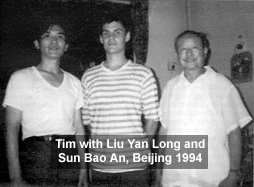
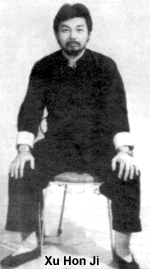
The list alone is mindboggling. Tim spent eleven years in China.
Soon he discovered that good martial art is simply good martial art. All this hoopla about labels is just convenient. When fighting styles are practiced the way they’re supposed to, they all exhibit the same principles. They have to. They’re designed to improve the capabilities of the human body and the human body is only designed one way.
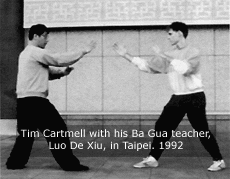
“The label ‘Internal Martial Arts’ is fairly recent, about 100 years old. It has come to refer to specific styles that adhere to similar principles. In actuality, there is no ‘Internal/External’ dichotomy, nor even separate ‘styles’, there are only individuals moving and fighting. Labeling movement and fighting skills as ‘styles’ is just a convenient way of organizing types of training and technique.”
This goes against what a lot of martial art schools preach, that their style is inherently superior and the only true way. That’s nonsense. It’s a marketing ploy.
There’s only individuals moving and fighting. Fighting being the practical way in which to measure skill. It’s an essential part of the process.
Tim has an impressive competition record, from full-contact tournaments in Taiwan to grappling tournaments here in the US. I asked him if he thought competition was a necessary part of the learning process.
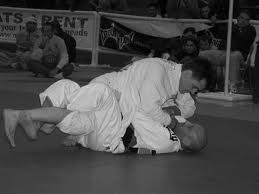
“I fought in several Sanda competitions in Taiwan. I felt it was the best way to test my skill level and mental state in a realistic venue. I did well, but after every fight I learned valuable lessons. Since being back and practicing Brazilian Jiu Jitsu, I started competing as a white belt and continued competing at every level into black belt. My grappling competitions were for exactly the same reason.”
Tim credits this type of training with his ability to train fighters.
“Now that I coach grapplers and professional MMA fighters, I realize I wouldn’t have the skills necessary to coach at this level if I would have only practiced and never competed. Competition is a great way to learn about yourself, your strengths and weaknesses, and your character as a human being. I’ve found that a five minute round in the ring or on the mats will often teach you more about yourself than a lifetime of solo forms or cooperative, non full-contact training.”
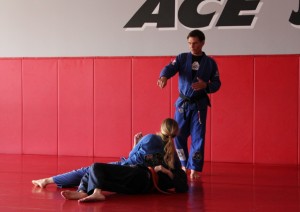
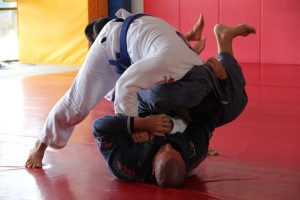
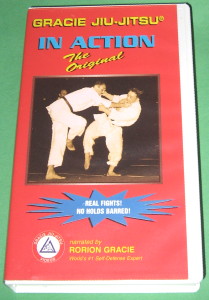
When Tim came back from China, Brazilian Jiu Jitsu was waiting “I was back from Taiwan to teach seminars in late 1993. I heard about, at the time, a relatively unknown family of grapplers that were fighting all comers. I bought the first ‘Gracie in Action’ tape and watched the fights. I immediately wanted to practice Jiu Jitsu.”
It turned out to be the thing he’d been looking for.
“I had been on the ground a couple times in actual fights, and already understood the absolute importance of learning practical ground fighting skills. The Chinese martial arts are virtually devoid of ground fighting practices, so I saw BJJ as my chance to round out my skills as a martial artist.”
Tim started studying BJJ in 1995 and received his black belt in 2004, the first one his instructor, Cleber Luciano, ever awarded.
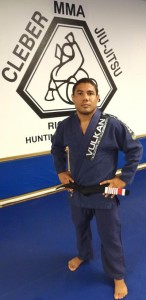 Cleber Luciano
Now Tim is the head BJJ and submission grappling instructor at the Ace Jiu Jitsu Academy in Southern California. He also coaches MMA fighters and teaches the Chinese arts in private lessons and at seminars.
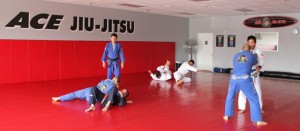
When I asked him if there was ever any conflict with training in all these different styles, especially going from the internal arts to Brazilian Jiu Jitsu, this is what he had to say:
“The underlying principle of BJJ is to cultivate the skills necessary to defeat larger and stronger opponents using superior strategy and leverage, the same as Internal Martial Arts. This principle is true to the original directive of all martial arts.”
True to the original directive. Wouldn’t it be great if all martial arts training was like that?
It is rare to find a teacher that can express these complex ideas in such a clear manner and then demonstrate them with ease. That is, in my humble opinion, the true essence of mastery.
Watching Tim do Jiu Jitsu is like watching somebody do Tai Chi on the ground. Like opponents used to say about Jigoro Kano, “It’s like fighting with an empty Jacket.”
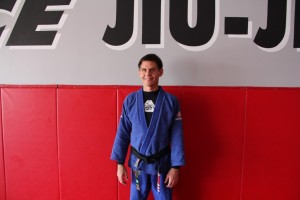
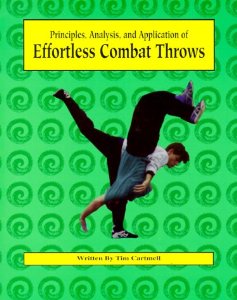
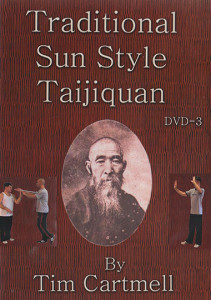
Tim has written and translated a number of books. For more information on him, Brazilian Jiu Jitsu and the Chinese Internal Martial Arts, visit www.shenwu.com.
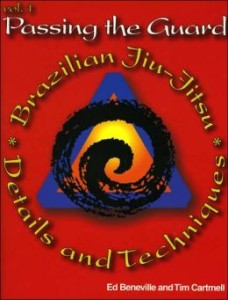
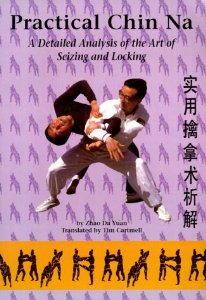
FOUND ON THE AWMW BLOG: HERE
When I first drove to Tim Cartmell’s Shen Wu school in Garden Grove I really didn’t know what to expect. I had heard of Tim through a martial arts internet board, Emptyflower.com and there was a general consensus amongst the members that he was the man to see in California if you were looking for the Chinese Internal Martial Arts. This was back in 2004.
California freeways can be anything but free at certain times. That particular day, they were a parking lot. I gave myself an hour and a half to get there from LA and it took nearly all of that.
The school was in the back of a strip mall. All other stores were closed at that hour. It was kind of eerie actually. I remember thinking: “Hell, this better be good.”
The only two other people in the lot were a couple of guys loading what appeared to be an endless amount of shady boxes into the back of a van.
I had lived in LA all of two months. The soundtrack from the movie Boyz in the Hood seemed to be coming out of my radio.
Apprehensive, I waited.
I was looking for a good Ba Gua teacher. About a year before I had become enamored with the art through Kumar Franzis’ book The Power of Internal Martial Arts.
I had dreams of vanquishing opponents with my chi. I was in for a rude awakening.
Tim got there a few minutes before class. The small group of students that had gathered went into the studio and soon we were warming up. Everything was done very simply, without ceremony.
What followed was the complete destruction of what I had previously considered to be true martial art. I had been training already back then for 20+ years. But I was not prepared for the display of practical, no-nonsense knowledge that ensued.
The class literally floored me.
Tim gave no lectures about chi or the gathering of energy or anything like that. What we got was practical applications, one after the other, delivered with clear precision and superior understanding.
I “was convinced” I had trained hard in many classes before this one. I just didn’t know what training hard was. It wasn’t just an ignorance of the endurance and physical requirements. It was a revelation as to what it really took to be effective.
Some teachers can talk themselves silly about power and martial application. Tim, in truth, didn’t talk much. He showed.
He threw guys twice his size with little effort. He maneuvered around them, took them down, and made them tap in seconds. He was able to apply his skills and leverage with superior effectiveness on dudes that looked like they could lift Buicks. It was uncanny.
The martial arts are designed to allow a smaller person to be able to defeat or at least have a chance against a larger opponent. That’s their “original directive.” Tim is the embodiment of that purpose.
It’s been a while since I’ve trained with Tim. We talked recently about his career, the “original objective” of the martial arts, and his plans for the future. “I actually started practicing TKD and Hapkido when I was 10,” Tim said to me. “A couple years later, I visited a Kung Fu San Soo school and liked the way they trained, it was all about self-defense techniques and most of the time was spent drilling the techniques with a partner. Even at a young age, what I was really interested in was developing some practical fighting skills.”
San Soo is a non sportive, purely fighting martial art. Tim quickly realized that there was a limit to how fast and strong he could become. Plus those attributes decline with age.
He started searching for something that could even the odds.
“I had read a lot about the Internal styles and became very interested in the idea of using ‘soft’ skills to overcome opponents that were stronger. My idea was that all true ‘martial arts’ must have started with a similar premise.”
This idea of a premise is marvelous. The soft overcomes the hard, so that physical strength is not the defining factor, but your skill. Let me just say that again: Strength doesn’t win, skill does. This is why I got into martial arts in the first place. This is humans reversing the laws of nature. Is what separates us from the other animals, the pinnacle of homo sapiens’ physical ability.
For many years I asked myself if this was even possible. It sounds good and you really want it to be, but in truth, I had never seen anybody demonstrate it. I had never seen anybody with that kind of skill. Maybe only in the movies.
Tim has dedicated his life to the improvement of his skill. When he couldn’t find the right teachers here in the states he decided to go to the source. He didn’t know anybody in Taiwan. He couldn’t speak the language. But he had a dream and the determination to make it happen.
“After finishing university in the States I decided to go to Taiwan. In the early 80′s travel and study in Mainland China wasn’t so easy. But Taiwan had many fine teachers that had left the Mainland after the war. I enrolled in the Chinese language program at the Taipei Normal University and I spent quite a bit of time looking for teachers and was very fortunate to find several that were not only top rate martial artists, but also very accepting of me as a foreign student.”
While in Taiwan Tim studied Xing Yi Quan with Xu Hong Ji and later with his son Xu Zhen Want. He studied Old style Yang Tai Ji and Xu Xi Dao with Chen Zhuo Zhen. His next Tai Ji teacher was Lin Ah Long, who taught him the Yang and Chen Zhao Bao styles. He studied Yi Quan and the Internal styles with Gao Liu De, old Frame of the Chen style with Xu Fu Jin. He studied Gao style Ba Gua and Chen Pan Ling style Tai Ji with Luo De Xiu. In mainland China he studied He Bei style Xing Yi with Liang Ke Quan, Sun style Ba Gua and Tai Ji with Sun Jian Yun, Sun Bao An and Liu Yan Long. And he studied Shan Xi Xing Yi with Mao Ming Chun.
The list alone is mindboggling. Tim spent eleven years in China.
Soon he discovered that good martial art is simply good martial art. All this hoopla about labels is just convenient. When fighting styles are practiced the way they’re supposed to, they all exhibit the same principles. They have to. They’re designed to improve the capabilities of the human body and the human body is only designed one way.
“The label ‘Internal Martial Arts’ is fairly recent, about 100 years old. It has come to refer to specific styles that adhere to similar principles. In actuality, there is no ‘Internal/External’ dichotomy, nor even separate ‘styles’, there are only individuals moving and fighting. Labeling movement and fighting skills as ‘styles’ is just a convenient way of organizing types of training and technique.”
This goes against what a lot of martial art schools preach, that their style is inherently superior and the only true way. That’s nonsense. It’s a marketing ploy.
There’s only individuals moving and fighting. Fighting being the practical way in which to measure skill. It’s an essential part of the process.
Tim has an impressive competition record, from full-contact tournaments in Taiwan to grappling tournaments here in the US. I asked him if he thought competition was a necessary part of the learning process.
“I fought in several Sanda competitions in Taiwan. I felt it was the best way to test my skill level and mental state in a realistic venue. I did well, but after every fight I learned valuable lessons. Since being back and practicing Brazilian Jiu Jitsu, I started competing as a white belt and continued competing at every level into black belt. My grappling competitions were for exactly the same reason.”
Tim credits this type of training with his ability to train fighters.
“Now that I coach grapplers and professional MMA fighters, I realize I wouldn’t have the skills necessary to coach at this level if I would have only practiced and never competed. Competition is a great way to learn about yourself, your strengths and weaknesses, and your character as a human being. I’ve found that a five minute round in the ring or on the mats will often teach you more about yourself than a lifetime of solo forms or cooperative, non full-contact training.”
When Tim came back from China, Brazilian Jiu Jitsu was waiting “I was back from Taiwan to teach seminars in late 1993. I heard about, at the time, a relatively unknown family of grapplers that were fighting all comers. I bought the first ‘Gracie in Action’ tape and watched the fights. I immediately wanted to practice Jiu Jitsu.”
It turned out to be the thing he’d been looking for.
“I had been on the ground a couple times in actual fights, and already understood the absolute importance of learning practical ground fighting skills. The Chinese martial arts are virtually devoid of ground fighting practices, so I saw BJJ as my chance to round out my skills as a martial artist.”
Tim started studying BJJ in 1995 and received his black belt in 2004, the first one his instructor, Cleber Luciano, ever awarded.
Cleber LucianoNow Tim is the head BJJ and submission grappling instructor at the Ace Jiu Jitsu Academy in Southern California. He also coaches MMA fighters and teaches the Chinese arts in private lessons and at seminars.
When I asked him if there was ever any conflict with training in all these different styles, especially going from the internal arts to Brazilian Jiu Jitsu, this is what he had to say:
“The underlying principle of BJJ is to cultivate the skills necessary to defeat larger and stronger opponents using superior strategy and leverage, the same as Internal Martial Arts. This principle is true to the original directive of all martial arts.”
True to the original directive. Wouldn’t it be great if all martial arts training was like that?
It is rare to find a teacher that can express these complex ideas in such a clear manner and then demonstrate them with ease. That is, in my humble opinion, the true essence of mastery.
Watching Tim do Jiu Jitsu is like watching somebody do Tai Chi on the ground. Like opponents used to say about Jigoro Kano, “It’s like fighting with an empty Jacket.”
Tim has written and translated a number of books. For more information on him, Brazilian Jiu Jitsu and the Chinese Internal Martial Arts, visit www.shenwu.com.
FOUND ON THE AWMW BLOG: HERE
Monday, January 14, 2013
Monday, December 31, 2012
Luo De Xiu - Yi Zong - Bagua Zhang - Full Video!
Sunday, April 22, 2012
Tim Cartmell Interview!
A short teaser video for a great interview with Tim Cartmell Internal Martial Arts practitioner, BJJ blackbelt.
Teaser Video
Full Video Interview
Teaser Video
Full Video Interview
Saturday, December 17, 2011
Tim Cartmell Ground Proofing DVD PREVIEW
Love this material! I took this from Tim a few years ago and i get mileage out of it every time i spar!
Wednesday, September 14, 2011

Wednesday, April 13, 2011
INTERNAL VS. EXTERNAL What Sets Them Apart? By Tim Cartmell
Introduction
There has been a great deal of discussion over whether a martial art is internal or external, and the differences between the two. Most people familiar with Chinese martial art probably associate the internal with exercises for health, softness and "chi," and associate the external with strength, hardness and fighting. We should start by defining the criteria which qualify an art as internal or external. It is very popular today to talk about internal martial arts as being methods of cultivating the chi (intrinsic energy), whereas external martial arts favor building physical strength.
The first question is, "What exactly is chi?" And once we have come to what we believe is an adequate definition, the next question should deal with the relationship chi has to martial ability. Finally, we come back to the question of why internal martial arts would cultivate chi in some way that external martial arts do not. The point is, both internal and external martial arts talk about chi development; saying a martial art is internal because it "has chi" is not valid. The difficulty in defining chi has led some martial artists to conclude that chi doesn't exist at all, therefore there is no difference between internal and external martial arts. But there definitely is a difference, and it does not depend on whether or not one believes in chi.
Let's put aside the whole question of chi and talk about similarities and differences among the three orthodox internal styles (as representatives of internal styles in general) and external martial arts from a more tangible point of view. Let's compare and contrast the martial arts from the standpoint of body mechanics, mindset, and application. The real difference between the internal and external martial arts is not chi, softness/hardness, or which is better for health; rather, it boils down to how specific movements are done in a particular mindset, and how these apply to real fights.
The internal myth
The orthodox internal martial arts, namely Xing Yi Quan, Tai Ji Quan and Ba Gua Zhang , have all incorporated Taoist techniques of breathing, meditation and medical theory into their methods of power, development (nei kung) and fighting movements. Although the resultant arts are superior as systems of health cultivation and physical development, health was not the primary concern of the developers of these styles. The primary focus of any martial art is, by definition, martial. The wedding of Taoist practices and martial technique came about because the masters felt movement in accordance with natural principles performed in a meditative state of mind was the quickest way of realizing the goal of absolute potential as a martial artist (fighter).
For centuries, China has had a great variety of therapeutic chi kung and related health systems that are equally as effective as the internal martial arts for restoring, maintaining and improving one's health, and are far simpler to learn and practice than the internal styles. There was no need to invent complex and often extremely physically demanding martial arts to fulfill the same purpose. Although the internal martial arts may be practiced solely as exercises for physical fitness, they were not created with this goal in mind. The internal martial arts were developed for fighting, with their health benefits more or less side effects of training for martial ability.
Body mechanics: An overview
The most basic and important difference between internal and external martial arts is the method of generating power or "jing" (manifest energy). At the root fundamental level, the most important factor which qualifies an art as internal is the use of what the Chinese call "complete," "unified" or "whole body" power (jengjing). This means the entire body is used as a singular unit with the muscles of the body in proper tone according to their function (relaxed, meaning neither too tense nor too slack). Power is generated with the body as a singular unit, and the various types of energies (jing) used are all generated from this unified power source.
The external martial arts, although engaging the body as a whole in generating power sequentially, do not use the body in a complete unit as do the internal martial arts. The external styles primarily use "sectional power" (ju bu li), which is a primary reason they are classified apart from the internal arts. A variation of this sectional power in the external arts is the special development of one part of the body as a weapon (iron palm, iron broom, etc.). The internal tends to forego these methods in favor of even development of the whole body, which m turn is used as a coherent unit.
Xing Yi Quan, Tai Ji Quan and Ba Gua Zhang all have unified body motion as their root; hence, they are internal styles. However, since each of these styles emphasizes different expressions of this unified power, they are not the same style.
Xing Yi Chuan
Xing Yi Chuan provides perhaps the easiest example of the principle of unified movement in action, as motion is stripped to its bare efficient essentials. Traditional five-element based Xing Yi Quan was created on static posture training (Zhan Zhuang). The primary purpose of these postures is to train the feeling of connectedness into the brain and nervous system, as it is easier to cultivate this feeling standing still than moving. One stands until whole body unity becomes the natural state. Only after this has been achieved does the student slowly begin to move while paying attention to maintaining this unity in motion. Typically, a single move such as splitting (Pi Quan) will be practiced exclusively and repeatedly for several months until the student understands bow to move the body without losing its dynamic unity. Once the student "gets the feeling" with a single form, other forms can more quickly be mastered.
Because the ancient Xing Yi Quan masters knew that using the body in a unified manner produced the greatest amount of power, they developed five basic movements (the five elements) which allow one to issue power (fa jing) in a unified manner. These movements are splitting (issuing power downward), crushing (issuing power straight forward), drilling (issuing power upward), pounding (issuing power outward) and crossing (issuing power inward). The developers of Xing Yi Quan saw these five basic variations of unified power as covering the range of motions useful to fighting. Hie 12 animal forms of the style are further elaborations and variations of the five original "themes". The simple beauty and profundity of the art of Xing Yi Quan as an internal boxing style is in its logical development from a single principle, using the body in a unit, to the basic energies that can be generated from this unit, the five elements, to the further elaboration of these five basic energies into the 12 animal forms.
Tai Ji Quan
In the first passage of the Tai Ji Classics, Jang San Peng (the legendary founder of Tai Ji Quan) states that the body must be light and agile, and that it must be connected throughout (gwan chwan). This is the basis of Tai Ji Quan as a martial art. The most basic energy of this art is the ward off energy (peng jing). Ills energy is the same as using the body as a unit. As the masters say, "No peng jing, no martial art." The reference here is not to the actual technique of ward off from the forms, but rather to the ward off energy that must permeate the whole body connecting it with unified power, from which all subsequent variations in power are based.
The basic postural requirements for Tai Ji Quan practice (head floating up, shoulders sunk, chest lifted) are the physical prerequisites of unified body power. As in the other internal styles, the student begins by standing in static postures for a considerable length of time to cultivate the body's peng jing body before singular postures are practiced and mastered one at a time. Single technique practice (dan ba lian) and issuing power (fa Jing) are practiced until all the various postures of Tai Ji Quan can be executed with whole body power. Finally, the student is taught to link the postures into a continuous sequence that trains sensitivity to postural changes (listening energy or tingjing) and the ability to flow from one technique to the next without disconnecting the body. One of the fundamental reasons most Tai Ji Quan forms are practiced slowly is 'so the student can constantly adjust and monitor the body to make sure it is always moving in a unit. This is much easier to feel moving slowly than quickly.
Eventually, the student develops the body into a strong, supple unit which allows the frame to act as a spring against the ground (jyc di jr Ii), enabling the boxer to absorb incoming energy and rebound it into the opponent This type of power is impossible unless the body is always maintained in a unit, just as a spring is one continuous thread of steel
Ba Gua Zhang
Although there are much older versions of Ba Gua Zhang, most of the variations of the art found today can be traced back to Dong Hai Chuan, who taught during the last years of the Ching dynasty. Dong Hai Chuan already was an accomplished martial artist before he learned the Ba Gua circling method of the Taoist school. As with the other internal styles, Ba Gua Zhang training begins with singular movements which develop unified power. Next, the student progresses to holding various postures while walking in a circle, Here again, the primary purpose of these exercises is to train the body to maintain a balanced unity in motion. Once the basic movements have been mastered and the student can walk the circle to complete the eight basic palm changes with unified body power, the necessary groundwork has been laid for martial application.
Just as the Xing Yi Quan masters developed the five elements to represent the basic ways power may be produced and applied from the foundation of unified motion, the Ba Gua Zhang masters created the single palm change. The single palm change includes all the basic energies and footwork used in Ba Gua Zhang as a martial art. The single palm change, double palm change and eight mother palm changes are not fighting techniques in themselves, but rather methods of developing whole body power to be used in separate fighting techniques created around these basic types of power.
Although the three orthodox internal styles have very different movements, they all developed from the same fundamental principle of using the body in a unit. This is why, from a body mechanics point of view, these arts are classified as internal.
External martial arts
Although body mechanics and movements of external martial arts may vary greatly from style to style, the major difference between these and the internal styles is that external styles, while generating power through the coordination of the body as a whole, lack unity of motion in the internal arts sense. For example, many external martial arts strike using the power of the waist and upper body from the base of a stable stance, the blow would be relaxed during delivery, then tightened for an instant at impact This type of strike is capable of generating a great amount of power, with the force being produced mainly by the waist and striking limb. This whipping of a limb and tensing at impact is referred to as "sectional power" ju bu li) and differs from the whole body power of internal martial arts.
The sequence of training in external martial arts also differs in purpose. In the early stages of training, external martial arts place greater emphasis on increasing strength and endurance as the "raw material" to be refined later into precise technique. Whereas the goal of internal style stance training is to train the nervous system into the feeling of a unified body, the external martial artist stands to increase the strength, endurance and flexibility. As a consequence, external stance training is usually lower and wider than that of the internal. Although an oversimplification, it may be said that the internal martial artist stands to cultivate feeling, while the external martial artist stands to develop strength.
External martial artists often spend considerable time conditioning specific areas of the body, either to withstand impact or to increase sectional power. An external martial artist may especially condition the head, fists, elbows, shoulders, fingers, or emphasize a specific movement, resulting in the development of a specialized weapon. This is another example of the development of sectional power in the external martial arts. Once the martial artist has a strong foundation, form and technique training begins. Once again, the forms and techniques emphasized in external styles are designed around the sectional power developed through basic training.
Mindset of the martial arts
Another major difference between internal and external martial arts is in the approach they take to training the mind. The internal places great emphasis on mind/body unity. The Taoists realized that a relaxed body controlled by a quiet mind produced a holistic entity, capable of fulfilling its potential. At the outset of training, the internal arts place the greatest emphasis on refining and training the nervous system to control the body. In contrast, most external styles emphasize increasing strength and endurance (external power) as the base upon which martial technique will be built. Students of the internal, through mind/body unity, seek to balance the nervous and hormonal systems, thereby producing a power from within the body (nei jing or internal power). The unified power is completely dependent upon fine neuromuscular control, which is completely mentally directed. The internal martial arts also talk at great length about practicing with a quiet mind. It is often quoted that, "There should be stillness in movement," and internal martial artists seek to remain calm in spirit as they move. One of the primary reasons internal martial arts are good for health is that one may simultaneously exercise the body and rest the mind.
Turning to external martial arts, much less emphasis is placed on a quiet mindset. In many external styles, cultivation of a state the Chinese call the "killing air" (sha qi) is preferred. The spirit is raised and directed outwardly toward the opponent, rather than inwardly, much like athletes "psyching up" before an event. An externally observable manifestation of the different mindsets is apparent in the facial expressions of the individual practitioner: the external martial artist often shouts and grimaces fiercely, while the internal boxer looks calm and may even be faintly smiling during a fight.
In application
The third major difference between the internal and external martial arts is in how they are applied to a live opponent, as well as the various methods of training martial application. The students of both schools first develop their power, balance, feeling and body mechanics from solo training. The next step is to bridge the gap between form and function. This type of training will be determined mainly by a particular school's theories of combat. The internal schools stress sticking to, following and going with the opponent's power, borrowing energy, the avoidance of force against force directly, and the issuing of power only after one has "the right opportunity and advantageous position." External styles vary greatly in theory (some following principles almost identical to the internal), but in general, whereas an external stylist may punch through his opponent's defenses, the internal stylist never fully issues his power until he has the opponent in an unbalanced position either physically or spatially.
Most internal styles also have some variation of "push hands" practice. The primary purpose of pushing bands is to develop "listening energy" (ting jing) or become sensitive to outside pressure from the opponent in relation to one's own balance. Finally, both internal and external martial artists practice footwork drills, repeated single-technique practice, issuing power on a live opponent, and eventually free sparring to develop practical fighting skill.
Conclusion
This article has shown the similarities and differences among the three orthodox internal styles of Chinese martial art and external styles in general. It's clear that external and internal styles are indeed different, in theory, practice and application, and the factors that classify an art as either internal of external are clear-cut and concrete. This classification of an art as either internal or external is based solely on adherence in practice and use to a specific set of principles, and not on particular forms or posturing. It is important to remember that all arts, both internal and external, were originally intended for fighting. Finally, no judgment as to the superiority of one art over another is intended. After all, any martial art is only theory until a human being moves, and the value of any art lies ultimately in the skill and understanding of the individual artist.
http://www.shenwu.com/Internal_VS_External.htm
Subscribe to:
Posts (Atom)
Boulder Internal Arts - Classes Ongoing in 2026
Although I don't post much here anymore. We are still training and teaching in Boulder, Colorado USA after 20 years! Boulder Internal A...

-
 FOUND HERE - Dragons Armory web site Jinyiwei: Ming Elite Guards 錦衣衛 1. Bloodhounds ...
-
 Although I don't post much here anymore. We are still training and teaching in Boulder, Colorado USA after 20 years! Boulder Internal A...
-
In this episode, Owen and Randel talk about the eras of a teacher and how their training changes over time and how you should approach it.