"1986 - Rare footage of many of the influential Taijiquan masters of this generation including footage of Wu Tunan (Wu Style), Chen Xiaowang ( Chen Style), Yang Zhenduo (Yang Style), Wu Yinghua (Wu Style), Yao Jizu (Wu(Hao) Style), Sun Jiayun (Sun Style), Gu Liuxin (Yang Style TJQ), Li Tianji (88 Set), Sha Guozheng (2-man Taijiquan Set), Fu Zhongwen (Yang Style Saber) and Ma Yueliang (Wu Style Sword)"
Showing posts with label Wu Style Tai ji. Show all posts
Showing posts with label Wu Style Tai ji. Show all posts
Tuesday, August 12, 2014
Tai Chi Chuan - 1986 Taiji Gathering
"1986 - Rare footage of many of the influential Taijiquan masters of this generation including footage of Wu Tunan (Wu Style), Chen Xiaowang ( Chen Style), Yang Zhenduo (Yang Style), Wu Yinghua (Wu Style), Yao Jizu (Wu(Hao) Style), Sun Jiayun (Sun Style), Gu Liuxin (Yang Style TJQ), Li Tianji (88 Set), Sha Guozheng (2-man Taijiquan Set), Fu Zhongwen (Yang Style Saber) and Ma Yueliang (Wu Style Sword)"


Tuesday, October 22, 2013
Tai Chi Master - Li Jing Wu
The Hidden Tao: Li Jingwu’s life in Taijiquan
Found:HERE
I have been reading a book called ‘Hidden Tao [大道显隐]‘ by one Mei Mosheng, which is a compilation of articles commemorating the life of the eminent taiji master Li Jingwu, who learnt Chen and Wu style taiji from some of the greatest masters of his day. As M Li is not that well known in the West, perhaps some introduction is in order.
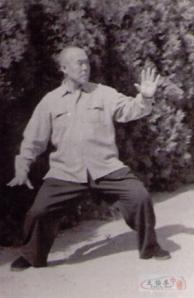
Li Jingwu in a Chen style posture
M Li was from Shandong, but moved to Harbin when he was 14. While in Harbin, he started learning Mizong quan [lost track boxing, made famous in China by Huo Yuanjia of the Jingwu association] under Liu Ziyuan at the age of 17 in order to heal his legs, which had been frostbitten during the harsh Harbin winters. After 3 years of training, his legs got better and he had achieved a degree of gongfu. In the early ’30s, Li moved to Beijing for business. While there, Li always kept an ear to the ground for martial arts teachers. A friend from his village who had practiced xingyi, taiji and bagua for many years and knew the Beijing martial arts scene well recommended that Li study taiji. Li managed to get a recommendation to study Wu style taiji under Zhao Tie’an, a disciple of Yang Yuting (of northern Wu style) and Wu Jianquan. Among Wu stylists in Beijing, Li Jingwu was known as one of the ’5 tiger generals’ [五虎上将], a group which also included the famous master Wang Peisheng.
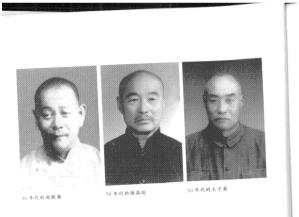
L-R: Zhao Tie An, Yang Yuting, Wang Ziying Wang Maozhai's son, who coached Li Jingwu in push hands)
The Chen style master Chen Fake was also teaching in Beijing at that time (having been invited to teach in Beijing in 1928 by his nephew, Chen Zhaopi). In the early ’40s, through an introduction from Hu Yaozhen, the famous master of xingyi and qigong who also taught Feng Zhiqiang, Li Jingwu became M Chen’s disciple and studied with him for over a decade. Prior to liberation, Li ran a department store in Beijing. 1959 was a turning point in his life, for it was in that year that Li accepted a post to teach taiji full-time at the Beidaihe Qigong Rehabilitation Hospital in Hebei province. M Li spent the rest of his life teaching taiji in the relative ‘backwater’ of Beidaihe.
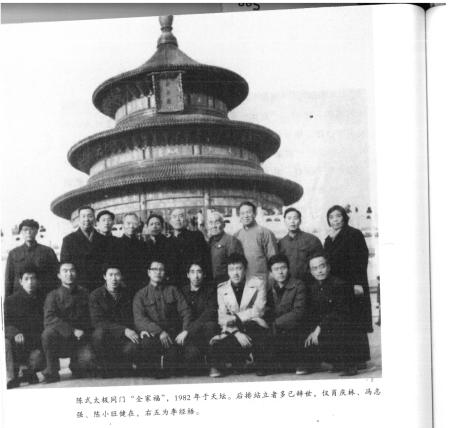
Chen style ‘Family photo’ taken in Beijing in 1982. Back row, 3rd from left (L3): Chen Xiaowang. L5: Feng Zhiqiang. R5: Li Jingwu. R4: Hong Junsheng. Chen Zhaokui’s disciple Ma Hong is front row, far right.
M Li was unusual in that he made all of his students learn both Wu and Chen styles, and was also unusual in that, although he was mostly known for his Chen and Wu style, he had a good working knowledge of Sun and Yang styles as well. Based on his experiences, M Li created a separate set of neigong exercises, which was later made public in the book ‘Taiji Neigong’. His art is carried on by his disciples such as Lu Dehe, Wang Dayong and Zuo Zhiqiang, as well as by his son Li Shujun and grandson Li Hongshun.
I wanted to share a small extract from this book which I thought was interesting:
“M Li’s neigong was incredibly developed. One time he got me to feel his stomach – it felt as though there was a half-inch wide hard band around his stomach. He was smiling while I did this, he definitely wasn’t holding his breath or anything. Once, during a course of lectures on taiji, whilst explaining the phrase ‘don’t let qi mix with qi’, he said: ‘this is the ancients showing us that there are two kinds of qi: one is breath, and the other is the ‘inner qi’ of the dantian. The meaning of this phrase is not to confuse breath and inner qi. When M Li taught me neigong, he said: ‘it’s a gradual, stepwise regimen that produces gudang qi [surging qi] – it is surging qi that can be used in push hands and fighting. When M Li pushed hands and launched people, you could see his dantian rotating, the spirit flowing up the back [神通于背], and there would occasionally be ‘heng,ha’ sounds. Even in his old age, M Li could still launch people more than a zhang [3 metres] away, a feat made possible by his deep neigong.
M Li lived to be 86, which is a ripe old age, I guess. His taiji combined both health and fighting: even when he was over 80 he could still launch people in a moment. Even after he had had an operation on his legs and he couldn’t walk, he could still push hands with us whilst sitting down – this must have been thanks to his neigong. I remember, one time when I went to see him, he said ‘I’ve gotten old, I’m good for nothing, I can’t even carry a basket of eggs. But if someone applies force on me, I can still use my neigong to yield, neutralise and then launch him. I guess this is ‘reaction force’. However, this ‘reaction force’ can only be used after long practice. This is skill [gongfu] – once you have developed the ‘taiji body’, you won’t lose your gongfu. It can even be used lying on a bed. Finally, M Li said “the neigong of internal martial arts, once achieved, stays with you your entire life, this is one of the unique characteristics of internal martial arts.” Found:HERE
Subscribe to:
Posts (Atom)
Boulder Internal Arts - Classes Ongoing in 2026
Although I don't post much here anymore. We are still training and teaching in Boulder, Colorado USA after 20 years! Boulder Internal A...

-
 FOUND HERE - Dragons Armory web site Jinyiwei: Ming Elite Guards 錦衣衛 1. Bloodhounds ...
 -
Here is Gao Style Bagua practitioner C.S. Tang performing his version of the Tian Gan - Heavenly Stems Nei Gong set.
-
Since i don't speak Chinese i assume these guy are martial artists.

